The short answer
Choose the dumbbell fly if you want the most stretch with the least kit: a bench and a light pair. Choose the cable crossover if you want tension all the way to the squeeze and the freedom to aim high, low or straight across. Choose the pec deck if you want a fixed path you can push hard on without balancing anything, or if you are new to flyes.
None of them replaces a press. They are the second or third chest exercise of a session, after one or two presses, as the chest training guide sets out, and swapping one for another every few weeks is a perfectly good way to use all three.
Side by side
| What differs | Dumbbell fly | Cable crossover | Pec deck |
|---|---|---|---|
| Where it is hardest | Arms wide, in the stretch | Fairly even, depending on the pulley height | Through the middle and the squeeze, depending on the machine |
| At the squeeze | Almost no load once the dumbbells are over the chest | Tension stays on as the hands cross | Tension stays on as the pads meet |
| Path | Unguided; you steer the arc | Unguided; the pulleys set its direction | Fixed by the machine |
| Angle options | Flat, incline or decline bench | High-to-low, straight across, low-to-high | Mostly level; the seat shifts it slightly |
| Body position | Lying on a bench | Standing, in a staggered stance | Seated, back supported |
| Control needed | The most, at the bottom | Moderate: you hold your own stance | The least |
| One arm at a time | Possible, but awkward | Easy | On some machines |
| Loading steps | Fixed jumps between pairs | Small pin steps | Pin steps, often larger |
| Kit | Dumbbells and a bench | Two facing pulleys, or one for single-arm work | The machine itself |
Where each one loads the chest
The difference comes down to the direction of the resistance. A dumbbell's weight always pulls straight down. With your arms out wide it sits far from the shoulder and the chest works hardest; as the arms rise and close, that distance shrinks until, over the chest, the load is almost nothing. That is why the dumbbell fly is a stretch exercise, and why the last part of each rep feels easy.
A cable pulls along the line from your hand back to the pulley. Because the pulleys sit out to the sides, that line stays roughly across your body as your arms close, so the load carries through to the squeeze, and moving the pulleys up or down tilts the line and with it the part of the chest doing the most. A pec deck's arms pivot around fixed points above your shoulders, and the cam or lever linking them to the stack decides how the load changes along the arc. The profile varies by machine, but most keep the chest working at the point where the pads meet.
Which profile builds more muscle is not settled, and few studies compare flyes directly. A fly you control through its whole range is worth more than any profile done badly.
Fly, crossover, butterfly: what the names mean
Gym names blur these together. Fly, sometimes spelled flye, is the general name for the movement and, on its own, usually means dumbbells on a bench. Cable fly and cable crossover are the same exercise on a cable station, crossover pointing to the hands crossing at the end. Pec deck, pec fly machine and butterfly machine all name the seated machine, the first often for the version with elbow pads and the second for the version with handles. Whatever the label, the job is the same: the upper arms come in across the body with the elbows held at one angle. If the elbows bend and straighten, it has become a press.
Which one to pick
When the dumbbell fly is the right pick
You train with free weights only, you want a deep stretch, or you are pairing it with a dumbbell press on the same bench. Keep the load light and stop at a comfortable depth; the bottom of the arc is where it goes wrong.
When to use the cable crossover
You want to aim at the upper or lower chest specifically, you like tension at the squeeze, or you want single-arm work to even out your sides. Expect to spend a minute matching both pulleys and pins before you start.
When the pec deck makes more sense
You are new to flyes, you are tired at the end of a session, or you want to take a set close to failure without worrying about control. It is also the quickest to set up between other exercises.
Using them together
Rotating between the three keeps one movement fresh without changing what it trains. Three ways to do it:
| Plan | How it runs |
|---|---|
| Two chest days a week | Dumbbell fly after the press on day A, 2–3 × 10–12; cable crossover after the press on day B, 2–3 × 12–15 |
| One chest day, rotating by block | Pec deck for four weeks, then cable crossover for four, then dumbbell fly; 3 × 10–15 each time |
| Stretch, then squeeze | Dumbbell fly for 2 × 10–12, then pec deck or cables for 1–2 × 15–20, in the same session |
Rest about a minute between fly sets. Two to four fly sets after your presses is enough for most sessions.
All three at RPM
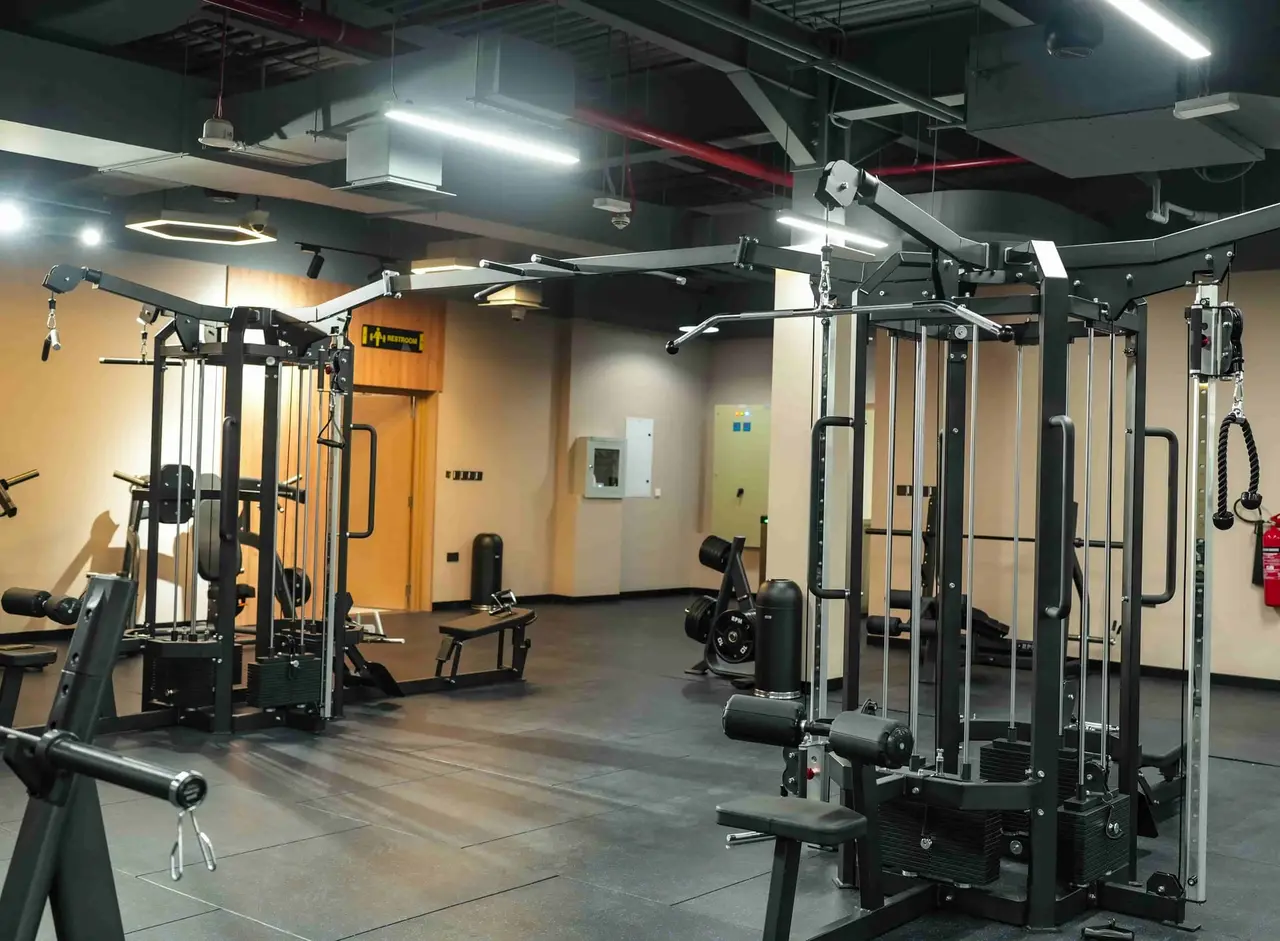
In RPM's floor photos you can see a dumbbell rack, flat benches and multi-station cable towers, so the dumbbell fly and the cable crossover are both possible on the training floor in Al Manhal. A pec deck is not shown, so ask on your free tour; if there is none, the cables do its job. The women-only Ladies section has its own strength equipment, so ask what it includes. A personal training session can help you find a depth and angle that suit your shoulders.
Questions, answered.
Pec deck or cable fly for muscle growth?
Either works if you train it hard and consistently. The pec deck makes it easier to push close to failure; the cable fly lets you change the angle. Pick the one you will do well, or alternate them by training block.
What is the difference between a cable fly and a dumbbell fly?
Where the load sits. The dumbbell fly is hardest in the stretch and easy at the top; the cable fly keeps tension through the squeeze and lets you change the line of pull with the pulleys.
Is a seated cable fly the same as a pec deck?
Close. Sitting on a bench between two cable columns gives you back support like a pec deck, but your hands still move freely and you choose the pulley height. It is a good substitute when the machine is busy or missing.
Do I need a fly at all if I already press?
No, but it helps. Presses train the chest well; a fly adds work without the triceps and loads the chest in positions presses do not reach. One fly exercise after your presses is plenty, as the chest training guide shows.
Which fly should I use if flyes bother my shoulders?
The pec deck, or a cable fly with a short stretch, is usually easier to control than dumbbells at the bottom of the arc. If a fly causes pain rather than effort, stop and get the shoulder checked by a doctor or physiotherapist before you continue.