What the trap bar deadlift trains, and who it suits
A trap bar, also called a hex bar, is a hexagonal frame with sleeves for plates at each end and two handles inside it. Standing in the middle puts the weight beside you instead of in front of you, so you can bend your knees more and lean forward less than in a straight-bar deadlift. The result sits between a squat and a deadlift: the quads do more of the work, the glutes and hamstrings still drive the hips, and the back, traps and forearms hold everything in place.
That makes it one of the easier heavy lifts to learn. There is no bar to keep tight against your shins, the grip is a natural palms-in position, and most people find the start position comfortable. Coaches use it with beginners, with athletes who want strong, fast legs, and with anyone who finds the straight-bar start awkward. It works as the main lower-body lift of a session, and the leg training guide shows how it fits with squats, presses and hinges across a week.
Your legs and back work hard in this lift. Sharp pain in the back, pain that travels into a leg, or knee pain that lingers is a reason to stop and get it checked by a doctor or physiotherapist before you continue.
Setting up inside the bar
- Load the bar evenly and fit collars so the plates cannot slide. Check which way up the handles are: many trap bars have a raised set and a low set, and you flip the bar over to choose.
- Step into the centre of the frame with your feet about hip width apart. Line up the middle of your feet with the centre of the handles, so the frame clears your shins at the front and your calves at the back.
- Hinge and bend your knees to reach the handles, and grip each one in its middle so the bar stays level as it lifts. Holding too far forward or back tips it.
- Set your back: chest up, back flat from hips to head, shoulders drawn down away from your ears, arms straight.
- Choose a starting load you can lift for five reps that all look alike. Trap bars weigh different amounts depending on the model, so check the bar's own weight before you work out your total.
How to lift a rep
- Take a big breath into your belly and brace.
- Pull the slack out: squeeze the handles and lift just enough that your whole body tightens before the plates leave the floor.
- Push the floor away with your legs. Your hips and chest rise together, and the bar travels straight up through the middle of your body.
- Stand tall with your glutes squeezed. Stop once you are upright; do not shrug or lean back at the top.
- Lower by pushing your hips back and bending your knees until the plates touch the floor, keeping the bar level. Reset your breath, then lift again.
Because the bar is not in front of you, the lift can easily drift into a squat with the chest dropping, or into a stiff-legged hinge with the hips high. Aim for the middle: hips a little higher than in a squat, shoulders just ahead of the handles. For the brace itself, see breathing and bracing when lifting.
Mistakes to fix first
| Mistake | What it looks like | The fix |
|---|---|---|
| Gripping off-centre | The bar tips forwards or backwards as it leaves the floor | Take each handle in its middle and check the bar is level before you lift |
| Standing off-centre | The frame knocks your shins or calves on the way up | Line up the middle of your feet with the centre of the handles |
| Turning it into a squat | The hips start very low and the chest falls forward as you lift | Start with the hips a little higher and the shoulders over the handles |
| Hips shooting up | The legs straighten first and the back does the lifting | Push through the legs so hips and chest rise together, and lighten the bar |
| Rounding the back | The lower back loses its flat shape off the floor | Reduce the load, brace before every rep, and use the high handles if you cannot reach the low ones with a flat back |
| Shrugging or leaning back at the top | The shoulders hike up and the lower back arches to finish | Stand tall and stop; train shrugs as their own exercise |
Variations and other uses for the trap bar
The same frame does several jobs. These are the variants people ask about most, plus the question that comes up when a gym has no trap bar at all.
High handles vs low handles
The raised handles start you higher, which shortens the range: they are easier to reach with a flat back and usually let you lift more. The low handles sit at roughly the height of a straight bar loaded with full-size plates, so the range is longer and the legs and hips work through more of it. Beginners and tall lifters often start on the high handles; the low handles suit anyone who can reach them without the back rounding. Log them as two separate lifts when you track your numbers.
Trap bar shrug
Stand up with the bar, then lift your shoulders straight up towards your ears, hold for a moment and lower. The palms-in grip and the load at your sides make it a comfortable way to load the upper traps heavily. Keep your arms straight and do not roll your shoulders; the shrug page covers the movement in detail.
Farmer's carry with the trap bar
Lift the bar, then walk with short, steady steps, standing tall with your shoulders down. The frame balances the load evenly, so it is easier to carry heavy than two separate handles. Walk a clear, straight path, turn slowly, and set the bar down the way you picked it up. The loaded carry guide shows where carries fit in a session.
No trap bar? What to do instead
Hold a dumbbell in each hand by your sides and deadlift them from the floor, or from low blocks if they sit too low. The load is in the same place as with a trap bar, so this is the closest substitute, though you will run out of dumbbell weight sooner. A kettlebell deadlift or a straight-bar deadlift are the other options, and deadlift vs trap bar deadlift explains how the straight-bar version differs.
Some power programmes also use jumps with a light trap bar. That is a specialised drill to learn from a coach rather than from a page.
Sets, reps and progression
| Goal | Sets × reps | How hard |
|---|---|---|
| Learning the lift | 3 × 5 | Light; every rep starts from the same set-up |
| Building strength | 3–5 × 3–5 | One or two reps left, bar level throughout |
| Building muscle | 3 × 6–10 | Two reps left, with a controlled lowering |
Rest two to three minutes between heavy sets. The deadlift 1RM calculator gives an estimate from a set of reps; work it out for the trap bar separately from your straight-bar deadlift.
Once or twice a week suits most people. Add small plates when every set reaches the top of its range with the same clean set-up, and include the bar's own weight when you log the total. Many lifters handle somewhat more on a trap bar than on a straight bar; in one study of nineteen male powerlifters, the hex-bar maximum was clearly the heavier of the two. The gap varies from person to person, so do not convert one number into the other.
Trap bar deadlifts at RPM
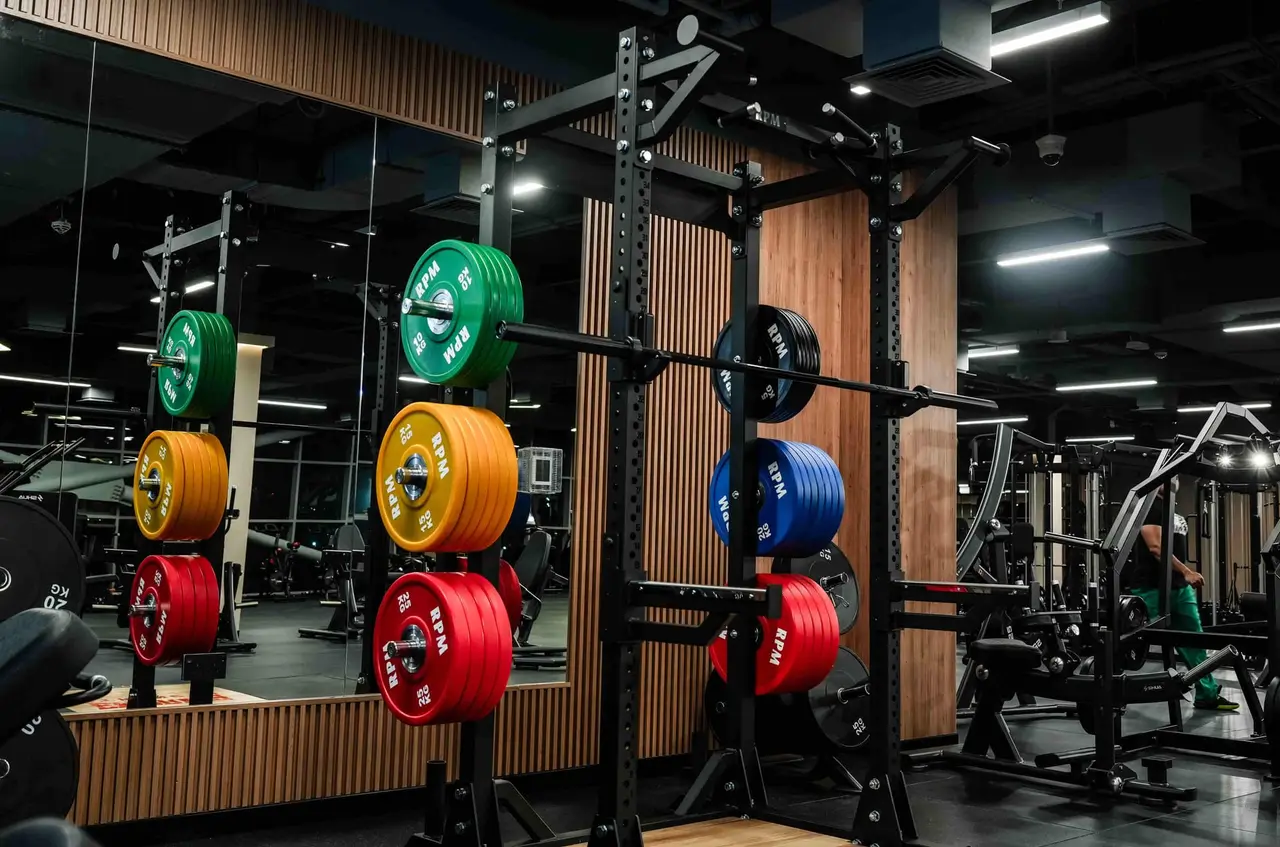
A trap bar does not appear in RPM's floor photos, so ask whether one is on the floor during your free tour before you plan around it. The photos in Al Manhal do show barbells with colour bumper plates for the straight-bar deadlift and a dumbbell rack for the dumbbell version, and a personal training session can set you up on whichever you use.
Sources
Questions, answered.
What muscles does the trap bar deadlift work?
The quads, glutes and hamstrings move the weight, while the back, traps and forearms hold it. Compared with a straight-bar deadlift, the quads do more and the lower back works at a more upright angle.
Is the trap bar deadlift a squat or a deadlift?
A bit of both. You pick the weight up from the floor like a deadlift, but the knees bend more and the torso stays more upright, like a squat. It does not replace a deep squat, but it makes a strong main lift for the legs.
Is the trap bar deadlift easier on the back?
It changes where the load goes. In one study of experienced lifters, the hex bar lowered the turning force on the lower back and hips and raised it at the knees compared with a straight bar. That does not make it a fix for back pain: if your back hurts, stop and get it checked by a doctor or physiotherapist.
How much does a trap bar weigh?
It depends on the model. Trap bars are not standardised the way competition barbells are, so two bars can differ noticeably. Check the label or ask the staff, and add the bar's weight to the plates when you log the lift.
Can beginners start with the trap bar deadlift?
Yes, and many coaches prefer it as a first heavy pull from the floor: the set-up is simpler and the start position is comfortable for most people. Learn the hinge with a light bar, and move to heavier sets once every rep looks the same.