The short answer
Choose the conventional deadlift if you are learning to pull from the floor, if your hips are not comfortable in a wide, turned-out position, or if you want the most work for the hamstrings and back. Choose the sumo deadlift if the conventional start feels cramped, if your hips open easily, or if you want a pull that hands more of the work to the quads and inner thighs. Both are standard styles in powerlifting competition, both train the glutes hard, and many lifters find after a few weeks of each that one simply fits their body better.
The reason they feel so different is geometry. Widening the stance lets the hips sit closer to the bar, so the torso can stay more upright and the bar has less distance to travel. Narrowing it lets the hands hang straight down outside the legs, so the torso leans further over the bar and the hips and back work against a longer lever. The hamstring guide shows where either style sits among the other hinges.
Side by side
| What differs | Conventional | Sumo |
|---|---|---|
| Stance | Feet about hip width, toes slightly out | Wide, often close to the plates, toes turned well out |
| Hands | Outside the legs | Inside the knees, about shoulder width |
| Torso angle | Leans further forward | More upright |
| Bar travel | Longer | Shorter for most lifters |
| Main muscles | Glutes, hamstrings and back, with the quads helping off the floor | Glutes, quads and inner thighs, with the back holding a more upright position |
| Where lifters often stall | Around the knees, as the hips need to come through | Off the floor, where the bar can break slowly |
| Mobility it needs | Hamstrings that let you reach the bar with a flat back | Hips that open wide with the knees over the toes |
| Learning curve | Simpler stance; the bar path takes practice | The wedge and the stance take longer to find |
| Equipment | Barbell and plates | The same |
What the research found
Two older studies from the same research group are often quoted on this question. The first filmed sumo and conventional lifters at a national powerlifting championship. The sumo group stood far wider, turned their feet out more, gripped narrower and kept the trunk and thighs more upright, and the bar travelled a noticeably shorter vertical distance, so less mechanical work was done per lift. The turning forces at the hip did not differ significantly between the groups; those at the knee and ankle did.
The second measured muscle activity in thirteen college football players lifting a load they could manage for about twelve reps. Two front-thigh muscles and the muscle at the front of the shin were more active in the sumo style, and a calf muscle was more active in the conventional style; the summary reports overall differences only for those muscles. Neither study followed muscle growth or injuries over time, and both samples were small and male, so read them as a description of how the two styles move rather than a verdict on which is better.
Which is harder, and is sumo cheating?
Neither style is easier across the board; each is hard in a different place. Sumo asks for patience and hip mobility off the floor, conventional for a solid back position and enough hamstring length to reach the bar. Because the bar travels less in sumo, some lifters lift more that way, while others are clearly stronger pulling conventional.
That settles the cheating argument too. Sumo does move the bar a shorter distance, but it is a standard competition style and it works muscles hard that conventional pulling works less. If it feels easier for you, that means it suits your build, not that you are skipping part of the lift.
When conventional is the better fit
- You are new to deadlifting. The stance is simple, and it builds on the hinge you learn with the Romanian deadlift.
- You want the most work for the hamstrings and the muscles along the spine.
- Your hips feel uncomfortable or pinched in a wide, turned-out stance.
- Your sport or job involves lifting things from in front of you with a narrow stance.
When sumo is the better fit
- You cannot reach the bar with a flat back in the conventional stance, even after working on it.
- Your hips open easily and your knees track over your toes in a wide stance.
- You want a heavy pull that also loads the quads and inner thighs.
- Your lower back is tired from other training and you want a more upright torso for a block.
Using both in one programme
You do not have to choose for good. A common approach is to make one style the main lift and use the other as a lighter variation later in the week, or to alternate them from one training block to the next.
| Day | Main lift | Sets × reps | Then |
|---|---|---|---|
| Lower body A | Conventional deadlift | 3–5 × 3–5, one or two reps left | Split squats and a core exercise |
| Lower body B | Sumo deadlift, lighter | 3 × 5–6, two or three reps left | Leg curls and hip thrusts |
Swap the roles if sumo is your main style. Leave at least two days between the sessions, and if your lower back still feels tired on day B, drop a set.
Track each style as its own lift. A number in one says little about the other, so run the deadlift 1RM calculator for each separately.
Both styles at RPM
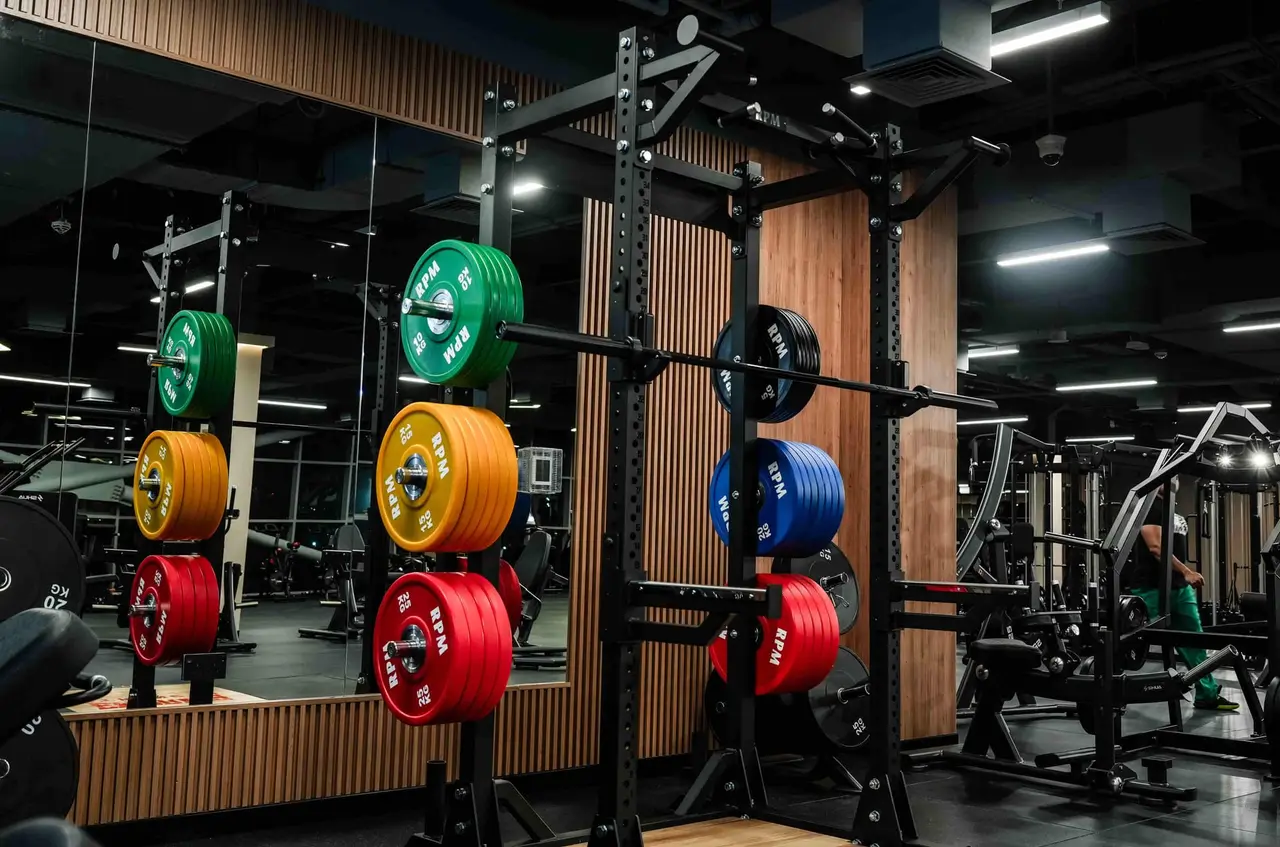
Both need only a barbell and plates, and RPM's floor photos in Al Manhal show barbells with colour bumper plates, plus kettlebells for practising the sumo stance with a light load. A lifting platform and the rules on dropping the bar are not confirmed, so ask on your free tour, and book personal training if you want a coach to watch you try both.
Sources
- Escamilla RF, Francisco AC, Fleisig GS, Barrentine SW, Welch CM, Kayes AV, Speer KP, Andrews JR. A three-dimensional biomechanical analysis of sumo and conventional style deadlifts. Medicine and Science in Sports and Exercise, 2000
- Escamilla RF, Francisco AC, Kayes AV, Speer KP, Moorman CT 3rd. An electromyographic analysis of sumo and conventional style deadlifts. Medicine and Science in Sports and Exercise, 2002
Questions, answered.
Which is better for the glutes, sumo or conventional?
Both train the glutes hard, because the hips extend through a similar range in each. Sumo adds more inner-thigh work and conventional more hamstring and lower-back work. If the glutes are your priority, either one plus a hip thrust covers it.
Which builds more muscle?
Neither has a clear edge for muscle growth. Choose the style you can load and progress consistently, then cover what it trains less: extra hamstring work alongside sumo, extra quad work alongside conventional.
Can I compare my sumo and conventional numbers?
Only loosely. The bar travels a different distance and different muscles limit each lift, so many people are clearly stronger in one style. Log them separately and judge each against itself.
Which style suits my body type?
A long torso with shorter legs, or hips that sit comfortably wide, often suit sumo; long arms and good hamstring length often suit conventional. The shape of your hip joints matters as much as your proportions, so try each for a few weeks before deciding.
Should beginners learn sumo or conventional first?
Most coaches start with conventional, after the Romanian deadlift, because the stance is simple and the hinge carries straight over. Learn sumo next if conventional feels cramped or you want to compare.
Is sumo easier on the lower back?
The torso is more upright, so the lower back works at a different angle, but it still works hard. Neither style is a solution for back pain; if pulling hurts your back, stop and get it checked by a doctor or physiotherapist.