The answer in brief
Both are squats for the same muscles: the quads and glutes do the work, the inner thighs help out of the bottom and the trunk holds you in position. What differs is where the load sits. In a goblet squat you hug one dumbbell or kettlebell to your breastbone; in a back squat a barbell rests across your upper back and comes out of a rack. That one change decides how upright you stay, what ends your sets, how far you can progress and how long the set-up takes.
So this is less a contest than a question of timing: when the dumbbell is the right tool, and when it has run out. The leg training guide shows where both fit among the other leg movements.
Side by side
| What differs | Goblet squat | Back squat |
|---|---|---|
| Where the load sits | One dumbbell or kettlebell held upright against the breastbone | A barbell across the upper back, lifted out of a rack |
| Torso | Upright: the weight in front balances you as you sit down | Some forward lean to keep the bar over mid-foot |
| What holds the position | Arms, upper back and trunk stop the weight pulling you forward | Upper back, lower back and trunk hold your torso angle under the bar |
| What usually ends a set | Arms and upper back, or running out of heavier dumbbells | The legs, or your brace |
| How far it progresses | Up to the heaviest weight you can hold at your chest | In small plate jumps, well beyond that |
| Set-up | Pick up a dumbbell: seconds | Set the hooks and safety arms, load and collar the bar |
| If a rep goes wrong | Stand up or set the weight down | Sit the bar onto safety arms set below your depth |
| Level | Beginner | Intermediate |
| Where it fits | Learning, warm-ups, higher-rep sets, dumbbell-only days | The main squat, for strength and heavier muscle-building sets |
What moving the load from your chest to your back changes
Any squat has to keep you and the load balanced over the middle of your feet. With a dumbbell at your chest, the load sits in front of that line, so your hips can drop straight down while your torso stays tall; the price is that your arms and upper back must stop the weight dragging your chest forward. With a bar on your back, the load sits behind your shoulders, so you lean forward a little and send the hips back to keep the bar over mid-foot, and the muscles along your spine work to hold that angle.
That is why depth often comes more easily in a goblet squat, and why a first barbell squat can feel as if the bar is trying to fold you forward. It is also why the two give out in different places: a goblet set tends to end when the hands, arms or upper back tire, a back squat set when the legs or the brace do. A dumbbell that feels heavy in your arms is often still light for your legs.
Strength or size: what the dumbbell's ceiling costs you
The goblet squat's limit is load, so the useful question is what that limit costs. A 2017 review pooled 21 studies in which people trained for at least six weeks with either light loads, 60% of their one-rep max or less, or heavy loads above that, taking every set to failure. Gains in one-rep-max strength were greater with heavy loads, while muscle growth was similar across the two.
Those studies compared loads, not these two exercises, but the lesson carries over. For a stronger squat, the back squat is the better tool once the heaviest dumbbell turns light, because only the bar lets you keep training heavy. For bigger legs, a goblet squat can keep doing useful work for longer than its weight suggests, provided your sets end close to failure: slow the lowering, pause at the bottom, raise your heels or add reps. The catch is that your arms and upper back may tire before your legs get there, and that is the sign the dumbbell has done its job.
Signs you are ready for the bar
- You squat to depth with a flat back for sets of 8–10, and every rep looks the same.
- Your arms or upper back end the set while your legs still have reps left.
- You have reached the heaviest dumbbell you can hold for 10–15 reps, and slower lowering or pauses no longer make the last reps hard.
- Your goal now involves a one-rep max, a strength programme written in percentages, or powerlifting.
- You can hold a bar on your back comfortably, hands just outside the shoulders and shoulder blades squeezed together.
Your goblet weight does not convert into a bar weight. Start your first barbell sessions with the empty bar and the safety arms set, and expect a different feel: more lean, and the hips travelling further back.
When the goblet squat stays the right pick
- You train at home, or with dumbbells and kettlebells only.
- You want a warm-up before heavy squats, or a higher-rep second exercise after them.
- Every rack is in use and you would rather not wait.
- You are back after a break and want to rebuild depth before loading a bar.
- The bar position bothers your shoulders. If that means pain rather than stiffness, speak to a doctor or physiotherapist first.
Keeping both in your week
| Stage | Day A | Day B |
|---|---|---|
| Learning to squat | Goblet squat 3 × 8–10, pausing at the bottom | Goblet squat 3 × 8–10 with a slower lowering |
| Moving to the bar | Back squat 3 × 8, light, every rep identical; then goblet squat 2 × 10 | Goblet squat 3 × 10–12 |
| Settled programme | Goblet squat 1–2 × 8 to warm up, then back squat 3–4 × 6–10 or 4–5 × 3–5 | Heels-raised goblet squat 3 × 10–15 as the second leg exercise |
Stop each set with one to three reps left. Rest two to three minutes between heavy back squat sets and a minute or two between goblet sets, and add load only when every set reaches the top of its range.
If the rack you planned on is taken, make the goblet squat that day's main lift with a slow lowering and a pause. If the dumbbell you need is in use, a kettlebell close in weight or the leg press keeps the session on track.
Both squats at RPM
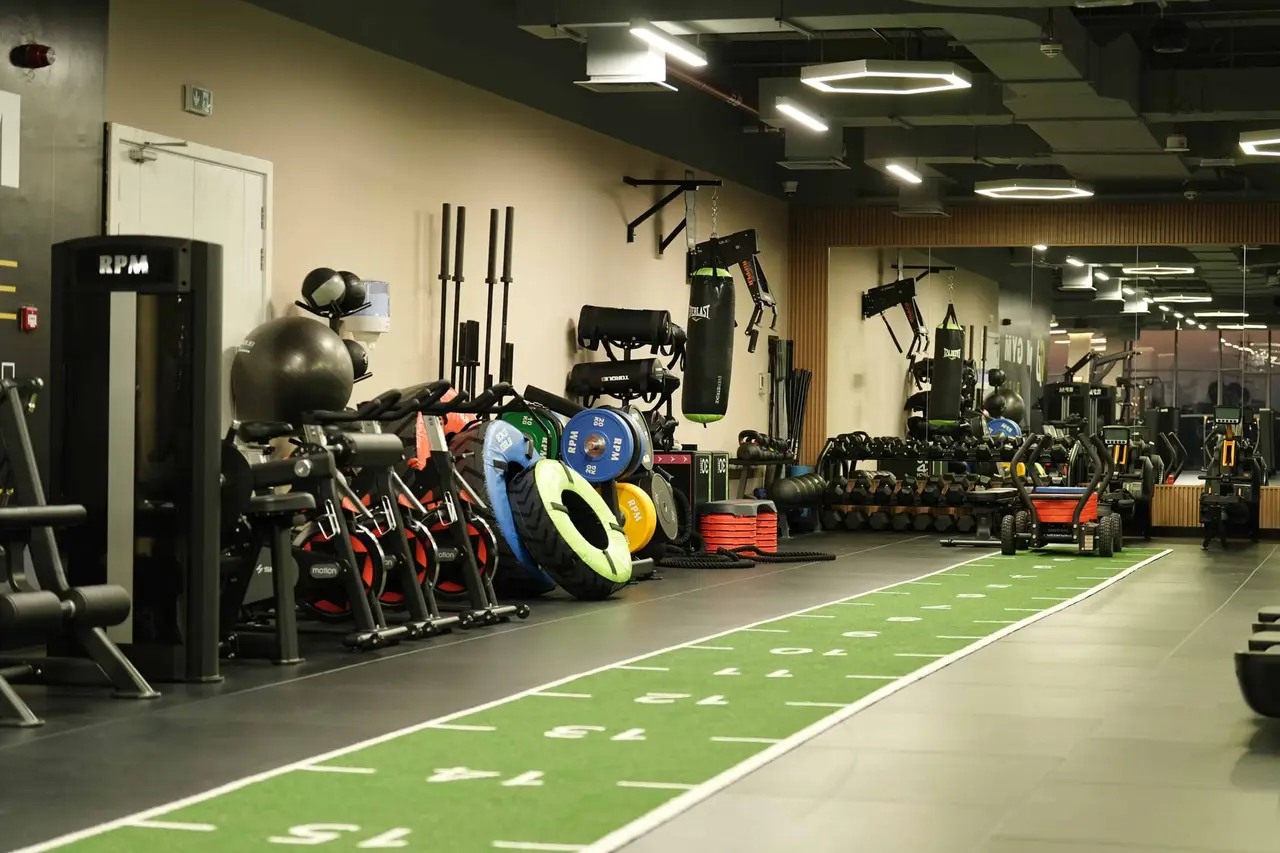
RPM's floor photos show a squat rack with a barbell and colour bumper plates, and a dumbbell rack and kettlebells, so both squats can be done at the gym in Al Manhal. If you want someone to judge when you are ready for the bar and to set up your first barbell sessions, book a personal training session, or see female personal training if you would rather work with a woman coach.
Sources
Questions, answered.
Can goblet squats alone build bigger legs?
For a good while, yes, if your sets end close to failure: the review above found muscle growth similar with light and heavy loads. The limit arrives when your arms or upper back give out first; then a barbell squat, the leg press or a single-leg exercise lets your legs work harder.
Why can I squat deeper with a dumbbell than with a bar?
The dumbbell in front counterbalances your hips as they move back and down, so you can sit lower before your weight drifts onto your heels. With a bar on your back you have to lean and push the hips back, a position that takes practice before the same depth comes.
Is the goblet squat easier than the back squat?
To learn, yes: one is a beginner exercise, the other an intermediate lift. At the same effort both are hard, and a slow, paused goblet squat taken close to failure is no easy option.
Do I need to back squat at all?
No. Strong legs can be built with goblet squats, the leg press, split squats and hinges. You need the barbell if your goal is a heavier squat itself, a strength sport that tests it, or simply more load than you can hold.
Can I do both in the same session?
Yes. A few light goblet squats make a good warm-up before the bar, and a set or two after heavy back squats adds volume without another set-up. Keep the goblet sets clearly lighter than the main work.