The short answer
On a hack squat your body moves: you stand on a platform with pads on your shoulders and squat down a track, knees travelling well forward. On a leg press your body stays still: you sit in a reclined seat and push a sled away with your feet. That one difference drives most of the others, from how hard the quads work to how much your trunk is involved.
If you are weighing a free-weight squat against a machine, that is a different question, answered in the squat rack vs leg press guide. This page compares two machines. The leg training guide shows where each one sits in a full week.
Side by side
| What differs | Hack squat | Leg press |
|---|---|---|
| Body position | Standing, back on an angled pad, shoulders under pads | Seated and reclined, back on a pad |
| What moves | You and the carriage, down a fixed track | Only the sled and its plates |
| Main muscles | Quads first; glutes and inner thighs at the bottom | Quads and glutes, with foot position shifting the balance |
| Load on the spine | Through the shoulder pads and down the trunk | Little: the back is supported and the load goes through the feet |
| Knee bend | Deep, with the knees travelling far forward | Deep, but the hips usually limit the range first |
| Learning curve | Moderate: depth and heel position take practice | Low: seat, feet and depth are quick to learn |
| Foot options | Narrow, mid or wide, plus a reverse version facing the pad | High, low, wide, narrow and single-leg |
| Where it often goes wrong | Heels lifting, hips peeling off the pad | Hips rolling off the pad, knees locking out |
How each one loads your legs
In the hack squat, the angle of the track lets your knees move forward as far as your ankles allow, so the knee bends a long way while the torso stays fairly upright. That is why most lifters feel it overwhelmingly in the front of the thighs. Your trunk still braces against the shoulder pads, which carry the load down your spine much as a bar would, only along a guided path.
In the leg press, the hip angle closes as the sled comes down, and for most people the limit is the point where the pelvis starts to roll off the pad rather than the knee. Moving your feet up or down the platform shifts the balance between hip and knee work far more than on the hack squat, which is what makes the leg press so adjustable. With nothing pressing on your shoulders, it is the gentler choice when your trunk is tired.
When to choose the hack squat
- You want a quad-focused machine that feels close to a deep squat.
- You already squat and want to add hard quad work without balancing a bar.
- You want to train the full range of knee bend under load, and your ankles let your heels stay down.
- Your gym has one: not every floor does, so check before building a plan around it.
When the leg press makes more sense
- You are a beginner and want to load your legs with the simplest set-up.
- You want to move work between the quads and glutes by changing foot position.
- You want single-leg work on a machine, or need to train around a tired lower back or shoulders.
- You want high-rep sets taken close to failure with very little skill involved.
Using both in a week
They work well together because they load the same muscles from different positions. One simple way to pair them:
| Session | First | Then |
|---|---|---|
| Leg day A | Hack squat, 3–4 × 6–10, one or two reps left | Leg press with the feet high, 3 × 12–15 |
| Leg day B | Back squat or another free-weight squat, 3–4 × 5–8 | Single-leg leg press, 2–3 × 10–12 each leg |
Rest about two minutes between hard sets. If you only have time for one machine, alternate them across training blocks rather than within a session.
Track each machine on its own terms: carriage and sled weights differ between models, so a number on the hack squat says nothing about the leg press. When every set reaches the top of its range at full depth, add a small plate to each side.
Both machines at RPM
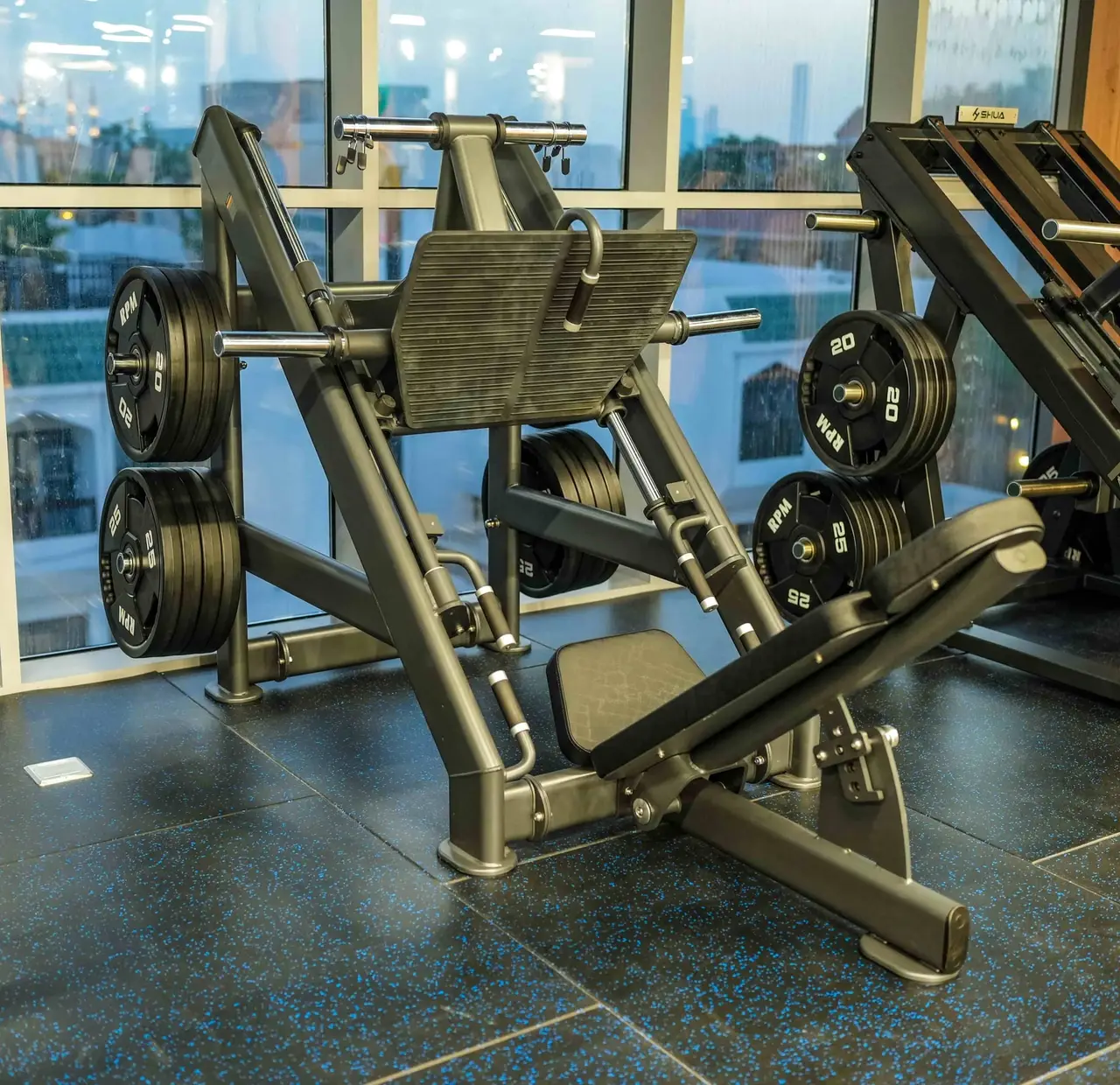
RPM's floor photos show a plate-loaded 45-degree leg press, but not a hack squat, so ask on your free tour what is on the floor before planning around one. A personal training session can set up whichever machine you use and pick a substitute if needed.
Questions, answered.
Which is better for quads, the hack squat or the leg press?
Most lifters feel the hack squat more in the quads, because the knees travel further forward while the torso stays upright. A leg press with the feet low and narrow comes closer, but the hack squat is usually the more direct quad exercise.
Which is better for glutes?
The leg press with the feet high and slightly wide lets the hips do more of the work, and the reverse hack squat also shifts load towards the glutes. For a glute focus, add a hip movement such as the hip thrust.
Can I compare the weight I use on each machine?
No. Sled and carriage weights, angles and leverage vary by machine and manufacturer, so the numbers are not comparable. Track progress on each machine separately.
Is the hack squat harder than the leg press?
For most people, yes. Standing under the shoulder pads, the deep knee position and keeping the heels down all take more practice than sitting in a leg press.
Do I need both?
No. Either can be the main machine in a leg session. Using both adds variety and hits the quads and glutes from different angles, but one, done consistently, is enough.