What the dead bug trains, and who it is for
Like the plank, the dead bug is an anti-extension exercise: your trunk muscles stop the lower back from arching. The difference is that your arms and legs move while they do it, in opposite pairs, right arm with left leg, the same pattern as walking and running. The rectus abdominis at the front, the deep muscle that wraps around your middle and the obliques at your sides do the holding, while the hip flexors control the leg as it lowers. The name comes from the position: on your back with your limbs in the air, like an insect that has rolled over.
Because you are lying down and the effort is low, it is one of the first core exercises coaches teach, and it is easy to fit in: a set or two in a warm-up before squats or deadlifts, or part of a short core block at the end of a session. It suits beginners learning what bracing feels like, people whose elbows or shoulders dislike planks, and experienced lifters who want slow, controlled trunk work. The core training guide shows how it sits alongside holds, carries and the big lifts.
Its benefit is control: learning to keep the pelvis and ribs still while your limbs move, which is what your trunk does under a bar or on a run. If it causes pain in your lower back, stop and get it checked by a doctor or physiotherapist.
Getting into the start position
- Lie on your back on a mat with your knees bent and feet flat.
- Lift your legs one at a time until your hips and knees are both bent at right angles, knees stacked over your hips and shins parallel to the floor.
- Raise your arms straight above your shoulders, fingertips pointing at the ceiling.
- Breathe out fully and let your ribs drop towards your hips. Your lower back should press gently into the mat; slide a hand underneath to check, and you should feel light pressure rather than a gap.
- If your back lifts before you have even moved, or you cannot hold this position for a few breaths, start with one of the easier versions below.
How to do a rep
- Breathe out as you slowly lower your right arm back towards the floor behind your head and straighten your left leg out towards the floor, heel just above it.
- Go only as far as your lower back stays down. For many people that is well short of the floor at first, and that is the right range.
- Pause for a moment at the end, then bring the arm and leg back to the start.
- Repeat with the left arm and right leg. Count one reach on each side as one rep, or count the sides separately and keep the totals equal.
- Take about three seconds to reach out and two to come back. The slower you go, the harder it gets.
The range ends where your back starts to arch, not where the floor is. A long, steady breath out as your limbs reach helps keep the ribs down; if you catch yourself holding your breath, shorten the reach until you can breathe and brace at the same time. The breathing and bracing guide covers the same brace you use under a bar.
Dead bug mistakes to fix first
| Mistake | What it looks like | The fix |
|---|---|---|
| Back arching off the mat | A gap opens under the lower back as the leg lowers | Shorten the reach, or go back to legs-only or arms-only reps |
| Rushing | Arms and legs flap out and back in a second | Three seconds out, a pause, two seconds back |
| Holding the breath | A red face and a gasp at the end of each rep | Breathe out on every reach |
| Ribs flaring | The chest lifts as the arm goes overhead | Take the arm only as far as the ribs stay down |
| Same-side pairing | The arm and leg on the same side move together | Opposite arm and leg: right with left, left with right |
| The resting leg drifting | The bent knee wanders away from over the hip while the other leg works | Keep the resting knee stacked over the hip |
Easier, loaded and harder versions
Make the dead bug easier by moving fewer limbs, and harder by adding a load or a longer lever. Move one step at a time, and only when the version you are on is clean.
Legs-only and arms-only regressions
Keep your arms pointing at the ceiling and move only the legs, tapping one heel towards the floor with the knee still bent, then returning. When that is easy, straighten the leg as it lowers. Arms-only works the other way round: the legs hold the bent position while you lower one arm at a time overhead. Combine them into the full dead bug once both are steady.
Holding a dumbbell, a medicine ball or a band
Hold a light dumbbell, kettlebell or medicine ball in both hands above your chest and move only the legs; the weight makes your trunk work harder to keep the ribs down. Or anchor a resistance band behind your head, hold it with straight arms and keep it taut while your legs move, which pulls you into the brace. Add load only once the bodyweight version keeps a flat back on every rep.
Hollow-body hold
The next step up, borrowed from gymnastics. From the dead bug position, extend both arms overhead and both legs out, and lift your shoulders and legs a little off the floor while your lower back stays pressed down. Hold for fifteen to thirty seconds. If the back lifts, bend your knees or bring your arms forward until it stays down.
If the floor space is taken, a Pallof press at a cable tower trains the trunk to resist movement while you stand. The bird dog, on hands and knees, is another floor option that works the back muscles more, and the ab wheel rollout is where anti-extension work goes once both the dead bug and the plank feel easy.
Sets, reps and progression
| Goal | Sets × reps | How hard |
|---|---|---|
| Learning the movement | 2–3 × 6–8 each side | Slow reps, stopping before the back lifts |
| Building control | 3 × 8–10 each side | Three seconds out; every rep with the back down |
| Moving to harder work | 3 × 6–8 each side, or 3 × 15–30-second hollow holds | With a weight or band, or the hollow hold, back still flat |
Rest thirty to sixty seconds between sets. In a warm-up, one or two easy sets are enough.
Two or three times a week suits most people, either before the main lifts or in a short core block after them. Progress the range first, until your heel hovers just above the floor with a straight leg; then the tempo, with slower reaches and longer pauses; then the load or the hollow hold. With a plank and a Pallof press, it covers the main jobs of a core session.
Dead bugs at RPM
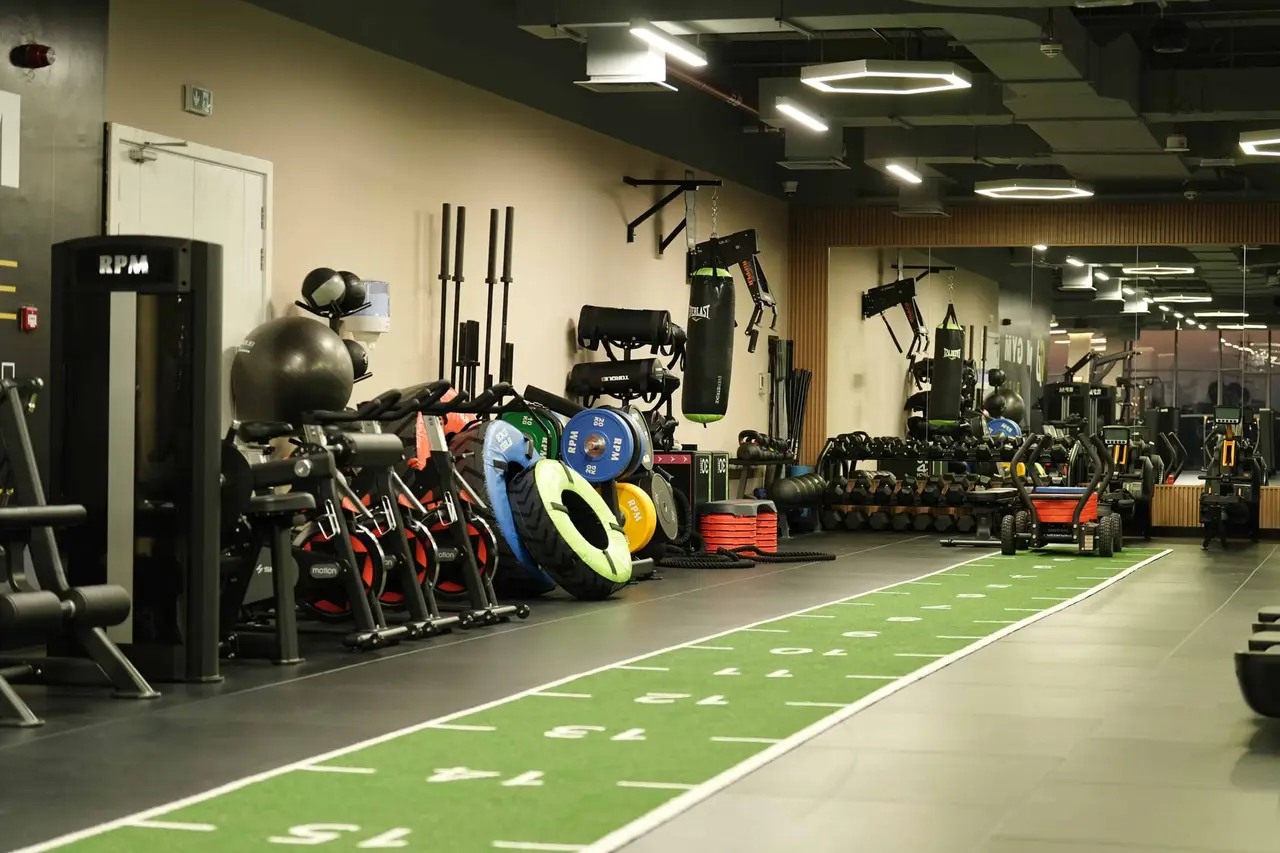
The dead bug needs only a mat and some floor, so you can do it in either RPM section, the Mixed floor or the women-only Ladies section. RPM's photos show kettlebells, medicine balls on a ball rack and a dumbbell rack in the functional area for the loaded version; ask on your free tour where the mats and resistance bands are kept. A personal training session is a quick way to have someone check that your back stays down, and you can ask for a female personal trainer.
Questions, answered.
What are the benefits of the dead bug exercise?
It teaches you to brace your trunk while your arms and legs move, which is what the trunk does in most lifts and sports. It is easy to learn, needs no equipment and can be made harder in small steps. It will not flatten your stomach on its own; how your waist looks depends far more on overall body fat.
Dead bug vs plank: which is better?
They train the same job, resisting a back arch, in different ways. The plank is a still hold on your elbows and toes; the dead bug adds moving limbs and puts no load through your elbows or shoulders. Many core blocks use both.
Dead bug vs bird dog: which should I do?
Both, if you can. The dead bug works the front of the trunk while you lie on your back. The bird dog, on hands and knees reaching one arm and the opposite leg out, works the muscles along the spine and the glutes more, and asks you to resist twisting.
Is there a dead bug machine?
No; it is a floor exercise. The nearest thing on a machine is the Pallof press on a cable station, which trains the trunk to resist movement while you stand rather than lie down.
Can I do dead bugs while pregnant or after giving birth?
Ask your doctor or midwife which core exercises suit you. Pregnancy, the postnatal period and abdominal separation all change the answer, and this page does not give guidance for them.