What the Russian twist trains, and its limits
Two jobs share the work. The leaned-back position is a hold: the rectus abdominis and the hip flexors stop you from falling back or slumping. The rotation is the moving part, done by the external oblique on one side and the internal oblique on the other, which turn the ribcage over a pelvis that stays put. When people say the exercise does nothing for them, it is usually because only their arms are moving.
Be realistic about the range. The spine rotates less than it looks, and a heavy weight swung quickly mostly trains momentum. Done slowly, the twist is a reasonable rotation exercise for beginners that needs only floor space. Pair it with work in which the trunk resists twisting, such as the Pallof press; the core training guide explains why both have a place in a week.
Setting up the lean
- Sit on a mat with your knees bent and your heels on the floor, about a forearm's length in front of your hips.
- Lengthen your spine, then lean back until you feel your stomach switch on, roughly halfway between sitting upright and lying down. Your back stays long, not slumped.
- Bring your hands together in front of your chest with the elbows slightly bent, as if holding a ball.
- Press your knees lightly together. They point at the ceiling for the whole set.
- Start without a weight. Ten slow turns each way with still knees and a long back come before any plate.
Turning from side to side
- Breathe out and rotate your ribcage and shoulders to the right, moving your hands as one unit with your chest, until they sit beside your right hip.
- Let your eyes and head follow your hands so the whole upper body turns, not just the arms.
- Pause briefly at the end of the turn without letting your back round.
- Rotate back through the centre as you breathe in, and carry on to the left.
- Count one rep per side, and end the set when your knees start to sway or your back collapses.
One cue fixes most Russian twists: your breastbone turns, not your hands. If your hands travel further than your chest, you are swinging your arms. Keep each turn to about a second. If the twist hurts your lower back, stop and have it checked by a doctor or physiotherapist.
Russian twist mistakes
| Mistake | What it looks like | The fix |
|---|---|---|
| Arms-only swinging | The hands sweep side to side while the chest faces forwards | Turn the breastbone; the hands stay in front of it |
| Slumping | The lower back rounds and the shoulders sag | Sit taller and lean back less until you can hold a long spine |
| Swaying knees | The knees drop to the side opposite the hands | Squeeze the knees together and keep them pointing up |
| Going too fast | Rapid taps of the weight on the floor | About a second per side, with a pause at each turn |
| Too heavy, too soon | A weight that drags you past your range and forces a hunch | Bodyweight first, then a light plate held close |
Feet, weights and a cable alternative
You make the basic twist harder by taking away your base or adding a load, and its most useful alternative moves the rotation to a standing position.
Feet down or feet raised?
Heels on the floor give you a stable base, so you can concentrate on the rotation; learn this version first. Lifting your feet a little way off the floor makes the hold much harder, because the hip flexors and abdominals must now balance your legs as well. Try raised feet only once ten slow turns each way are clean with your feet down, and put them back down when your back starts to round.
Holding a plate, dumbbell or medicine ball
A weight held close to the chest adds a little; the same weight held at arm's length adds a lot, because it sits further from your spine. A light plate gripped by its edges or a dumbbell held by both ends works; a medicine ball is the easiest to hold. Start very light and keep the tempo slow. If the weight has to touch the floor beside you, you are probably leaning and rounding to reach it.
Cable woodchop as an alternative
If seated twisting does not suit you, or you want heavier, standing rotation, stand side-on to a cable tower with the pulley set high or low and pull the handle diagonally across your body, turning through your hips and trunk together. The load is set on the stack, your feet stay on the floor and the movement is closer to how you turn and throw in sport. The cable machine guide covers pulley heights and handles.
If you would rather train rotation lying down, the bicycle crunch does it with the legs moving instead of a held lean.
Sets, reps and progression
| Goal | Sets × reps | How hard |
|---|---|---|
| Learning the turn | 2–3 × 8–10 per side, heels down | Slow, with still knees; end the set before your back rounds |
| Building the obliques | 3 × 10–15 per side, light weight | Two or three slow turns left in reserve |
| Harder control | 3 × 8–12 per side, feet raised | Stop as soon as the feet touch down or the turn shortens |
Rest about forty-five seconds between sets. A set of twists followed by a Pallof press makes a two-exercise rotation block.
Twice a week covers most people's needs. Progress one thing at a time: slower turns, then raised feet, then a light weight held close, then the same weight held further out.
Russian twists at RPM
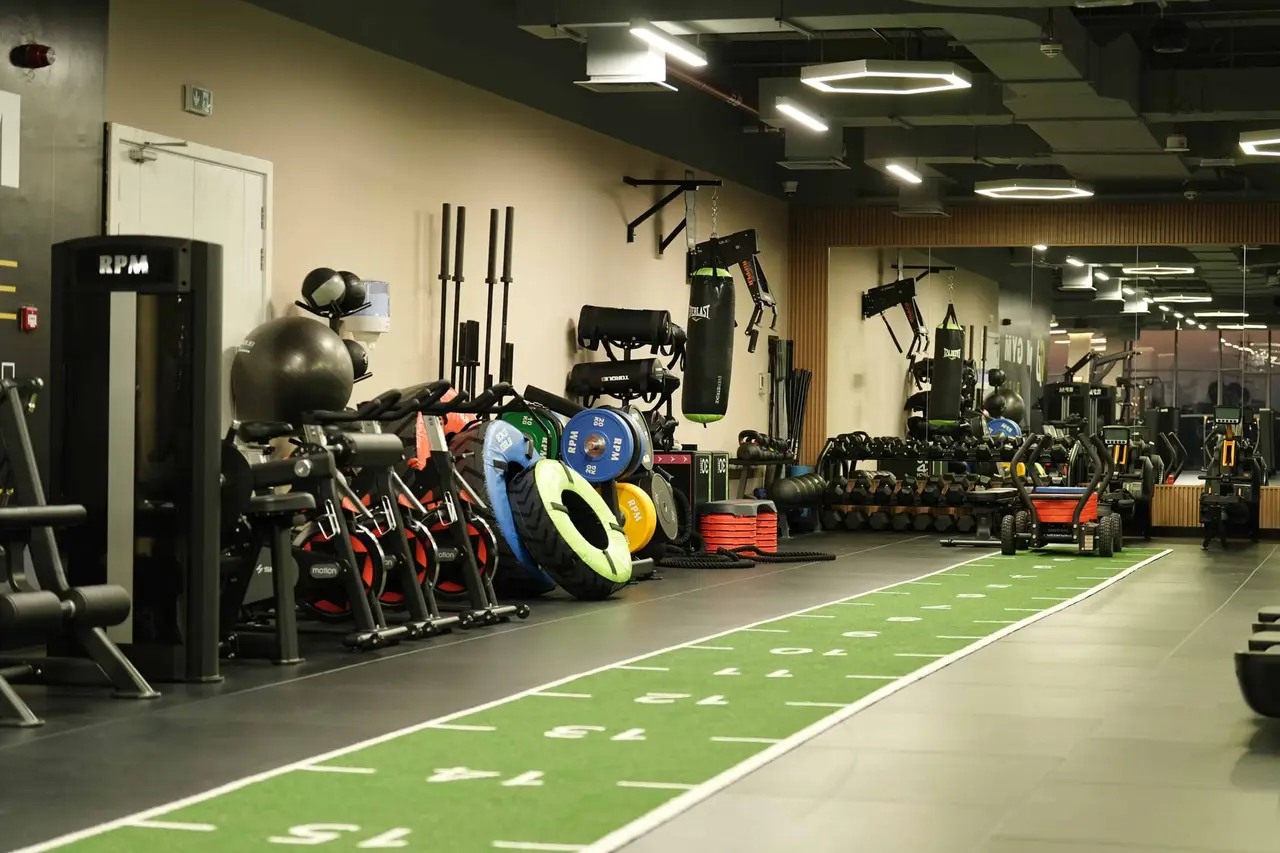
A Russian twist needs only a mat and, for the weighted version, something to hold. RPM's photos show dumbbells, kettlebells, colour bumper plates and medicine balls on a ball rack, so any of them works for the weighted version. For woodchops, the cable towers in the photos give you the pulley.
Questions, answered.
What muscles does the Russian twist work?
The obliques do the turning; the front abdominal muscle and the hip flexors hold the leaned-back position. With your feet raised, the hip flexors and abdominals work harder still.
Russian twist or bicycle crunch?
The Russian twist is seated and easy to load with a weight; the bicycle crunch is done lying down and adds alternating legs. With only a few minutes to spare, pick whichever you can do slowly with good form; the bicycle crunch page explains the other option.
Do Russian twists slim the waist or get rid of love handles?
They cannot choose where fat comes off. Russian twists build the obliques, which adds muscle at the sides of the waist rather than shrinking it. A smaller waist comes from losing body fat overall, through eating and activity.
What can I do instead of Russian twists?
Standing, the Pallof press or a cable woodchop; lying down, the bicycle crunch; on a machine, a rotary torso machine if the gym has one, which the ab crunch machine page describes.
Can I do Russian twists while pregnant or with abdominal separation?
Ask your doctor or midwife first. They can tell you whether rotation exercises suit you and what to do instead.