What the rollout trains
The rollout is an anti-extension exercise, the same job as the plank, made far harder by a lever that grows as you roll. The further the wheel travels from your knees, the more your own weight pulls your middle towards the floor, and the rectus abdominis, the deep abdominal wall and the obliques must stop your lower back from arching. On the way back, the lats and the fronts of the shoulders pull the wheel in, which is why many people feel it under the armpits the next day.
That makes it the step after a comfortable one-minute plank, not a first core exercise. It is short and intense: a few slow reps near the end of a session, next to a curling exercise such as the hanging leg raise or a crunch. The core training guide lists rollouts as the harder version of the plank and dead bug, which is exactly where they belong.
Setting up on your knees
- Kneel on a mat or a folded pad with your knees hip-width apart, and place the wheel on the floor just in front of them.
- Grip both handles with your shoulders directly above the wheel and your arms straight.
- Round your upper back very slightly and tuck your pelvis, as if tightening a belt by one notch, so your ribs are drawn towards your hips.
- Squeeze your glutes. That locks the pelvis and keeps your lower back from dipping as you roll.
- Decide your range before the first rep. Beginners roll only a short way, or towards a wall that stops the wheel, as described below.
Rolling out and back
- Brace your stomach and take a breath in.
- Roll the wheel forwards slowly, letting your hips and arms travel together, so your body lengthens into one line from knees to shoulders.
- Stop the moment you feel your lower back begin to arch, or when your arms are roughly overhead and your chest is just above the floor.
- Pull the wheel back by pressing it down into the floor with straight arms, the same action as pulling a bar down in a pulldown, while your ribs stay down and your glutes stay tight.
- Return until your shoulders are over the wheel again, breathe out, reset and go again.
Range is earned. Rolling a little less with a perfect line trains your trunk; rolling further with a sagging back only loads your lower back. If rollouts cause pain in your lower back or shoulders, stop and have it checked by a doctor or physiotherapist. If you are pregnant or postnatal, ask your doctor or midwife before using the wheel.
Rollout mistakes to fix first
| Mistake | What it looks like | The fix |
|---|---|---|
| Sagging in the middle | The lower back dips towards the floor at the far end | Shorten the range, tuck the pelvis and squeeze the glutes harder |
| Hips left behind | Only the arms move; the hips stay over the knees | Let the hips travel forwards with the wheel |
| Returning hips first | The bottom shoots back first and the body folds in half | Pull with straight arms and let the hips follow |
| Bent elbows | The arms bend to push and pull the wheel | Keep the arms straight; the movement happens at the shoulders |
| Craning the head | The chin lifts to look forwards | Eyes on the floor a little ahead of the wheel |
| Too far, too soon | Every rep goes to the floor at the cost of form | Use a wall stop and move it back a little each week |
Kneeling, standing, wall and barbell rollouts
Every version trains the same job. They differ in how long the lever gets and what stops the wheel.
Kneeling or standing rollout?
Kneeling is the version almost everyone should use. The standing rollout starts from your feet in a bent-over position, so the lever runs from toes to hands and the load on the trunk is far greater. It is an advanced strength feat: work towards it only once full-range kneeling rollouts are easy, and then through partial ranges first, such as rolling towards a wall or up a slight incline.
Rolling out to a wall
Kneel facing a wall with the wheel a short distance from it, so the wall stops the wheel at a fixed point. You can roll out without guessing where the rep ends, and each week you shift your knees a little further back. It is the simplest way to extend the range in measured steps.
Barbell rollout
A barbell with a round plate on each end rolls the same way. The bar is heavier than a wheel, so it rolls more smoothly and slowly, and the wider grip feels steadier on the shoulders. Use two plates of the same diameter so the bar rolls straight, and grip just outside shoulder width. If there is no wheel, this is the closest substitute.
If neither a wheel nor a bar is available, a long-lever plank with your elbows a little ahead of your shoulders trains the same job, and the dead bug is the gentler floor option.
Sets, reps and progression
| Goal | Sets × reps | How hard |
|---|---|---|
| Learning the line | 3 × 5–6, rolling to a wall | Every rep stops before your back moves |
| Building strength | 3 × 6–10, kneeling, longer range | Leave two clean reps, slow out and slow back |
| Advanced | 3 × 3–6, full kneeling range or partial standing | Only reps with a straight line count |
Rest about a minute between sets. The low reps are deliberate: the rollout is hard, and form fades quickly.
Twice a week is plenty. Progress the range before the reps: move the wall stop back, then build towards ten reps, then slow the outward roll to three seconds. Only after that is it worth trying the barbell or partial standing versions.
Rollouts at RPM
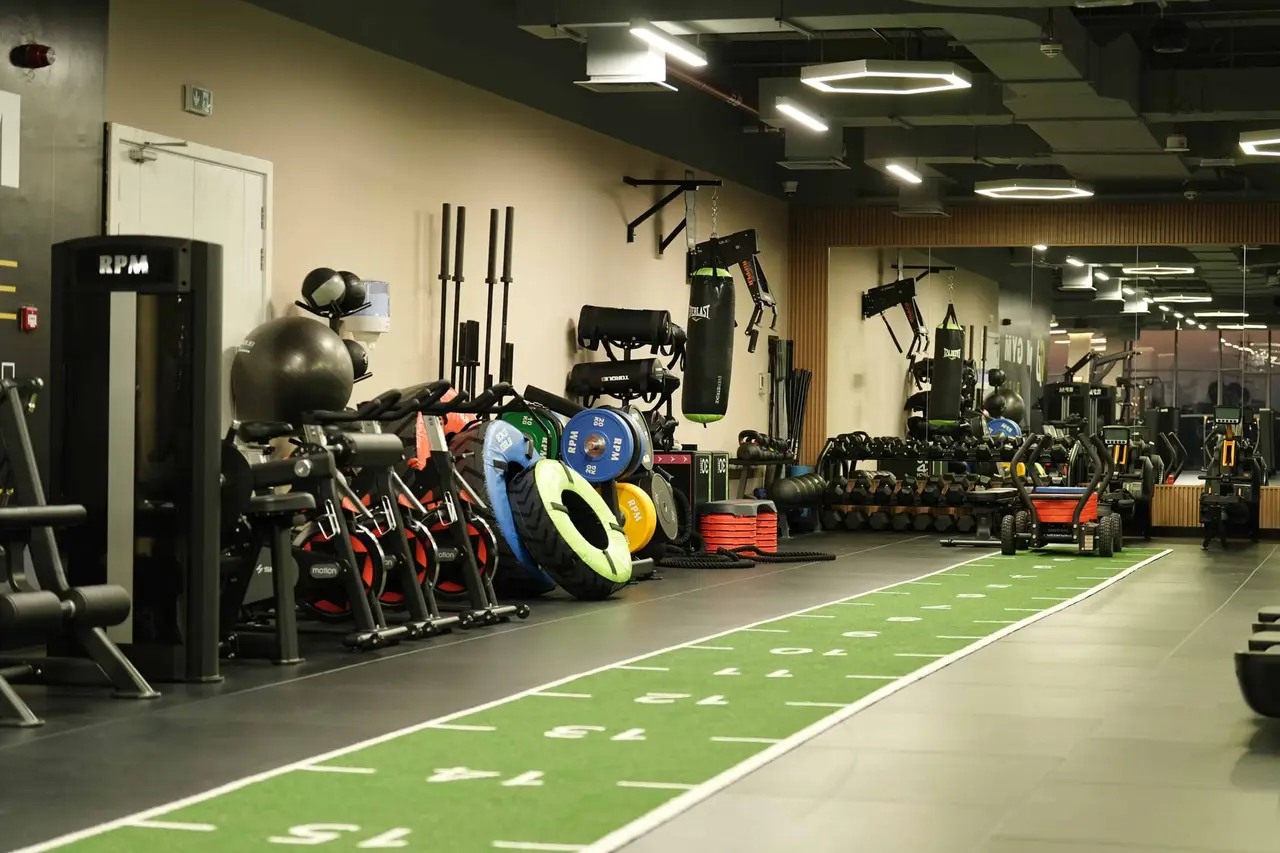
RPM's floor photos show barbells and colour bumper plates on the racks, which is everything a barbell rollout needs, but an ab wheel is not among the equipment they show, so ask about one on your free guided tour. For a coach to find your range and watch your lower back, book a personal training session.
Questions, answered.
What muscles does the ab wheel work?
Mainly the front and deep abdominal muscles and the obliques, which stop your back arching. The lats and shoulders pull you back in, and the glutes hold the pelvis in place.
Ab wheel or planks?
The rollout is the harder progression of the same job. Start with planks; once a one-minute plank feels easy, the wheel gives your trunk a load that planks can only match with very long holds.
Is the ab wheel good for beginners?
Not as a first exercise. Build a solid plank and dead bug first, then start with short rollouts to a wall. Rolling to full range too early is the usual reason the exercise ends up feeling like a lower-back exercise rather than an abdominal one.
What can I use instead of an ab wheel?
A barbell with round plates, a long-lever plank or the dead bug. At a cable tower, a straight-arm pulldown done with your ribs held down trains a similar link between the lats and the trunk.
Will the ab wheel flatten my stomach?
It strengthens the muscles underneath, but it cannot choose where you lose fat. A flatter stomach comes from losing body fat overall, through eating and activity.