What the Pallof press trains
The cable pulls sideways, trying to rotate your torso towards the machine. The obliques on both sides, the deep muscle that wraps around your middle and the rectus abdominis at the front stop it, while your glutes and hip muscles keep the pelvis square. The press is the clever part. With the handle against your chest the cable acts on a short lever, but as your arms straighten the same weight acts much further from your body and the turning force grows. You change the difficulty with your arms, not only with the pin.
It is named after John Pallof, the physiotherapist who popularised it; anti-rotation press is the descriptive name. It suits beginners, because the load is light and nothing moves fast, and it earns a place in experienced lifters' programmes as the twist-resisting part of a core block, next to a plank for arching and a side plank or a carry for leaning. People who play golf, racquet sports or combat sports often like it, since those sports ask the trunk to control rotation. The core training guide explains the three jobs and how to share a core block between them.
Setting up at the cable
- Set the pulley at chest height and clip on a single D-handle.
- Take the handle in both hands, one wrapped over the other, and stand side-on to the machine.
- Step away until the cable is taut and the stack lifts slightly with the handle held against the middle of your chest; about an arm's length or a little more from the pulley is typical.
- Stand with your feet about shoulder width apart and your knees soft, hips and shoulders facing straight ahead, not turned towards or away from the machine.
- Choose a light weight: one you can hold with straight arms for five seconds without your hands drifting towards the stack. Stepping further away makes the same pin harder.
How to do a rep
- Breathe in and brace, as if someone were about to push you sideways.
- Press the handle straight out from your breastbone until your arms are straight, hands in line with the middle of your chest.
- Hold for two to three seconds. The cable will try to pull your hands and shoulders round; let nothing move.
- Bring the handle back to your chest slowly, in the same square position.
- Finish your reps, then turn round so the machine is on your other side and do the same number.
Take short breaths through the hold rather than holding your breath, and breathe out as you press. The test is simple: if your hands drift off the line of your breastbone, or your hips turn, the weight is too heavy or you are standing too far out.
Mistakes that let the cable win
| Mistake | What it looks like | The fix |
|---|---|---|
| Turning towards the stack | The hands drift towards the machine as the arms straighten | Lower the pin or step closer until the hands stay centred |
| Leaning away | The whole body tilts away from the cable to fight it | Stand tall with your weight even on both feet, and reduce the load |
| Slack cable at the start | The plates rest on the stack with the handle at your chest | Step out until the stack lifts slightly before the first press |
| Pulley at the wrong height | The cable pulls up or down at an angle | Set it level with your chest so the pull runs straight across |
| No hold | Quick pumping presses with no pause at the front | Hold two to three seconds with the arms straight |
| One side only | All the sets face the same way | Do equal reps with the machine on each side |
Half-kneeling, band and overhead versions
Each version changes the base you work from or the length of the lever; the job of resisting the twist stays the same.
Half-kneeling vs standing Pallof press
Kneel on one knee on a mat with the other foot flat in front, hips square and the glute of the kneeling leg squeezed, and press from there. The narrow base takes away most of the help your legs give, so the trunk and hips work harder and you will need less weight. Kneeling on both knees sits between the two. Learn the standing version first, since it is easier to load, and when you kneel, swap which knee is down as you turn to work the other side.
Band Pallof press
Loop a resistance band around a rack upright or another solid fixture at chest height, hold the other end in both hands and step out side-on until it is taut. A band gets harder the further you step away, so you set the resistance with your feet. It is the version for home, or for when every cable station is taken.
Pallof press with an overhead reach
After pressing the handle out, raise your straight arms overhead while the cable keeps pulling from the side, then bring them back down and in to your chest. Overhead the lever is long, the cable also tries to bend you sideways, and raised arms make it easier for the ribs to flare and the back to arch. Use it only once the basic press is steady, and keep the reps slow.
If the cable towers are busy, a band does the same job, and a side plank on the floor trains the trunk to resist leaning. With only dumbbells or kettlebells, a one-sided suitcase carry is the closest free-weight equivalent; loaded carry workouts cover it.
Sets, reps and progression
| Goal | Sets × reps | How hard |
|---|---|---|
| Learning the movement | 2 × 8 each side | Two-second hold; hands never leave the centre line |
| Building trunk control | 3 × 10 each side | Three-second hold; the last reps hard but clean |
| Moving to harder work | 3 × 6–8 each side | Half-kneeling or with the overhead reach, at a lighter pin |
Rest thirty to sixty seconds between sets; working one side while the other rests keeps things moving. A single long hold in place of reps, twenty to thirty seconds a side with the arms straight, also works.
Two or three core blocks a week, after your main lifts, suit most people, and the Pallof press needs only a few sets in each. Progress in this order: a longer hold, a step further from the machine, a heavier pin, then a harder version. It also fits between sets of a lower-body exercise, because it barely tires the legs.
The Pallof press at RPM
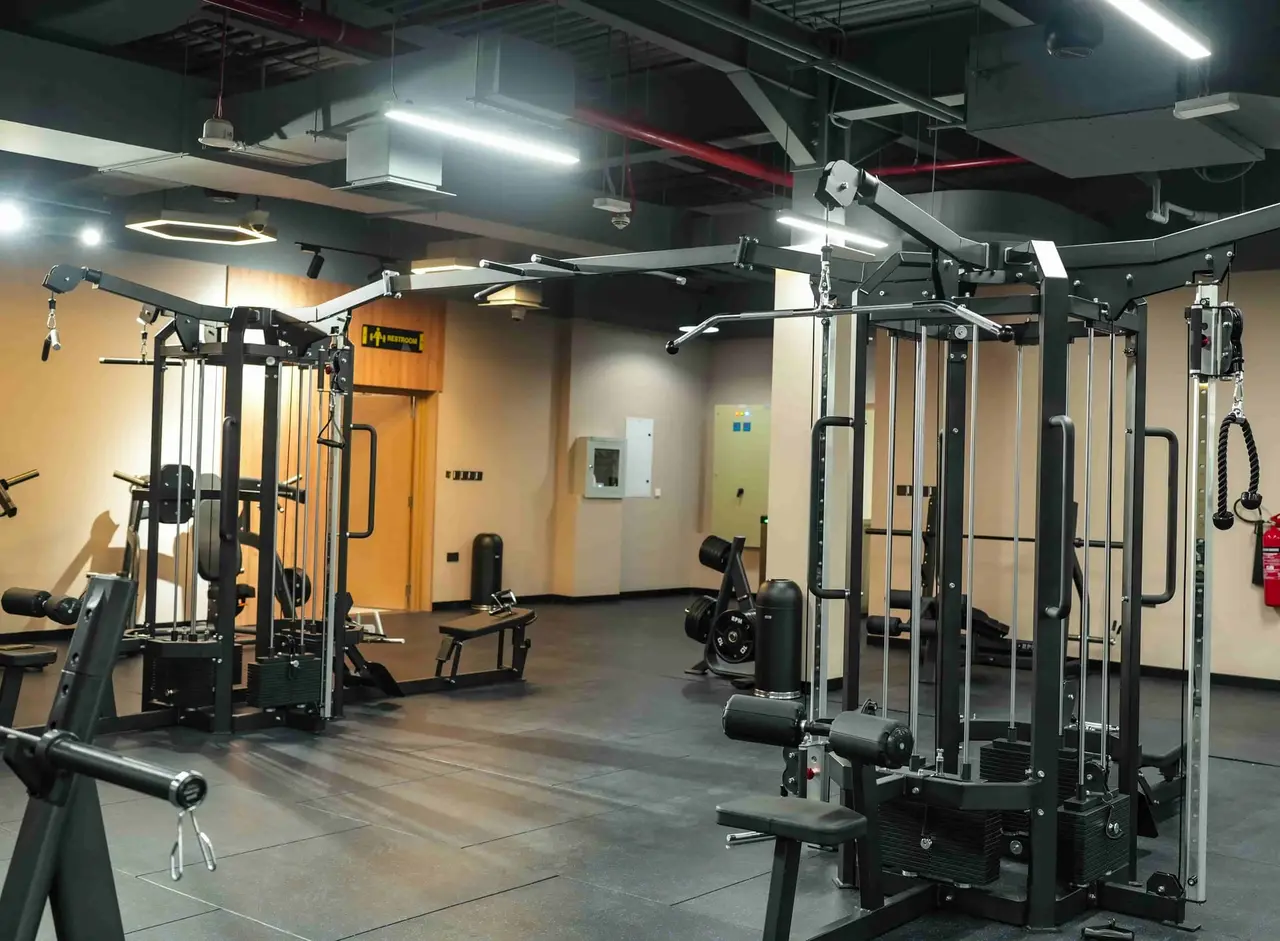
RPM's floor photos show multi-station cable towers on the training floor in Al Manhal. The Pallof press needs a pulley you can set at about chest height, so on your free tour ask which station adjusts, which handles and resistance bands are on hand, and which cable stations the women-only Ladies section has. A personal training session is a quick way to find the right weight and distance from the stack.
Questions, answered.
What muscles does the Pallof press work?
The obliques on both sides, the deep abdominal muscle that wraps around your middle and the rectus abdominis at the front, with the glutes and hip muscles keeping the pelvis square. Your shoulders and chest work lightly to hold the arms out.
Pallof press vs plank: which is better?
They train different jobs. The plank resists your back arching; the Pallof press resists your torso twisting. A balanced core block uses one of each, with a side plank or a carry for leaning sideways.
Pallof press vs wood chop?
The wood chop trains the trunk to rotate under control, pulling the cable across your body; the Pallof press trains it to resist rotation. Many coaches teach the Pallof press first and add chops once you can hold a square position.
Pallof press vs dead bug?
The dead bug is done lying on your back and mainly resists arching; the Pallof press is done standing and resists twisting. They work well together in the same core block.
Is there a Pallof press machine?
No dedicated machine is needed. Any cable station with a pulley you can set at chest height does the job, and a band anchored at the same height works too.
What can I do instead of a Pallof press with no equipment?
A side plank and a bird dog both train the trunk to resist movement with nothing but floor space. For the twisting element specifically, a high plank with slow shoulder taps comes closest.