What the preacher curl trains, and how it differs
The working muscles are the same as in any palms-up curl: the biceps, with the brachialis underneath it doing much of the bending. What the pad changes is the position. Your upper arms sit in front of your body, angled down the pad, and nothing above the elbow can move. Many lifters feel it more on the inner side of the biceps, the short head; that is a change in feel more than a different exercise, and the whole muscle still works.
The pad also moves the hard part of the rep. On a standing curl the load is heaviest halfway up, when the forearm is level with the floor. On a sloped preacher pad the forearm reaches level much earlier, so the lower part of the rep, with the arm nearly straight and the biceps lengthened, is the toughest, and the top gets easy once the forearm passes upright. That is why the bottom deserves so much control here, and why most people use noticeably less weight than they curl standing.
It suits anyone whose curls turn into a body swing, and it works as the second curl of a session or the main one on an arm day. You will also hear it called the Scott curl, after Larry Scott, the 1960s bodybuilder who made it popular. The biceps guide shows how it fits with pulling work and other curls.
Setting up the bench
- Adjust the seat so the top edge of the pad sits right in your armpits when you sit down. Too low and you have to shrug to reach it; too high and the pad presses into the middle of your upper arm.
- Sit with your feet flat and lean your chest into the pad, so the backs of both upper arms lie flat along it with the elbows about shoulder width apart.
- With an EZ bar, take an underhand grip on the angled sections, usually the outer bends, so your wrists turn in slightly. Fixed EZ bars have their weight printed on the end; pick one or two steps below what you curl standing.
- Start with the bar held just above the bottom, arms nearly straight but not locked. Many benches have hooks to rest the bar on between sets; otherwise have a partner hand it to you or set it in place before you lean in.
- Keep your wrists straight, in line with your forearms, and your shoulders down and back.
Doing the rep
- Curl the bar up, keeping the backs of your arms pressed into the pad from start to finish.
- Stop when your forearms are a little short of vertical. Beyond that point the weight rests on the joint and the biceps switches off.
- Squeeze for a moment, then lower over about three seconds.
- Slow down further as you near the bottom and stop just before the elbow locks, then start the next rep without a bounce.
- Stay seated with your chest on the pad; if your hips lift or your torso rocks back, the weight is too heavy.
The bottom of a preacher curl is where the biceps is longest and the load is highest, so it is the part to control, never the part to rush. Letting the bar drop and snap the elbow straight puts a sudden pull on the front of the elbow. Breathe out as you curl and in as you lower, and if you feel pain at the front of the elbow, stop and get it checked by a doctor or physiotherapist.
Preacher curl mistakes
| Mistake | What it looks like | The fix |
|---|---|---|
| Pad at the wrong height | The shoulders shrug up to reach the pad, or it digs into the middle of the arm | Raise or lower the seat until the top edge sits in your armpits |
| Elbows lifting off the pad | The arms leave the pad near the top and the shoulders join in | Keep the backs of the arms pressed down for the whole rep |
| Dropping into the bottom | The bar falls the last part of the way and the elbows snap straight | Lower over three seconds and stop just short of lockout |
| Resting at the top | The forearms go past vertical and the bar sits on the joint | Stop just before vertical to keep tension on the biceps |
| Bending the wrists | The wrists curl in to lift the bar the last part of the way | Keep the wrists straight; take a lighter bar if they fold |
| Lifting off the seat | The hips rise and the torso rocks to start each rep | Stay seated with your chest on the pad and use a lighter bar |
Dumbbell, machine and spider curl versions
All three keep the arm braced so the body cannot help. They differ in how the load is held and where in the rep it bites.
Single-arm dumbbell preacher curl
One dumbbell, one arm at a time, with the working arm along the pad and the other hand resting on the pad's top edge. The wrist can turn freely, and a stronger arm cannot take over as it can with a bar. Many benches have a steeper side, closer to vertical, which keeps more tension near the top. Your spare hand can also help you through one or two extra reps at the end of a set.
Preacher curl machine
A seat, an angled arm pad and a pair of handles on a lever, loaded with a pin stack or plates. Line your elbows up with the machine's pivot, usually marked on the frame, so the handles travel in the same arc as your forearms. Many machines use a cam to spread the resistance more evenly over the rep. It is the easiest version to take close to failure, and the weight changes in small steps.
Spider curl on an incline bench
Lie chest-down on an incline bench set fairly steep, arms hanging straight down in front of it, and curl. The upper arm is vertical rather than angled, so the load is lightest at the bottom and heaviest at the top, the reverse of the preacher curl. It needs only an adjustable bench, which makes it a common substitute, and alternating the two across training blocks covers both ends of the range.
With no preacher bench at all, a concentration curl, seated on a flat bench with your elbow braced against your inner thigh, gives the same no-swing effect, and a bicep curl on the cable keeps tension at the bottom of the rep, where the preacher curl is hardest.
Sets, reps and progression
| Goal | Sets × reps | How hard |
|---|---|---|
| Learning the movement | 2 × 10–12 | Stop with three reps left; a slow bottom on every rep |
| Building the biceps | 3 × 8–12 | One or two reps short of failure |
| Machine or dumbbell, after a heavier curl | 2 × 12–15 | Last set close to failure, elbows still on the pad |
Rest about a minute to ninety seconds between sets. The hypertrophy volume calculator adds your curls and pulls into one weekly total.
One preacher curl exercise in one or two sessions a week is plenty, alongside your rows and pulldowns. Pair it with a standing or hammer curl rather than piling three curls into one day. Add reps until every set reaches the top of the range, then move up to the next bar or dumbbell. Because the bottom is the hard part, add weight in the smallest steps you can, and keep the three-second lowering when you do.
Preacher curls at RPM
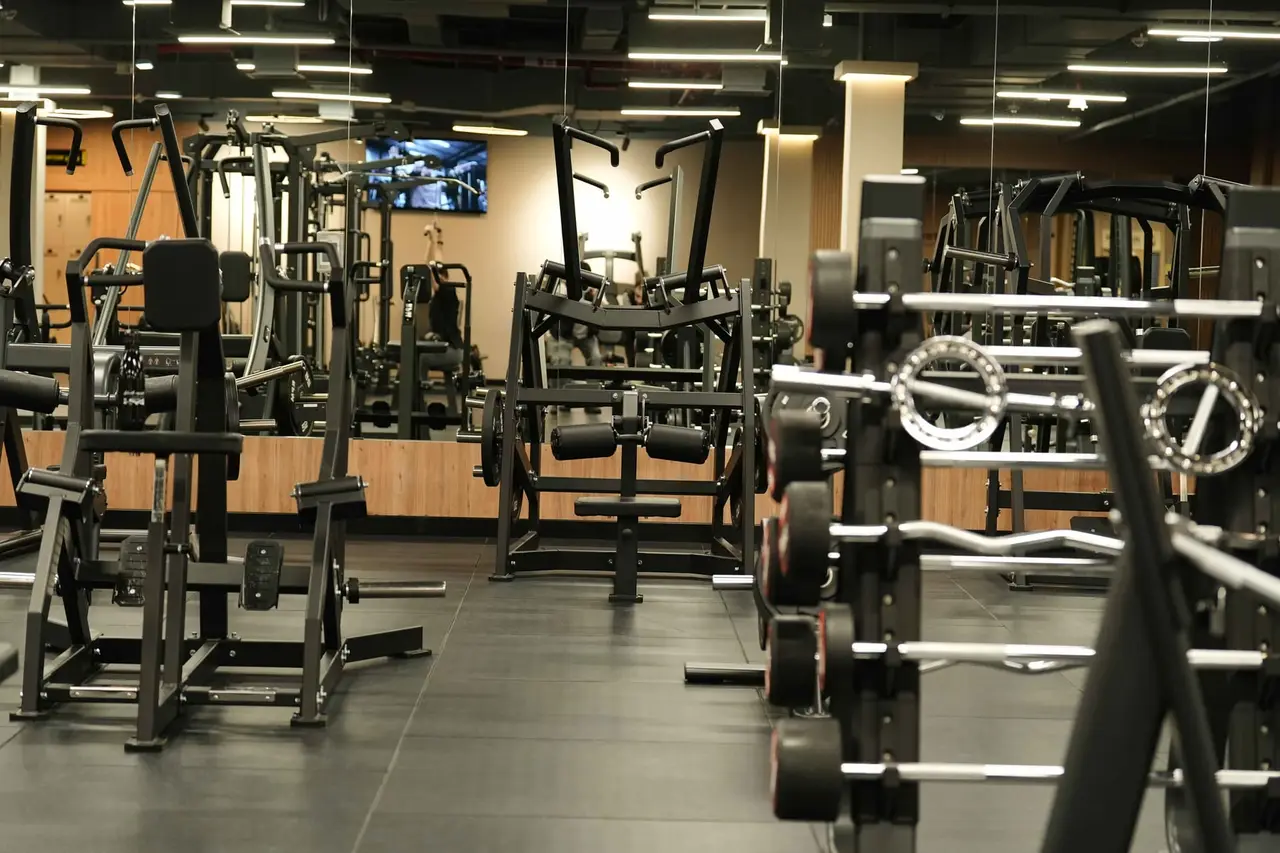
RPM's floor photos show a dumbbell rack, flat benches, a rack of fixed barbells that includes EZ bars and multi-station cable towers on the training floor in Al Manhal. A preacher bench, a preacher curl machine and an adjustable bench for spider curls are not in those photos, so ask what is on the floor during your free tour. If none is there, the concentration curl and the cable curl above do the same job. A personal training session can set up whichever version you use.
Questions, answered.
Preacher curl vs bicep curl: which is better?
Neither, overall. The standing bicep curl takes more weight and loads the middle of the rep; the preacher curl removes all swing and loads the bottom, where the biceps is stretched. Most programmes use one as the main curl and the other as a second exercise, or swap them between training blocks.
Which head of the biceps does the preacher curl target?
It trains both heads. With the upper arm in front of the body many lifters feel the short, inner head more, but no curl isolates one head, and the difference is small next to training through a full range and adding load over time.
Preacher curl vs hammer curl?
They do different jobs. The preacher curl is a palms-up curl with the arm braced; the hammer curl keeps the palms facing each other and shifts more work to the brachialis and forearm. The hammer curl vs bicep curl comparison shows how to combine a neutral-grip and a palms-up curl in one week.
Preacher curl vs incline dumbbell curl?
Opposite arm positions. The preacher curl puts the upper arm in front of the body; the incline curl, lying back on an incline bench, puts it behind, which stretches the long head of the biceps more. Both are strict curls, and many lifters use one of each across a training block.
EZ bar or straight bar on the preacher bench?
The EZ bar, for most people. Its bends let the wrists turn in slightly, which many find easier on the wrists and elbows in the stretched bottom position. A straight bar works if your wrists are comfortable with it.
Is the preacher curl necessary?
No. It is a good way to make curls strict and to load the stretched part of the rep, but strict dumbbell, bar and cable curls build the biceps without it. If your gym has no preacher bench, you are not missing anything you cannot replace.