Why the overhead position matters
All three heads of the triceps straighten the elbow, but only the long head starts on the shoulder blade. Raise your arm overhead and that head is pulled long before the elbow even bends, so an overhead extension loads it in a stretched position that a pushdown, done with the arms by your sides, never reaches. The lateral and medial heads still work hard; the long head simply takes a larger share than usual.
That difference seems to matter for growth. In a 12-week study, 21 adults trained one arm with cable extensions overhead and the other with the arm at the side. The overhead arm's triceps grew more, most clearly in the long head, even though it lifted lighter weights throughout. It is one study, so the sensible reading is to include overhead work, not to drop pushdowns. The triceps guide shows how both fit into a week.
The exercise suits anyone who can raise their arms fully overhead without discomfort, and it usually comes after the heavy presses of a push or upper-body day, either before or after a pushdown.
Setting up with one dumbbell
- Pick one dumbbell you could lift about fifteen times. The stretched bottom position is the hardest part of this exercise, so it feels heavier than a pushdown: start lighter than you expect.
- Sit on the end of a flat bench with your feet planted wide, or stand with your feet hip width and your knees soft; the choice is covered below.
- Stand the dumbbell on end on your thigh and cup the top plate with both palms flat against its underside, thumbs wrapped around the handle. Once it is overhead it will hang vertically from your hands.
- Lift it to one shoulder, then press it straight up until your arms are extended above your head, upper arms close to your ears.
- Before the first rep, breathe in, tighten your stomach and pull your ribs down so your lower back does not arch. This is the position you return to at the top of every rep.
Doing the rep
- Keep your upper arms pointing at the ceiling and bend only at the elbows, lowering the dumbbell behind your head.
- Let it travel down towards the top of your upper back until your forearms pass below level and you feel a strong stretch along the back of the arm. Stop short of any point that pinches the shoulder.
- Pause there for a moment without bouncing. The stretch is the part of the rep this exercise exists for.
- Straighten your elbows to bring the dumbbell back overhead, finishing with your arms fully extended.
- Throughout, your elbows point forward and up rather than out to the sides. A little flare is normal; a lot means the weight is too heavy.
Take two to three seconds to lower and about one to raise, and breathe out as you press back up. If your ribs flare and your lower back arches as the weight goes behind your head, lighten it and sit down: the arch means your trunk has lost its brace, and the rep has become a lean back instead of an elbow extension.
Mistakes that cost you the stretch
| Mistake | What it looks like | The fix |
|---|---|---|
| Arching the lower back | The ribs flare and the hips push forward as the dumbbell goes behind the head | Brace before each rep, sit on a bench and take some weight off |
| Elbows flaring wide | The elbows point out to the sides and the movement starts to look like a press | Keep them pointing forward and up, close to your head, and lighten the load |
| Upper arms drifting | The elbows swing forward and down on the way up, so the shoulders help | Fix the upper arm beside your head and move only the forearm |
| Cutting the bottom short | The forearms stop at level and never reach the stretch | Lower until the back of the arm lengthens, with a weight that lets you |
| Bouncing out of the stretch | The dumbbell drops into the bottom and rebounds | Lower over two to three seconds and pause before pressing |
| Pushing the head forward | The chin juts out to make room for the dumbbell | Keep the head still and let the weight travel behind it |
Dumbbell, cable rope and EZ-bar versions
Every version keeps the upper arm overhead; what changes is how the load is held and where the resistance comes from. Pick the one that feels comfortable on your shoulders and elbows, and rotate in a second one across training blocks if you want variety.
Two-hand dumbbell extension
The version set out above: one heavier dumbbell shared by both hands, which makes it the easiest to load. Its weak point is the grip. If the dumbbell feels insecure behind your head, move to the cable or the EZ bar rather than going heavier.
Single-arm overhead extension
One lighter dumbbell in one hand, palm facing in, lowered behind your head towards the opposite shoulder. Working one side at a time shows up a weaker arm and lets you angle the elbow to suit your shoulder. Steady the working elbow with your other hand if it wanders, and do the weaker arm first.
Cable overhead extension with a rope, facing away
Clip a rope to a low or mid-height pulley, take the ends behind your head and turn your back to the stack. Step forward into a split stance, lean slightly forward so the cable runs up along your upper arms, and straighten your elbows forward and up. The cable keeps tension in the stretched position, and the stack moves in smaller steps than the dumbbell rack.
Seated or standing?
Seated on a flat bench is the stricter choice: your hips are fixed, so it is harder to arch, and you can handle a little more weight. A bench with an upright back pad supports you further, where a gym has an adjustable bench. Standing makes your trunk work harder and is the natural position for the cable version. Neither is better for the triceps; use the one that lets you keep your ribs down.
EZ-bar overhead extension (French press)
An EZ bar held overhead with a close grip on the inner bends, lowered behind the head and pressed back up. It takes a good load and is easy to hold, but it fixes both hands together, so the elbows have less freedom than with a rope. Some gyms call this the French press; others use that name for the lying version, the skull crusher.
If the cable towers and the dumbbell rack are both busy, a skull crusher on a flat bench also works the long head with the arm angled back, and the tricep kickback needs only one light dumbbell.
Sets, reps and progression
| Goal | Sets × reps | How hard |
|---|---|---|
| Learning the movement | 2 × 12–15 | Stop with three reps left; full stretch on every rep |
| Building the triceps | 3 × 8–12 | End each set one or two reps short of failure |
| After pushdowns or presses | 2–3 × 12–15 | Last set close to failure, without the back arching |
Rest about a minute to ninety seconds between sets; the rest-between-sets calculator suggests a range for your goal.
One overhead exercise in each triceps session, twice a week, alongside a pushdown and your pressing, covers the muscle well. Add reps before weight. The step from one dumbbell to the next is large for this movement, so when you stall, slow the lowering to three seconds or add a one-second pause in the stretch, or move to the cable, where the stack rises in smaller steps.
Overhead extensions at RPM
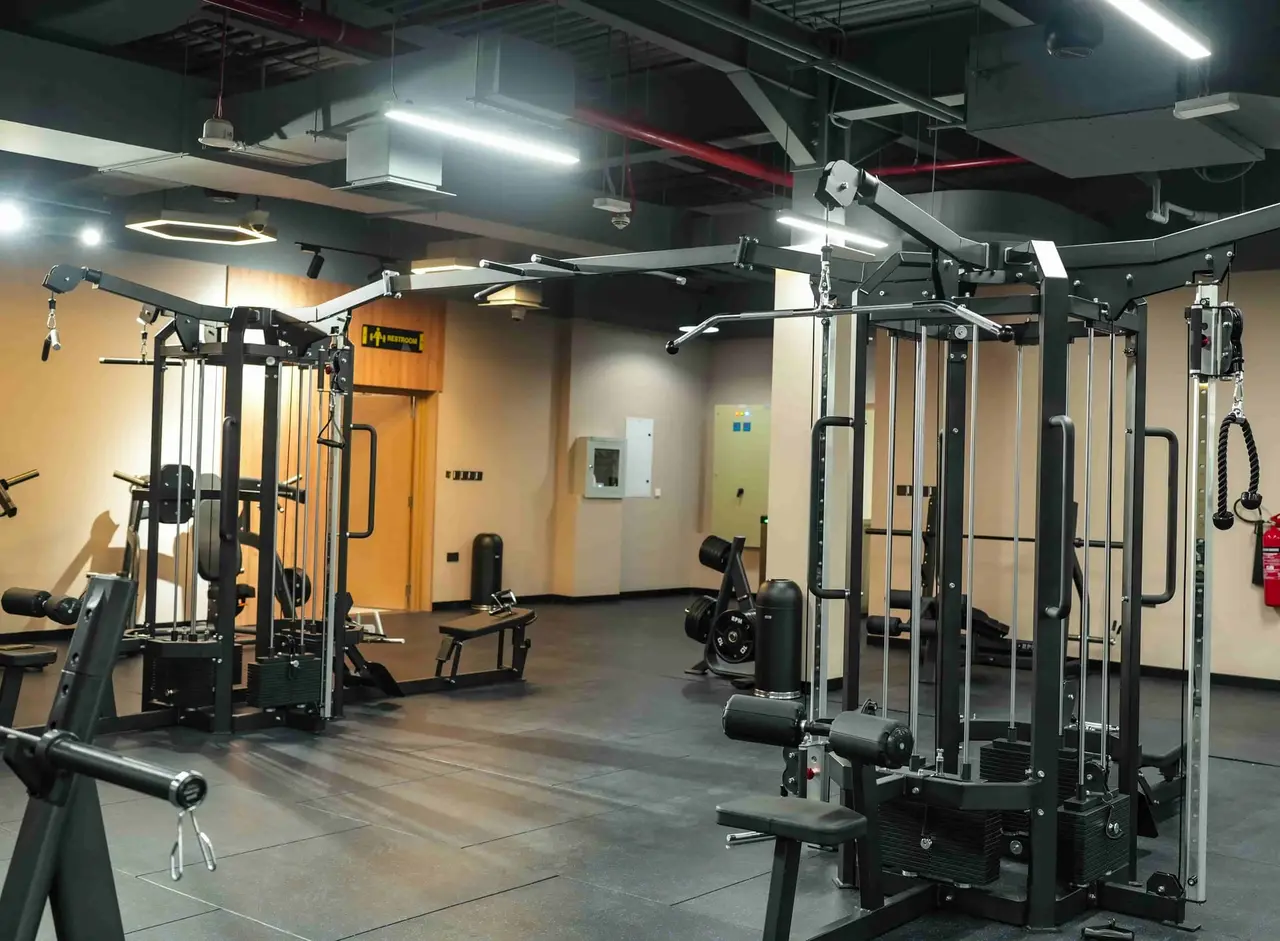
RPM's floor photos show a dumbbell rack, flat benches, a rack of fixed barbells that includes EZ bars and multi-station cable towers on the training floor in Al Manhal, so the dumbbell, EZ-bar and cable versions can all be done there. The photos do not confirm an adjustable bench with an upright back, a seated triceps-extension machine, a rope or which pulleys adjust to mid-height, so ask about those on your free tour. A personal training session is a quick way to have your elbow and rib position checked.
Sources
Questions, answered.
Overhead tricep extension vs tricep pushdown: which is better?
Use both. The pushdown, with your arms at your sides, is the easier one to learn and to load heavily; the overhead extension trains the long head in the stretched position that the study above links to more growth. One of each covers the muscle, and the tricep pushdown page covers the other half.
Overhead extension or skull crusher?
Both put the long head under stretch, the overhead extension more so because the arm is fully raised. The skull crusher is done lying on a bench with an EZ bar and usually takes more weight. Many lifters alternate them between training blocks, and those whose shoulders dislike the full overhead position often get on better with the skull crusher.
What muscles does the overhead tricep extension work?
All three heads of the triceps, with the long head working harder than in most other triceps exercises. Your shoulders hold the arms in place and your stomach muscles brace to stop your back arching.
Is there an overhead tricep extension machine?
Some gyms have a seated triceps-extension machine with the arms raised in front of you, and the cable station does the same job with a rope. Either is handy for training close to failure; neither does anything a well-controlled dumbbell or rope extension cannot.
Can I do overhead tricep extensions at home?
Yes, with one dumbbell or a resistance band. Stand on one end of the band, hold the other behind your head with both hands and straighten your arms overhead. A band gets harder as it stretches, so the top of the rep is the hardest part, the opposite of the dumbbell version.
What if my elbow or shoulder hurts during it?
Stop the exercise rather than hunting for a grip you can push through, and get it checked by a doctor or physiotherapist. Once you are cleared to train, a lighter single-arm version or a cable rope often feels more comfortable than a heavy two-hand dumbbell, but that decision comes after the check.