What the kickback trains, and why the weights are small
The kickback is an elbow extension done with the upper arm drawn back beside the body. All three heads of the triceps straighten the arm, and with the shoulder pulled back the long head works in a shortened position, the opposite of an overhead extension. That makes it an exercise for a hard squeeze at the end of a session rather than for a stretch.
It also explains why the dumbbells are light. Gravity pulls straight down, so while your forearm hangs vertically at the start there is almost nothing to lift; the load rises as the arm straightens and peaks at the very end, when the triceps is at its shortest and weakest. A cable from a low pulley pulls along the line of the forearm instead and keeps tension through more of the rep. Either way, the kickback belongs after presses and pushdowns, not in place of them.
It suits beginners, home training, since one dumbbell is enough, and anyone who wants a light triceps exercise to finish a push or arm session. The triceps guide shows where it sits next to the heavier work.
Setting up on a bench
- Take one light dumbbell; many people start with the weight they use for lateral raises. You can go up later, but begin lower than seems necessary.
- Place your left knee and left hand on a flat bench, hand under the shoulder, with your right foot on the floor a little out to the side. Your back is flat and close to parallel with the floor, the same base as a one-arm dumbbell row.
- Hold the dumbbell in your right hand with the palm facing in.
- Lift your upper arm until it sits alongside your torso, parallel to the floor, with the elbow bent at a right angle and the forearm hanging straight down. That is the start position, and the upper arm stays there for the whole set.
- Keep your shoulders square to the floor; do not let the working side open up towards the ceiling.
How to do a kickback
- Straighten your elbow so the dumbbell travels back and up in an arc until your whole arm is straight and in line with your torso.
- Hold the straight-arm position for a full second and tighten the back of the arm hard. With a dumbbell, this is the only part of the rep under real load.
- Lower the forearm back to vertical over about two seconds without letting the elbow drop.
- Keep the wrist straight; the dumbbell moves only because the elbow opens and closes.
- Finish all the reps on one side, then swap knee, hand and dumbbell and repeat.
Picture your upper arm resting on a shelf, with only the forearm swinging below it. If you need to rock the shoulder to get the dumbbell moving, or the elbow sinks towards the floor as the set goes on, take a lighter dumbbell. Breathe out as you straighten the arm.
Kickback mistakes to fix first
| Mistake | What it looks like | The fix |
|---|---|---|
| Upper arm dropping | As the set goes on, the elbow sinks towards the floor and the range shrinks | Keep the upper arm parallel to the floor and use a lighter dumbbell |
| Swinging the weight | The shoulder rocks forward and back to throw the dumbbell up | Slow down, pause at the top and drop the weight until the shoulder stays still |
| Never reaching a straight arm | The elbow stops short of full extension | Finish every rep with the arm straight; the end is the point of the exercise |
| Torso turning | The working shoulder opens towards the ceiling | Square the hips and shoulders to the floor, using the bench for support |
| Rounded back when bent over | The lower back rounds as you lean forward without a bench | Hinge from the hips with a flat back, or go back to the bench-supported version |
Cable or dumbbell, bench or bent over, and the palm
The versions below change where the load bites, how you are supported and how you hold the handle. What the elbow does is the same in all of them.
Cable kickback vs dumbbell kickback
Set a pulley at its lowest position, hold a single handle or the cable end itself, step back and hinge forward with your upper arm alongside your torso. Because the cable pulls from in front and below, there is tension from the first moment of the rep rather than only at the end, and the stack moves in smaller steps than the dumbbell rack. The dumbbell version needs no station and suits a quick finisher. Many lifters find the cable smoother; both train the same muscle.
Bent-over or bench-supported?
Bench-supported, one arm at a time, is the easiest to do well: the bench holds your torso, so your attention goes to the arm. The bent-over version, standing with a hip hinge and a dumbbell in each hand, works both arms at once and saves time, but your lower back has to hold the hinge for the whole set and the upper arms tend to drop as you tire. Learn it on the bench first.
Which way should the palm face?
Palm facing in, towards your body, is the standard grip and the most comfortable for most wrists. Some lifters turn the palm to face behind them as the arm straightens and feel a stronger squeeze; others keep it facing up. None of these singles out a different head, so use whichever keeps your wrist straight and your elbow comfortable.
If the dumbbells are all in use, the tricep pushdown trains the same muscle with the arms at your sides, and the overhead tricep extension covers the stretched position the kickback misses.
Sets, reps and where it goes
| Goal | Sets × reps | How hard |
|---|---|---|
| Learning the movement | 2 × 12–15 each arm | Stop with three reps left; a full second at the top |
| Building the triceps | 2–3 × 12–20 each arm | One or two reps short of failure |
| Finisher after presses and pushdowns | 1–2 × 15–20 each arm | Last set close to failure, with no swing |
Rest about a minute between sets, or let one arm rest while the other works.
Higher reps suit the kickback, because a heavier dumbbell almost always brings the swing back. Once or twice a week at the end of a push or arm session is plenty. When every set reaches the top of the range with a clean pause, move up one dumbbell. If that jump costs you the pause, switch to the cable, where the stack rises in smaller steps, or slow the lowering to three seconds before you add weight.
Kickbacks at RPM
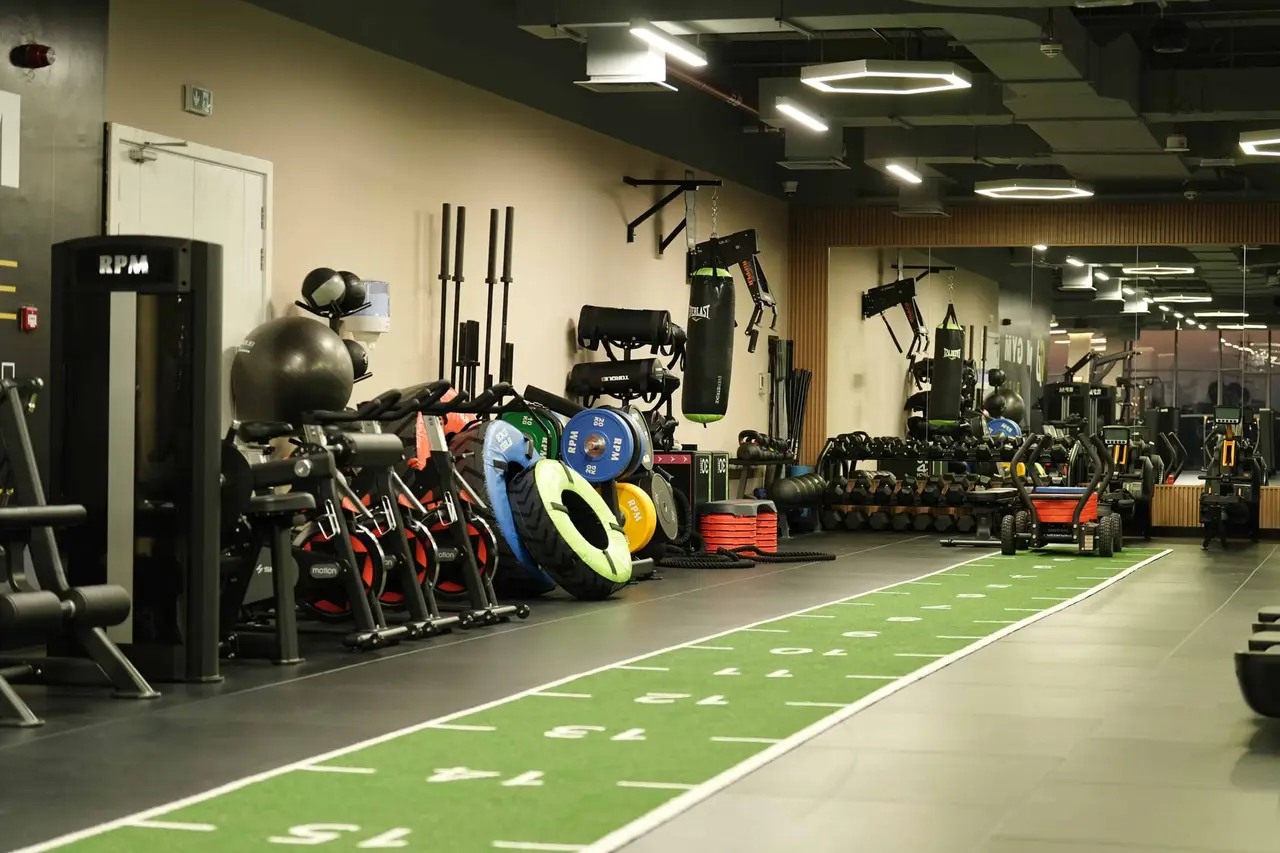
RPM's floor photos show a dumbbell rack, flat benches and multi-station cable towers on the training floor in Al Manhal, so the dumbbell, bench-supported and cable versions can all be done there. Which handles are on the cable stations is worth asking about on your free tour. If you would like someone to watch the position of your upper arm, book a personal training session, or ask for a female personal trainer.
Questions, answered.
What muscle does the tricep kickback work?
The triceps, the muscle on the back of the upper arm, with all three heads working to straighten the elbow. The rear shoulder and upper back hold the upper arm in place.
Is the tricep kickback a good exercise?
It is a useful finisher, not a main builder. The dumbbell version loads the triceps only near the end of the rep, so it cannot take much weight. Use it after pressing and pushdowns, or on the cable for steadier tension.
Tricep kickback vs pushdown or overhead extension: which should I do?
If you only have room for one triceps isolation exercise, the pushdown or the overhead extension does more, because both load the muscle through a longer part of the rep. The kickback is the third choice: light, simple and good for a final squeeze.
Is a kickback the same position as a dumbbell row?
The set-up is almost identical, a knee and hand on a bench with a flat back, but the movement is the opposite. In a dumbbell row you bend the elbow to pull the weight up towards your hip; in a kickback the upper arm is already back and you straighten the elbow.
Can I do kickbacks with a resistance band?
Yes. Stand on one end, or anchor it low in front of you, hinge forward and straighten your arm behind you. The band gets harder as it stretches, so like the dumbbell it is hardest with the arm straight.
What if kickbacks hurt my elbow?
Stop the exercise and get it checked by a doctor or physiotherapist rather than changing grips and carrying on. Elbow pain during triceps work is a reason to pause, not to push through.