What the seated row works, and where it fits
On this row the load comes at you from the front rather than from overhead, so most of the work happens around your shoulder blades: the middle trapezius and the rhomboids squeeze the blades together, and the lats join in as your elbows travel past your ribs. The biceps bend the elbow, and the rear shoulders help you finish the pull.
Seated with your feet braced, you have no hinge to hold, so the lower back does far less than in a barbell row. That makes it one of the first rows most people learn, and a sensible pick if your lower back tires before your upper back. The cable also keeps the muscles loaded at the stretched end of each rep, not only the squeezed end. In most back sessions it is the horizontal pull, paired with a vertical pull such as the lat pulldown.
Setting up the low row
- On a dedicated low-row seat the pulley is fixed by the foot plate; on an adjustable column, slide it to the lowest notch and sit facing it on a bench or the floor.
- Clip on a V-handle, which holds your palms facing each other, close together. It is the usual starting point; other handles are covered below.
- Put your feet on the platform with your knees softly bent. Locked knees tug your pelvis under you, and knees pulled up to your chest get in the way of the handle.
- Reach forward from the hips with a long, flat back to take the handle, then sit up tall until the plates lift off the rest of the stack and your arms are straight.
- Settle the torso: upright or leaning back only slightly, with your ribs stacked over your hips. This is the angle you will hold for every rep of the set.
- Choose a pin you can row to your stomach twelve times with no backward rock. Stacks differ between stations, so use the first set as a test.
Rowing one rep, start to finish
- Begin with long arms and your shoulders drawn slightly forward by the cable, so the upper back starts stretched. Your torso does not fold forward with them.
- Start the pull by drawing your shoulder blades back, then bring your elbows past your sides, close to your body if you are using the V-handle.
- Finish with the handle touching, or nearly touching, the top of your stomach, chest tall and shoulders low and away from your ears.
- Hold that squeeze for a one-count.
- Return the handle over two to three seconds until your arms are straight and your shoulder blades have spread, without letting the plates touch down.
Tempo matters more on this row than on most. The cable wants to drag you forward on the way back, and that is where people fold at the waist. Try one second to pull, a one-count hold and a slow three-second return. Exhale through the pull and inhale as the handle goes forward; the bracing guide shows how to keep your middle firm while you breathe.
Five faults that cost you the back work
| Mistake | What it looks like | The fix |
|---|---|---|
| Rocking the torso | You lean back to finish each rep and fold forward to start the next | Drop a plate and hold one torso angle; if your shoulders end up behind your hips, the pin is too heavy |
| Rounding to reach | The lower back curls forward at the stretch for extra reach | Let the shoulder blades travel forward instead, and keep your spine in the shape you sat down with |
| Shrugging the handle in | The shoulders creep up towards the ears as you pull | Set your shoulders low before the first rep and finish each pull with the chest up, not the shoulders |
| Pushing with the legs | The knees straighten to start the pull and you slide back on the seat | Keep a soft, fixed bend in the knees; the legs only brace |
| Flaring the elbows on a close handle | With a V-handle, the elbows drift out and the handle rises towards the chest | Keep the elbows tucked and aim the handle at your stomach; save wide elbows for the wide bar |
Handles, machines and one-arm rows
The handle changes which part of the back you feel most and how far your elbows travel; every version is still a horizontal pull for the upper back and lats.
Seated row machine (plate-loaded or pin-loaded)
Many gyms also have a row machine with a chest pad, loaded with plates or with a pin in a stack. The pad holds your torso for you, which suits heavy sets or the end of a session when your trunk is tired. The cable makes you hold that position yourself, a skill that carries over to free-weight rows.
V-handle, wide bar or rope?
The V-handle keeps the palms facing and close, lets the elbows travel well past the body, and is the version most people feel in the lats. A wide overhand bar flares the elbows, shortens the pull and shifts the work towards the upper back and rear shoulders; pull it to the lower chest. A rope lets the hands split apart at the finish, which suits lighter sets built around the squeeze.
Single-arm cable row
Row one side at a time with a D-handle. Your trunk now has to stop the cable twisting you towards the stack, and the shoulder can reach a little further at the stretch. It helps when one side lags, and works standing or half-kneeling at a mid-height pulley too.
If the cable station is taken, a one-arm dumbbell row on a bench trains the same muscles with similar torso support, and the barbell bent-over row is the step up once your hip hinge is solid.
Sets, reps and progressing the row
| Goal | Sets × reps | How hard |
|---|---|---|
| Getting the position right | 2–3 × 12 | Stop with three clean reps still in hand |
| Building the back | 3–4 × 10–15 | End one or two reps before your torso starts to rock |
| Upper-back strength | 3–5 × 6–8 | Heavier, but every rep still ends with a one-count hold |
Take around ninety seconds between moderate sets and up to two minutes between heavy ones. The rest-between-sets calculator suggests a starting point for your goal.
When every set reaches the top of the rep range with a still torso, move the pin down one plate. If that jump is too big on a particular stack, add a rep per set or slow the return first. Two rows a week, each beside a vertical pull, suit most programmes; the training volume calculator helps you total your weekly back sets.
The seated cable row at RPM
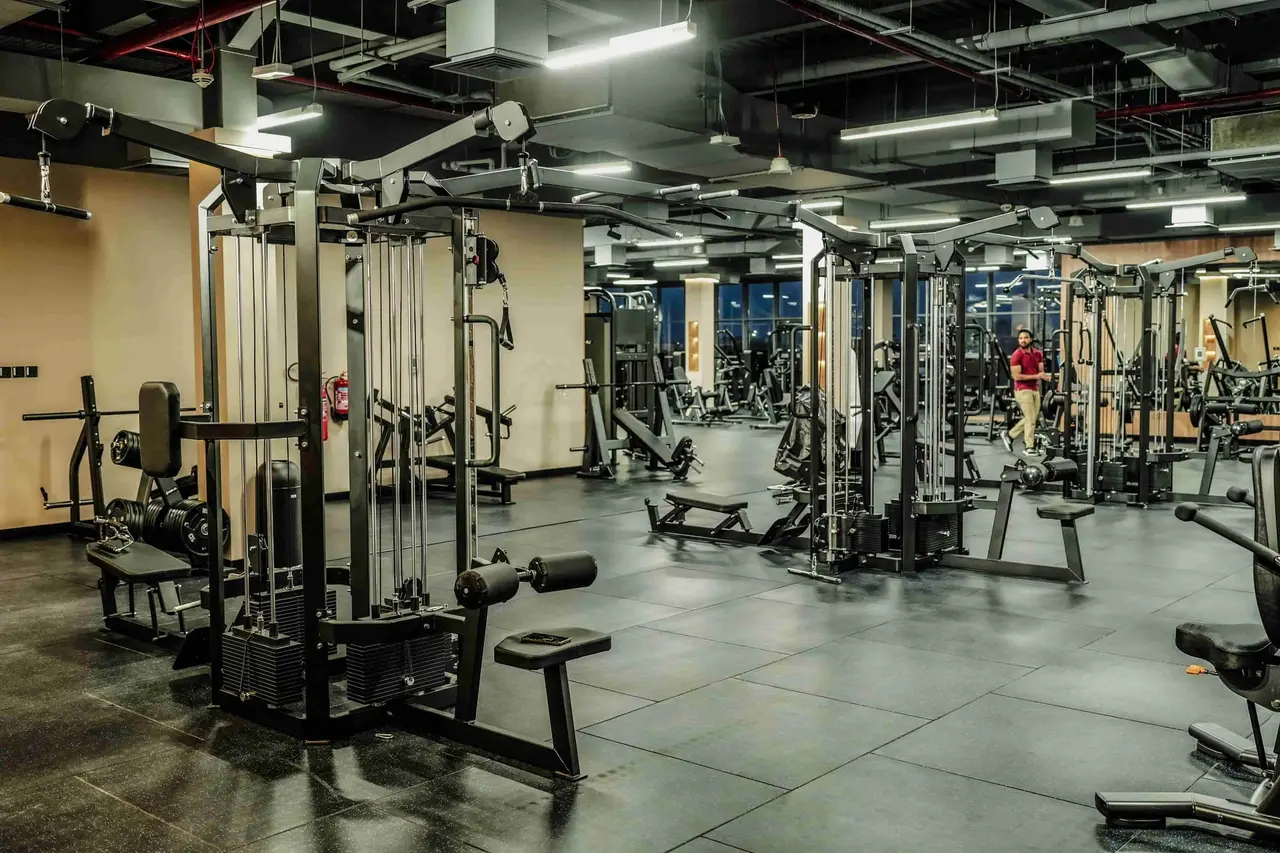
RPM's floor photos show multi-station cable towers on the training floor in Al Manhal, with single handles and a rope clipped to the stations and benches set around them. Which station is set up for low rows that day, and which handles are on the rack, is easiest to see on a free guided tour. To have a coach set your torso angle and starting pin, book a personal training session.
Questions, answered.
What muscles does the seated cable row work?
Mainly the upper back, meaning the muscles between your shoulder blades, and the lats. The biceps and rear shoulders assist, and your trunk works to hold you upright.
What is a good alternative to the seated cable row?
With dumbbells, the one-arm dumbbell row on a bench is the closest match. With a barbell, the bent-over row trains the same muscles but adds a hip hinge. With no machine at all, a resistance band looped around your feet or a low post gives you a similar seated pull.
Seated cable row or lat pulldown: which should I do?
Both, if you can. The row pulls horizontally and leans on the upper back; the pulldown pulls from overhead and leans on the lats. The back training guide shows how to pair them across a week.
Should I lean back on the seated cable row?
A slight lean is fine; a swing is not. Hold one angle close to upright for the whole set. If you need to lean further back to finish each rep, the weight is too heavy.