What the sumo deadlift trains, and who it suits
The sumo deadlift is the same lift as the deadlift, from the floor to standing, with a different geometry. The wide stance lets your hips sit closer to the bar, so your torso stays more upright and the bar has a shorter distance to travel. The glutes drive the hips forward to finish, the quads straighten the knees, and the inner-thigh muscles, the adductors, help pull the hips through from the wide position. The hamstrings, back, lats and grip still work hard; the back simply works at a less forward-leaning angle.
It suits lifters whose hips are comfortable in a wide, turned-out position and who find the conventional start cramped, or who want a pull that hands more of the work to the quads and inner thighs. It is not an easier way to deadlift: the start off the floor is slow and demanding, and getting into position takes practice. Put it first in a session, as the main lift of the day. The glute exercise guide shows how it fits alongside thrusts, squats and other hinges, and sumo vs conventional deadlift helps you choose between the two styles.
Some muscle tiredness in the hips, inner thighs and back the next day is normal. Pain in the groin or the front of the hip, sharp pain in the back, or pain that spreads into a leg is not: stop and get it checked by a doctor or physiotherapist before you pull again.
Setting your stance and grip
- Load the bar with full-size plates so it sits at the standard height. Walk up until your shins almost touch it, with the bar over the middle of your feet.
- Take a wide stance. A good starting point is wide enough that your shins are close to vertical when you are down at the bar, and narrow enough that your knees can still point over your toes. For many people that lands somewhere between one and a half and two times shoulder width.
- Turn your toes out until your knees can follow them comfortably; the angle is usually wider than in a squat.
- Get down to the bar by pushing your knees out and lowering your hips, then grip it between your legs, hands about shoulder width or a little narrower, arms hanging straight.
- Choose a starting weight you can pull for five identical reps. Expect it to be lighter than your conventional deadlift while the position is new.
How to pull a rep
- Set your back: chest up, lats tight, arms long. Take a big breath into your belly and brace.
- Wedge into the bar: pull up on it just enough to take out the slack, which draws your hips down and in towards it. You should feel tight from your hands to your feet before the plates move.
- Push your feet out sideways into the floor, as if spreading it apart, and keep your knees driving out over your toes as you stand.
- Keep the bar touching your legs and your chest up as it rises; hips and chest move together.
- Finish by squeezing your glutes and bringing your hips through to the bar until you stand tall. Do not lean back.
- Lower under control, hips back and knees out, letting the bar slide down your legs, and set it down before the next rep.
Be patient off the floor. A sumo pull often breaks slowly, and yanking the bar to speed it up usually throws the hips up or drops the chest. Build tension, then push. For the breath and brace itself, see breathing and bracing when lifting.
Mistakes to fix first
| Mistake | What it looks like | The fix |
|---|---|---|
| Stance too wide | You cannot get your hips close to the bar, and the knees cave as it leaves the floor | Bring the feet in until your knees can track over your toes |
| Knees caving in | The knees drift inwards as you push | Turn the toes out a little more and think about spreading the floor |
| Hips shooting up | The legs straighten first and the lift turns into a stiff-legged pull | Wedge harder before the bar moves and let the chest rise with the hips |
| Squatting the bar up | The hips start so low that the shoulders sit behind the bar | Set the hips just high enough that your shoulders are over or slightly ahead of the bar |
| Bar drifting forward | The bar swings away from the shins and the back rounds | Start with the shins close to the bar and keep the lats tight |
| Leaning back to finish | The lower back arches at the top | Stand tall with the glutes squeezed and the ribs down |
Stance, implements and grip
Small changes make a large difference in sumo, so adjust one thing at a time and film a few reps from the front and the side. The sumo deadlift high pull, a conditioning drill that pulls a lighter bar to chin height, shares the stance but is a different exercise and is not covered here.
Stance width and toe angle
There is no single correct width, only a range that suits your hips. A very wide stance, with the feet close to the plates, shortens the bar path the most but asks the most of your hip mobility. A moderate stance, sometimes called semi-sumo, is easier to get into and still keeps the torso upright. Whatever the width, turn your toes out until your knees can sit over them at the bottom; if your knees are forced to cave, the stance is wider than your hips allow.
Kettlebell or dumbbell sumo deadlift
Stand over a kettlebell, or hold one dumbbell upright by one end, with your feet wide and toes out, then pull it up from between your feet and lower it back to the floor under your hips. It is the usual way to learn the sumo position before a barbell, and a good option at home or when every bar is taken. If the kettlebell is short, stand on two low plates to gain depth.
Grip choices
Grip the bar inside your knees, hands roughly under your shoulders. Start with double overhand, both palms facing you, and move to a mixed grip, one palm towards you and one away with the sides swapped between sets, or a hook grip once the weight outgrows your hands. Lifting straps are fine for lighter back-off sets and higher reps. A narrower grip shortens the pull a little further but makes it harder to keep the upper back tight, so most lifters settle at about shoulder width.
If every bar is in use, the kettlebell version, a trap bar deadlift where one is available, or a dumbbell Romanian deadlift keeps a hinge in your session. For a wide-stance leg exercise without the hinge, see the sumo squat.
Sets, reps and progression
| Goal | Sets × reps | How hard |
|---|---|---|
| Learning the position | 3 × 5 | Light; every rep starts from the same wedge |
| Building strength | 3–5 × 3–5 | One or two reps left; the bar still breaks smoothly |
| Building muscle | 3 × 6–8 | Two reps left, with a controlled lowering |
Rest two to three minutes between work sets. The deadlift 1RM calculator estimates your max from a set of reps, and the plate calculator works out what to load on each side.
Once a week is enough for most people, or twice if one of the sessions is light. Add the smallest plates you can, and repeat a weight when the start slows or your stance drifts between reps. If you also pull conventional, make one style the main lift and the other a lighter variation rather than training both heavy in the same week.
Sumo deadlifts at RPM
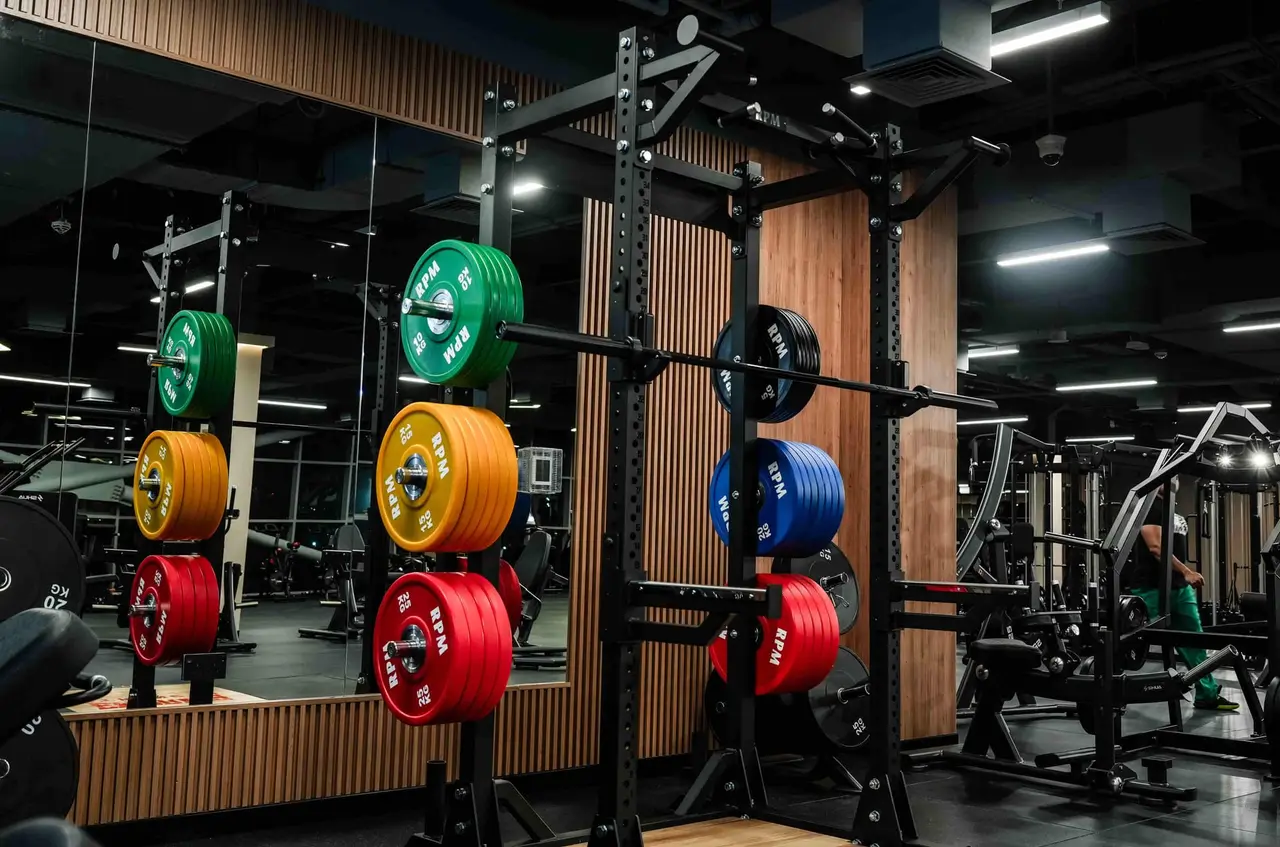
RPM's floor photos in Al Manhal show barbells and colour bumper plates for the barbell version, and kettlebells and a dumbbell rack for the lighter one. Whether there is a dedicated lifting platform is not confirmed, so ask on your free tour. A coach watching your stance from the front is the quickest fix for knee and hip position: book personal training for your first sessions.
Questions, answered.
What muscles does the sumo deadlift work?
The glutes, quads and inner thighs do much of the work, while the hamstrings, the muscles along the spine, the lats and the forearms hold and pull the bar. Compared with the conventional style, the quads and adductors contribute more and the lower back works at a more upright angle.
Is the sumo deadlift easier than a conventional deadlift?
Not easier, different. The bar travels a shorter distance and the torso is more upright, which suits some builds, but the start from the floor is slow and the position needs good hip mobility. Sumo vs conventional deadlift compares the two in detail.
Sumo deadlift or sumo squat?
The sumo deadlift is a hinge from the floor with a barbell; the sumo squat is a wide-stance squat, usually holding a dumbbell or kettlebell, with the torso upright throughout. The squat suits beginners and higher reps; the deadlift lets you load the hips far more heavily.
Sumo deadlift or Romanian deadlift?
They do different jobs. The sumo deadlift is a heavy pull from the floor for the glutes, quads and inner thighs; the Romanian deadlift starts standing and works the hamstrings and glutes in the stretch. Many programmes use both, on different days.
Is there a machine for sumo deadlifts?
No machine copies it. A Smith machine can hold the bar on a fixed path for a wide-stance pull, but most lifters use an ordinary barbell or, for lighter sets, a kettlebell.