What donkey kicks train, and who they suit
The donkey kick, also called the quadruped hip extension, is a kickback without a machine. On hands and knees, you lift one bent leg up and back from the hip, and the gluteus maximus does nearly all of the work at the top, where the hip is straight and the muscle is at its shortest. The trunk muscles have their own job: stopping the lower back arching and the pelvis twisting while one leg moves. With the knee bent, the hamstrings have little to add, which is why people feel this one so clearly in the glutes.
Bodyweight is a light load for a strong muscle, so donkey kicks work as a teaching drill, a warm-up and a finisher rather than as a way to build the glutes on their own. They suit beginners learning to feel their glutes, home workouts, and warm-ups before squats, hip thrusts and deadlifts. They are popular in women's glute programmes, but the muscle and the movement are the same for everyone. For the heavier lifts that do the main building, see the glute exercise guide.
Getting into position
- Kneel on a mat or some folded padding, hands flat under your shoulders and knees under your hips, about hip width apart.
- Set a flat back from your head to your tailbone, as if a glass of water were balanced on your lower back. Look at the floor just ahead of your hands.
- Brace lightly: draw your belly button gently towards your spine without holding your breath.
- Keep the working knee bent at about a right angle and flex the foot so the sole faces the ceiling as the leg rises.
- Start with bodyweight and 12 to 15 reps a side. If your wrists complain on flat hands, rest on your fists or forearms instead.
How to do a rep
- Shift your weight slightly towards the supporting knee so the working leg can move freely without your hips tipping.
- Drive the working foot up and back towards the ceiling, keeping the knee bend fixed.
- Stop when your thigh is level with your torso. Above that, the lower back arches and the glute stops doing the work.
- Squeeze the glute for a second at the top, with your hips level and both hip bones facing the floor.
- Lower the knee until it hovers just above the floor, then go again. Complete all your reps on one side before switching.
The cue is to move the leg, not the back. Picture the glass on your lower back: if it would spill at the top of the kick, you went too high. Breathe out as the foot rises and in as it comes back down.
Mistakes to fix first
| Mistake | What it looks like | The fix |
|---|---|---|
| Arching to kick higher | The lower back sags and the head lifts as the foot rises | Stop when the thigh is level with your back and keep the belly drawn in |
| Twisting the hips | The working hip rises and rotates outwards | Keep both hip bones pointing at the floor and kick a little lower |
| Swinging | Fast, bouncing reps driven by momentum | Pause at the top and take two seconds to lower |
| Straightening the knee | The leg opens out as it rises and becomes a different exercise | Hold the right angle at the knee throughout |
| Sinking into the shoulders | The upper back drops between the shoulder blades | Push the floor away so the upper back stays full |
| Craning the neck | You look forwards or up at a mirror | Keep your gaze on the floor just ahead of your hands |
Kneeling on a hard floor is uncomfortable, so pad your knees. If donkey kicks bring on pain in your lower back, hips, knees or wrists, stop and get it checked by a doctor or physiotherapist.
Variations: bands, ankle weights and the fire hydrant
Once fifteen slow reps a side feel easy, make each kick harder rather than doing more of them. These are the usual options, in rough order of how much load they add.
Banded donkey kick
Loop a resistance band around the sole of the working foot and pin both ends under your hands, or use a loop band just above both knees. A band pulls hardest at the top of the kick, exactly where the glute works most, which makes it a natural fit for this exercise. Choose a band that still lets you pause at the top.
Donkey kick with an ankle weight
A strap-on ankle weight, or a light dumbbell held in the crease behind the knee, adds load that stays the same through the whole rep. A dumbbell needs a firm knee bend to stay put, so start very light. When you outgrow ankle weights, the cable kickback is the next step.
Fire hydrant
Same starting position, different direction: keeping the knee bent, you lift the leg out to the side rather than back, like a dog at a hydrant. That moves the work to the side of the hip, the gluteus medius and minimus, and it is what many people mean by a side donkey kick. Donkey kicks and fire hydrants pair well in a warm-up but do not replace each other, and the hip abduction machine is the loaded version of the sideways movement.
A straight-leg version, pressing the heel back rather than up, brings in the hamstrings and lengthens the range. It overlaps with the standing cable kickback, which adds load you can raise in steps. Some lifters also kneel in front of a low cable with an ankle strap and do donkey kicks against it, the most loadable version of all.
Donkey kicks compared with similar moves
The donkey kick is often weighed against its neighbours. Each one answers a different question:
- Cable kickback: the same hip extension, standing against a cable. It takes more load and progresses in steps, so it is the natural next stage.
- Glute bridge: both legs at once from the floor, with room for much more load. It is the stronger base exercise; the donkey kick isolates one side.
- Bird dog: the same starting position, but you reach one arm forward and the opposite leg back and hold still. It is a trunk-control exercise, and the glute does little.
- Hip thrust and squats: the heavy lifts. Donkey kicks support them and do not replace them.
Sets, reps and progression
| Goal | Sets × reps | How hard |
|---|---|---|
| Warm-up | 1–2 × 10–12 each side | Easy and slow; feel the glute working |
| Learning the movement | 2–3 × 12–15 each side | Stop with three or four reps left and a pause at the top |
| Finisher with a band or weight | 2–3 × 12–20 each side | One or two reps left, hips still square |
Rest thirty to sixty seconds between sides and sets; working the second side gives the first its rest.
Progress in steps: a pause at the top, then a slower lowering, then a band or ankle weight, then the cable. Bodyweight work recovers quickly, so donkey kicks can sit in the warm-up on most training days, but count banded or weighted sets in your weekly glute total and pair them with at least one heavy glute lift.
Donkey kicks at RPM
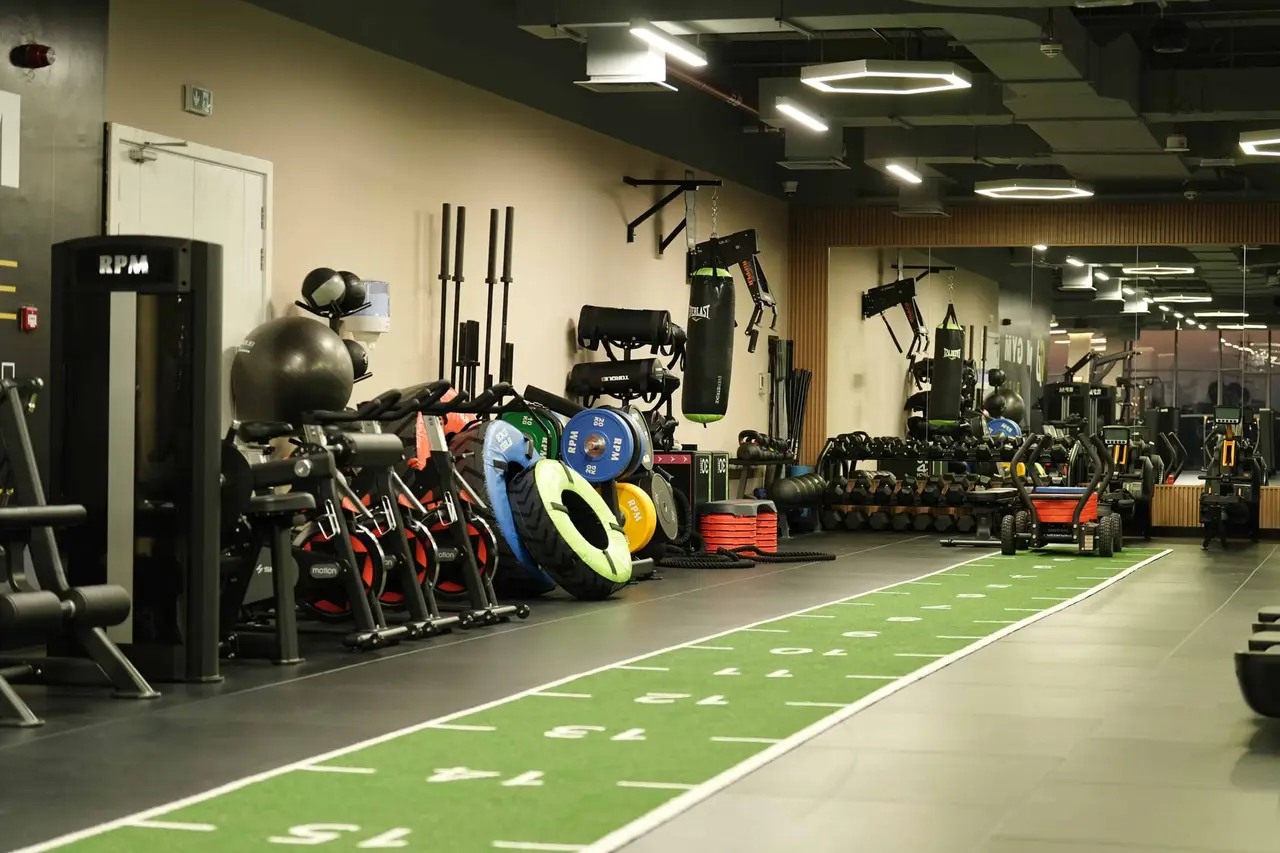
Donkey kicks need only a patch of floor, in either the Mixed or the Ladies section. Resistance bands and ankle weights are not in RPM's floor photos, so ask about them on your free tour. The photos do show multi-station cable towers in Al Manhal for the loaded version, and a personal training session can check that the work stays in your glutes.
Questions, answered.
What muscles do donkey kicks work?
Mainly the gluteus maximus of the working leg. The trunk muscles hold your back and pelvis still, and the hamstrings help only a little while the knee stays bent.
Do donkey kicks make your glutes bigger?
On their own, only a little once you are past the first weeks, because bodyweight is a light load for the glutes. They help most as a warm-up and finisher alongside heavier lifts such as the hip thrust, which give the muscle a reason to grow.
Donkey kicks or fire hydrants?
Both, if you have time: donkey kicks train the back of the hip and fire hydrants the side. If you only do one, choose the one that fills the gap in your plan; the glute guide shows which lifts cover what.
What is another name for donkey kicks?
Quadruped hip extension, bent-knee kickbacks or glute kickbacks on all fours. Done standing against a cable, the same movement becomes the cable kickback.
Can I do donkey kicks every day?
At bodyweight and as part of a warm-up, most people can. Banded or weighted sets taken close to failure need a day or two of recovery, like any other glute work.