What the glute bridge works, and where it fits
The bridge is hip extension done lying on the floor. Your hips start bent and resting on the ground, and the gluteus maximus straightens them by driving the pelvis up towards the ceiling. The hamstrings help, more so when the feet are further from your hips, and the deep trunk muscles stop the lower back arching to finish the job. Because your shoulders stay down, the hips travel a shorter distance than in a hip thrust, and the hardest moment is the top, when the glutes are fully squeezed.
That makes it one of the easiest glute exercises to start with: no equipment, nothing to balance and little to get wrong. Beginners can make it their main glute exercise for the first weeks; experienced lifters use it to warm up before squats and hinges, as a finisher, or loaded with a barbell when every bench is taken. It is also the usual answer to glute training at home. The glute exercise guide shows how it fits with the heavier lifts for the same muscle.
Setting up on the floor
- Lie on your back on a mat or a clear patch of floor, knees bent and feet flat, about hip width apart.
- Slide your heels towards your hips until your fingertips, with your arms by your sides, just brush them. That puts your shins close to upright at the top of the rep; adjust after the first few reps.
- Turn your toes out slightly if that feels more natural, and keep your knees pointing the same way as your toes.
- Rest your arms on the floor a little away from your body, palms down, to steady yourself.
- Start with bodyweight. If you can do fifteen slow reps with a pause at the top and feel them mostly in the glutes, you are ready to add load or move to one leg.
How to do a rep
- Breathe in, brace your trunk lightly and pull your ribs down towards your hips, so your lower back settles close to the floor.
- Tilt your pelvis back a fraction, as if flattening a belt buckle, then push through your heels and the middle of your feet to lift the hips.
- Rise until your knees, hips and shoulders form a straight line. Your weight rests across your upper back and shoulders, not your neck.
- Squeeze the glutes hard for one or two seconds at the top without pushing the hips any higher.
- Lower over about two seconds, touch the floor lightly with your glutes, and start the next rep without relaxing completely.
The cue that matters most is finishing with the hips, not the lower back. If you feel the effort in your back at the top, you have probably arched to gain height: lift a little lower, keep the ribs down and squeeze harder. Breathe out as you lift and in as you lower.
Mistakes to fix first
| Mistake | What it looks like | The fix |
|---|---|---|
| Arching to get higher | The ribs flare and the lower back takes over at the top | Stop at a straight line from knees to shoulders and keep the ribs pulled down |
| Feet too far away | The hamstrings cramp before the glutes tire | Walk the heels back towards your hips |
| Feet too close | The fronts of the thighs burn and the heels want to lift | Move the feet out until the shins are upright at the top |
| Pushing through the toes | The heels peel off the floor and the quads take over | Keep the whole foot down, with the pressure through the heels |
| Knees falling in or flopping out | The knees drift towards each other or splay wide | Keep the knees over the toes; a light band above the knees helps you feel the position |
| Rushing | Reps bounce off the floor with no pause | Hold the top and take two seconds to lower |
If the bridge brings on pain in your lower back or hips, stop and get it checked by a doctor or physiotherapist. If you are pregnant or have recently given birth, ask your doctor or midwife before doing it.
Variations: one leg, added load, frog pumps and bands
Each version below keeps the same hip extension and changes how hard it is or where you feel it. Choose the one that makes fifteen reps genuinely difficult.
Single-leg glute bridge
Lift one foot and draw that knee towards your chest, or straighten the leg in line with the other thigh, and bridge on the planted leg. It loads the working glute far more with no equipment at all, and it shows quickly if one side is weaker. Keep the pelvis level: if the raised side drops, end the set. Start with the weaker leg and match its reps on the other.
Weighted bridge: a dumbbell or a barbell on the hips
Hold a dumbbell or a plate across your hip crease with both hands, or roll a loaded barbell over your thighs as you would for a hip thrust, with a pad or a folded mat under it. The rep stays the same. Because the range is short, a bridge takes more load than most people expect, so add it in small steps and keep the pause at the top.
Frog pump
Press the soles of your feet together and let your knees fall out wide, heels close to your hips, then bridge in short, quick reps. The turned-out position lets many people feel the glutes more and the hamstrings less. It is usually done for high reps, twenty or more, as a warm-up or a finisher rather than with heavy load.
Banded glute bridge
A loop band just above the knees makes the side of the hip work to keep the knees apart while the glutes lift. It is a handy teaching aid if your knees drift inwards and a common warm-up. A band adds little load, so it sits alongside a weighted bridge rather than replacing one.
Holds and marches change the timing: hold the top position for twenty to thirty seconds, or lift one foot and then the other a few centimetres without the hips dropping. If you would rather train the same muscle standing up, a cable kickback or a Romanian deadlift does it; on hands and knees, the donkey kick is the floor alternative.
Bridge, hip thrust or something else?
The bridge and the hip thrust are one movement at two heights. Shoulders on the floor means a shorter range and a set-up that takes seconds; upper back on a bench means the hips travel further and you can load far more. Start with the bridge and move to the thrust once a loaded bridge no longer challenges you. The full side-by-side is on hip thrust vs glute bridge.
Three other names get mixed up with it. A hamstring bridge places the heels further away, or up on a bench, so the back of the thigh does more of the work. A pelvic tilt is a much smaller movement: you only rock the pelvis to press the lower back into the floor, without lifting the hips. And the glute bridge machine people search for is usually a hip thrust machine, which loads the same movement through a pad across the hips.
Sets, reps and progression
| Goal | Sets × reps | How hard |
|---|---|---|
| Learning the movement | 2–3 × 12–15 | Stop with three or four reps left and a clear squeeze at the top |
| Building muscle | 3–4 × 10–15, weighted or single-leg | Finish each set with one or two reps left |
| Warm-up before squats or hinges | 1–2 × 10–15 | Easy; the aim is to feel the glutes switch on |
Rest about a minute between bridge sets, a little longer when they are heavy. The rest-between-sets calculator suggests a rest for your goal.
Progress in this order: more reps at bodyweight, then a pause at the top, then one leg or added load, and finally the hip thrust. Count hard, loaded sets towards your weekly glute total.
Glute bridges at RPM
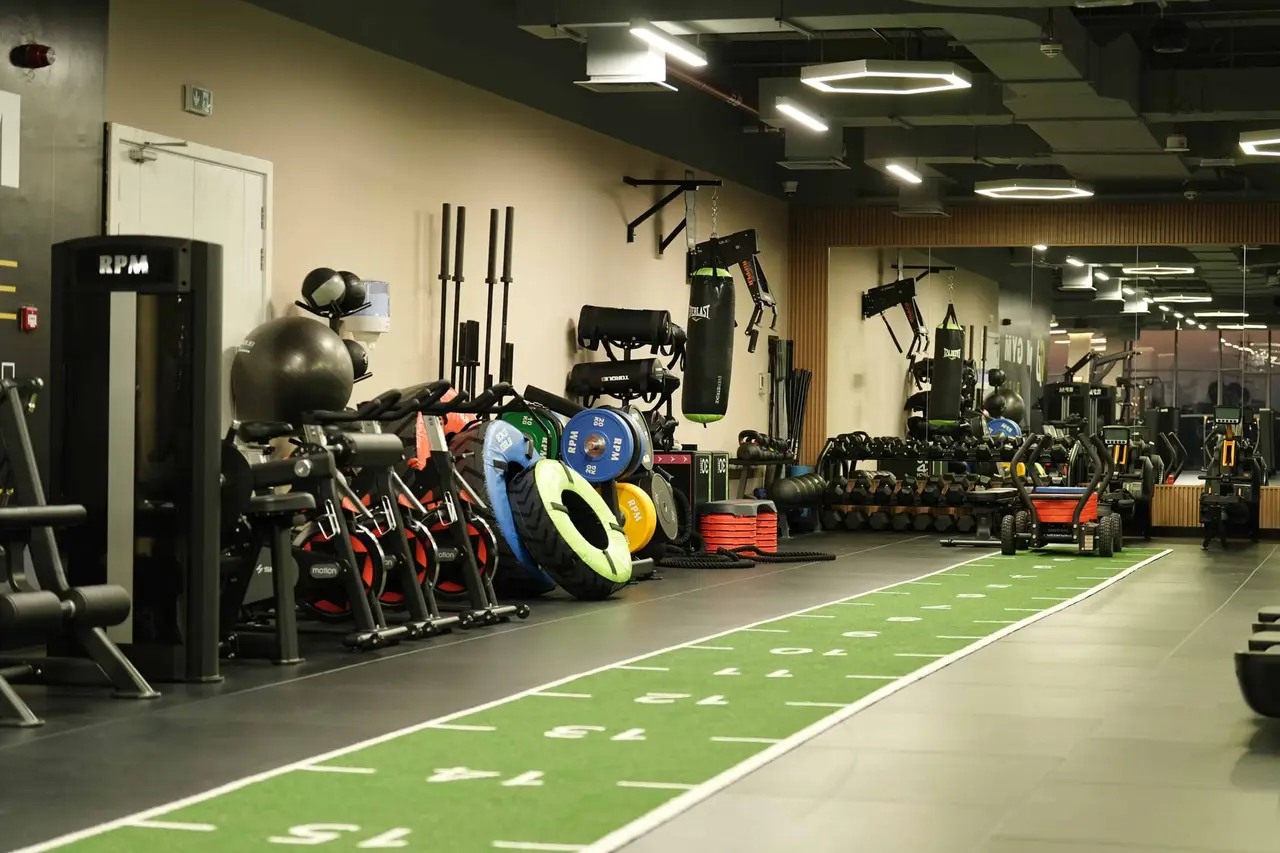
A bridge needs only a patch of floor, so it works in either the Mixed or the Ladies section. For the weighted version, RPM's floor photos in Al Manhal show a dumbbell rack, barbells and colour bumper plates. Loop bands and bar pads are not in those photos, so ask about them on your free tour, and book personal training if you want a coach to check where you feel the work.
Questions, answered.
What muscles does the glute bridge work?
Mainly the gluteus maximus. The hamstrings assist, more so with the feet further away, and the trunk muscles hold the lower back still. Single-leg versions also bring in the side of the hip to keep the pelvis level.
Are glute bridges good for the lower back?
Coaches use them to teach people to extend the hip with the glutes instead of arching the back. That is a training skill, not a fix for back pain. If your back hurts, or the bridge makes it hurt, stop and have it checked by a doctor or physiotherapist.
Can I do glute bridges when pregnant?
That is a question for your doctor or midwife, who know your pregnancy. Ask them before you start or continue any exercise lying on your back, and tell your coach what they advise.
How long should I hold a glute bridge?
Twenty to thirty seconds with a hard squeeze is a sensible start, building towards a minute if you like. Holds help you learn the top position, but reps with added load do more for strength and size.
Can I do glute bridges every day?
As a bodyweight warm-up, yes, if they feel easy. Hard, loaded sets need recovery like any strength work, so keep those to two or three days a week alongside the rest of your glute training.