What the cable kickback trains, and where it fits
A kickback is hip extension on one leg, done standing. The cable pulls your foot forwards, and the gluteus maximus on the working side pulls the thigh back behind you against it. The hamstrings help, especially with a straight leg, and the glutes of the standing leg work hard too, holding the pelvis level while the other leg moves. Unlike a squat or a deadlift, nothing else limits the set: no grip to fail, no back position to hold under a bar, no quads giving out first.
That precision is both the point and the limit. The load is small next to a hip thrust or a Romanian deadlift, so kickbacks earn their place as extra work after the heavy lifts rather than as the main exercise. They suit anyone who wants more glute volume without more load on the spine, people who struggle to feel their glutes in compound lifts, and lifters evening out a weaker side. The glute exercise guide shows where they sit in a full week, and cable glute exercises collects the other glute movements on the same station.
Setting up the cable
- Set the pulley to its lowest position and clip on an ankle strap, sometimes called an ankle cuff. Fasten it around the working leg just above the ankle bone so it cannot slide over your shoe.
- Face the weight stack and step back until the cable is tight, with the weight lifted slightly off the stack, while your strapped foot rests just ahead of the standing foot.
- Hold the frame or a handle with both hands. Hinge forward a little from the hips, roughly a quarter of the way to horizontal, with your back flat and a soft bend in the standing knee.
- Brace your trunk lightly and keep both hips level and square to the stack. The toes of the working leg point down or slightly out.
- Begin with the lightest plate or two. If you cannot pause with the leg fully back, the weight is too heavy.
How to do a rep
- Start with the working foot just in front of the standing foot and the cable taut.
- Push the leg back and slightly up from the hip, leading with the heel, as if pressing a door shut behind you.
- Stop when the hip is straight and the thigh is a little behind your body. Going further only arches the lower back.
- Squeeze the glute for one second at the end of the movement, with the pelvis still facing the stack.
- Bring the leg forwards over about two seconds, keeping tension on the cable, and repeat. Finish every rep on one side before switching.
The range is shorter than it looks. Much of the height a leg reaches behind the body comes from the lower back arching rather than from the hip, so the cue is to keep your trunk completely still and let only the leg move. If you feel it in your lower back, shorten the kick and lighten the stack. Breathe out as you kick and in as the leg returns.
Mistakes to fix first
| Mistake | What it looks like | The fix |
|---|---|---|
| Arching the lower back | The leg rises high behind you and the lower back bends to get it there | Stop when the hip is straight, with the ribs down and the trunk still |
| Swinging | The leg flies back and the stack bangs on the return | Lighten the load, pause at the end and take two seconds to come back |
| Opening the hip | The pelvis rotates and the toes turn out to the side as the leg rises | Keep both hip bones facing the stack and the toes pointing down |
| Standing too close | The cable goes slack at the start of the rep | Step back until there is tension from the first inch |
| Hanging on the standing leg | The hips shift sideways and the standing knee locks | Keep a soft standing knee and your weight over the middle of that foot |
| Shortchanging the weaker side | One leg gets fewer or sloppier reps | Start with the weaker leg and match its reps on the stronger one |
If kickbacks bring on pain in your lower back or hip, stop and get it checked by a doctor or physiotherapist.
Variations: knee angle, body position and the kickback machine
Every version below extends the hip against resistance; what changes is how much the hamstrings share the work and how still your body stays. One naming note: a cable kickback for the triceps is a different exercise, an arm movement with a handle, covered on the triceps kickback page.
Straight leg or bent knee?
With the knee straight, the hamstrings help extend the hip and the movement feels longer; many people feel it across the whole back of the leg. With the knee bent to roughly a right angle, the hamstrings are shortened and contribute less, so the glute takes more of the work over a smaller range. Both are reasonable. Bend the knee if your hamstrings cramp or take over, and keep it straight if you want a longer movement.
Standing or on all fours?
Standing is the usual version. Kneeling on hands and knees in front of a low pulley, with the strap on the working foot, turns it into a loaded donkey kick: your arms and knees support the trunk, so it is easier to keep still, but it takes longer to set up and the knee you kneel on needs padding. The bodyweight version is on the donkey kick page.
Glute kickback machine
Some gyms have a dedicated machine: you lean onto a chest or forearm pad and push a footplate or padded lever backwards, sometimes as one setting on a multi-hip machine. It does the same job with your body fixed in place, so the pelvis stays still more easily, and the load changes with a pin. RPM's floor photos do not show one, so ask on your tour; the cable version needs only the strap.
Side kickback on the cable
With the strap on the outside leg and the pulley beside you rather than in front, you lift the leg out to the side instead of back. That trains the side of the hip, the gluteus medius and minimus, rather than the main glute muscle. It pairs well with backward kickbacks, and the hip abduction machine is the machine version.
If every cable is busy, a loop band around the ankles anchored to a fixed post gives a lighter version, a glute bridge on the floor trains the same squeeze, and the hip thrust loads it far more heavily.
Kickback, hip thrust or Romanian deadlift?
People often weigh the kickback against heavier glute exercises, but they do different jobs. The hip thrust loads the same end of the hip's range with both legs and much more weight, which makes it the sounder base for building the glutes; the kickback adds single-leg volume afterwards. The Romanian deadlift works the glutes in the stretched position, the opposite end of the range, so it complements the kickback rather than competing with it. The abduction machine trains a different part of the glutes altogether. A balanced glute session usually takes one heavy lift and one or two of these lighter, targeted movements.
Sets, reps and progression
| Goal | Sets × reps | How hard |
|---|---|---|
| Learning the movement | 2 × 12–15 each leg | Stop with three or four reps left and a clear pause at the end |
| Building muscle | 3 × 10–15 each leg | Finish each set with one or two reps left |
| Finisher after heavy lifts | 2–3 × 15–20 each leg | Lighter, constant tension, no swinging |
Rest about a minute between sets; working the other leg counts as rest for the first. The training volume calculator helps you count your weekly glute sets.
Cable stacks often jump by a large amount between plates, and a small muscle working on one leg feels every jump. Add reps first, up to the top of your range, then move up one plate and drop back to the bottom of the range. Some stacks carry a small add-on weight for half steps; ask if you cannot find one. Two kickback sessions a week, after your main glute lift, are plenty for most people.
Cable kickbacks at RPM
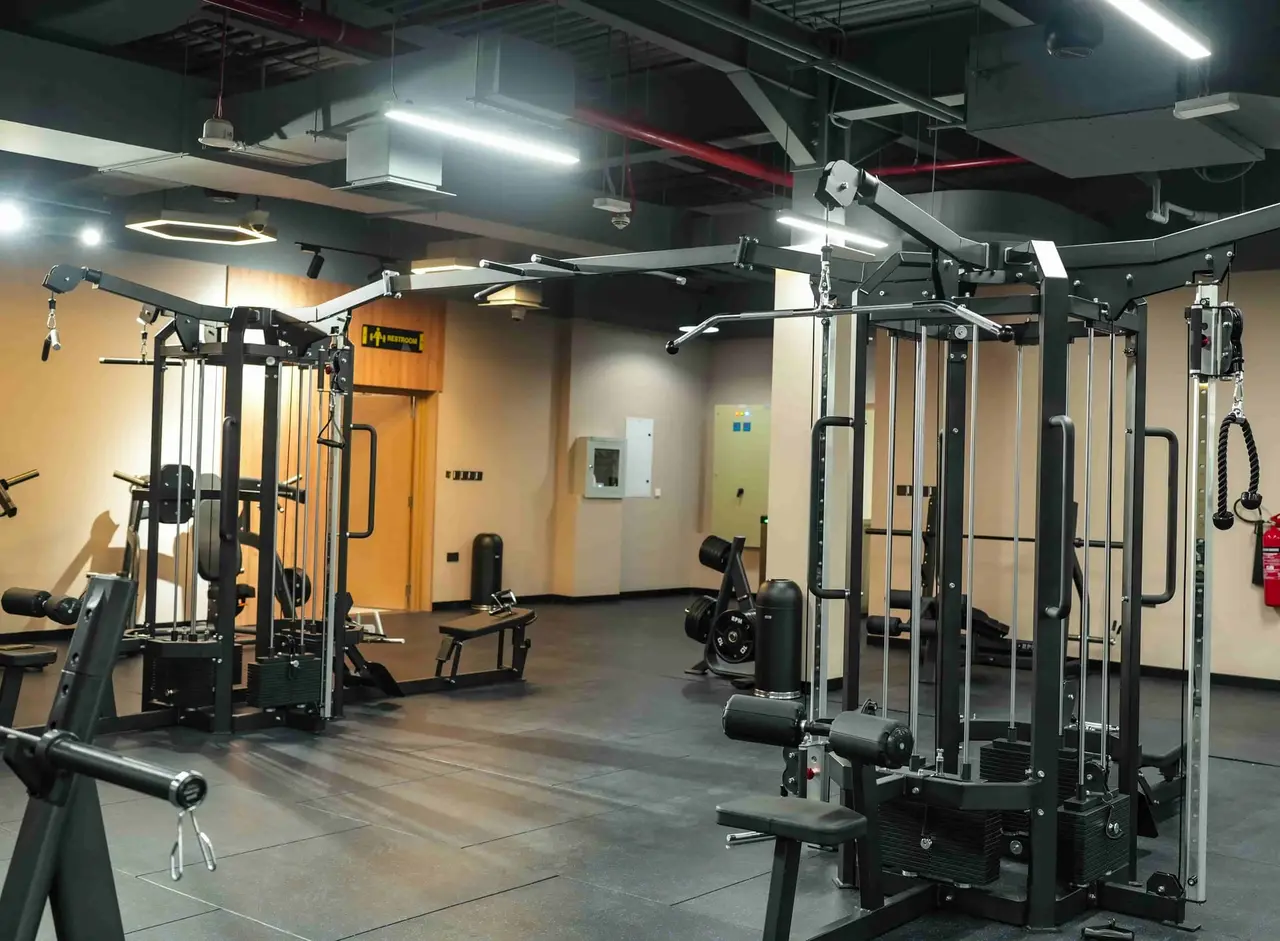
RPM's floor photos in Al Manhal show multi-station cable towers on the training floor, which is everything the exercise needs apart from an ankle strap. The strap is not visible in the photos, so ask where the attachments are kept on your free tour. The cable machine page explains pulley heights and attachments, and a personal training session is a quick way to have your stance and range checked.
Questions, answered.
What muscles do cable kickbacks work?
The gluteus maximus of the working leg, helped by the hamstrings, particularly with a straight leg. The glutes on the standing side work to keep your pelvis level.
Are cable kickbacks good for building glutes?
They are a useful addition rather than a foundation. They add targeted glute work without loading the spine, but the weights are small; hip thrusts, Romanian deadlifts, squats and lunges do the heavy lifting in a glute plan.
Do I need an ankle strap for cable kickbacks?
It makes the exercise much easier to set up and load evenly. Without one, some people loop a single handle around the foot, but it tends to slip. A band around the ankles is the home alternative.
How heavy should cable kickbacks be?
Light enough to pause with the hip fully straight and the trunk still on every rep. For most people that is the first few plates on the stack: the right weight makes the last two reps hard without the lower back joining in.
Can I do kickbacks at home?
Yes, with a loop band anchored low or around both ankles, or as a bodyweight donkey kick on all fours. Both are lighter than a cable, so use higher reps and slow returns.