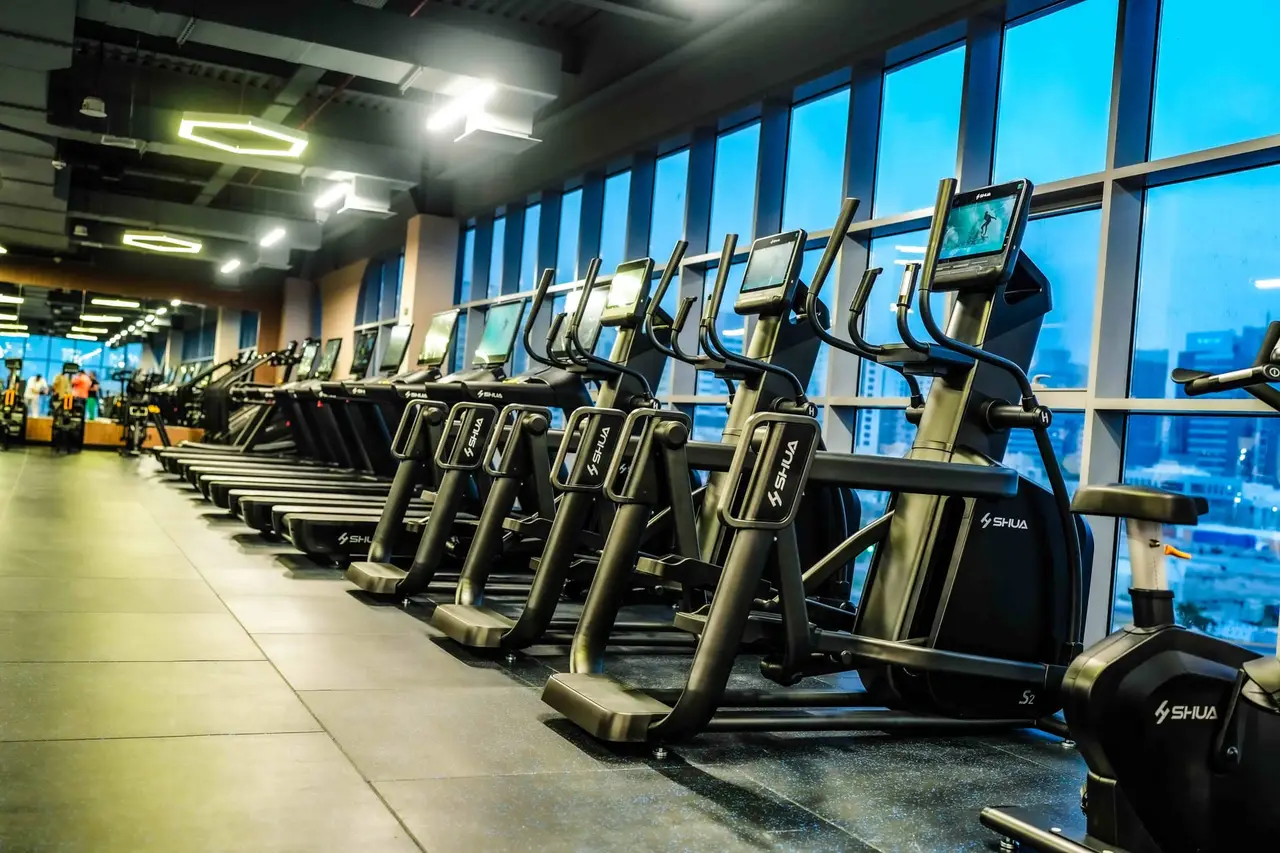
What an elliptical is, and what the names mean
Elliptical, elliptical trainer and cross-trainer all mean the same machine: two long foot pedals linked to a weighted flywheel, moving in an oval path (an ellipse, hence the name), with two tall handles that swing back and forth in time with them. Cross-trainer is the usual British name and elliptical the American one. The flywheel sits at the front on some models, at the back on others and between the pedals on a few; that changes the feel of the stride a little, but not how you use it.
A few other things share the name. An elliptical bike is either a cross-trainer with a seat or an outdoor bicycle you pedal standing up in an oval; neither is common on a gym floor. Cross-trainer shoes are trainers for mixed gym work, not this machine. For the rest of the training floor, see the library's equipment guides.
What the elliptical works
The legs do most of the work. Each push down and back on a pedal straightens the knee and the hip, so the quads, glutes and hamstrings carry the load while the calves keep the foot steady. Because the feet never leave the pedals, there is no landing to absorb, which is why many people whose joints dislike running can stay on it for long sessions.
The moving handles bring in the upper body. Pushing a handle away works the chest, the front of the shoulder and the triceps; pulling it back works the upper back and biceps. They only do this if you use them: resting your hands on handles that drag your arms along turns it back into a legs-only machine, which is fine for an easy day but wastes half the design. The trunk works throughout to hold you upright. It is cardio, though, not strength training. The resistance is light enough to repeat thousands of times, so for stronger legs, add lifts from the leg exercises page.
Setting it up: stride, resistance, incline and handles
- Step on from the side while the pedals are still, one foot at a time, holding the fixed handles in the middle. Many machines wake up as soon as the pedals turn.
- Choose manual mode and a low resistance. Resistance makes every stride heavier to push, like a higher gear on a bike; level numbers differ between machines, so judge by feel.
- Set the stride length if the machine lets you. Taller people usually prefer a longer stride, which feels closer to running; a stride that is too long for you makes you reach and rock.
- Set the incline, or ramp, if there is one. Raising it makes each stride feel more like climbing and asks more of the hips. Start flat.
- Choose your handles: the moving arms for whole-body work, or the fixed handles in the middle, often fitted with pulse sensors, for a legs-led session.
- Pedal easily for three to five minutes, then raise the resistance a level at a time until the effort matches the session you planned.
Pulse sensors on the fixed handles give only a rough reading, and only while your hands stay still on them. If you train by heart rate, a chest strap or a watch is steadier.
Posture and technique
- Feet: the whole foot on the pedal, toes pointing forward and centred on the footplate. If your toes go numb, a common complaint, push more through the heels and loosen your laces.
- Body: tall and quiet from the hips up, eyes ahead, shoulders relaxed. The console is for the buttons, not for your forearms.
- Arms: push one handle away as you draw the other back, in time with your legs, elbows bending naturally and staying close to your sides.
- Knees: tracking in line with your toes, and soft at the back of each stride rather than snapping straight.
- Rhythm: if your body bobs up and down or the pedals seem to run away from you, the resistance is too low for your speed. Add a level or two.
Because nothing lands, it is easy to work harder than you meant to without noticing. Check that you could still say a sentence during steady sessions, and keep the really hard minutes for planned intervals.
Elliptical workouts
Pick one or two a week to begin with, and keep the steady base session as the foundation.
| Session | What to do | How it should feel |
|---|---|---|
| Steady base | 20–40 minutes at one resistance you can hold, arms and legs working together | Talking in full sentences |
| Resistance ladder | Raise the resistance one level every 2 minutes for 10 minutes, come back down the same way, and repeat once | Heavier legs on the way up; breathing settles on the way down |
| Arms on, arms off | Within a steady session, 2 minutes holding the fixed handles, then 2 minutes driving hard with the arms; five rounds | Legs-led, then whole body |
| Short sprints | After a warm-up, 10 rounds of 20 seconds at a fast pace and moderate resistance, each followed by 70 seconds easy | Fast and hard, fully recovered before the next one |
| Forwards and backwards | 3 minutes forwards then 1 minute pedalling in reverse, for 20–24 minutes | The same effort, a different feel through the thighs |
Begin with two or three sessions a week and add time before resistance. The heart rate zone calculator helps you set effort. The calorie count on the console is an estimate from the machine's own formula; for a personal figure, use the calories burned calculator.
Mistakes to fix first
| Mistake | What it looks like | The fix |
|---|---|---|
| Resistance too low | Legs spinning fast, body bouncing, the pedals carrying you round | Add resistance until you are pushing the pedals |
| Leaning on the console | Forearms on the screen, hips pushed out behind you | Stand tall and hold the handles, not the console |
| Passive arms | Hands resting on handles that drag the arms along | Push and pull on purpose, or hold the fixed handles |
| Up on the toes | Heels lifting off the pedals, calves tight early | Press through the whole foot |
| Head down over a phone | Rounded shoulders and the pace drifting | Look ahead; save the screen for the easy minutes |
| The same session for months | Identical level and time every visit | Change one thing: the time, the resistance or the session |
Who it suits, and when another machine fits better
The elliptical suits people who want long, steady cardio with no landing, heavier beginners who find a fast walk uncomfortable, runners adding easy aerobic time between runs, and anyone who wants the arms to share the work. It is a weaker fit if you are training for a running race, because it does not practise the running stride; the elliptical vs treadmill comparison covers that choice. If you would rather sit, the exercise bike takes your weight off your feet altogether, and the cardio machines guide matches each machine to a goal.
No landing does not make it right for every joint problem. If a knee, hip or the lower back hurts while you pedal, stop, and ask a doctor or physiotherapist before you carry on.
Cross-trainers at RPM
RPM's photos show cross-trainers on the cardio row by tall windows, between the treadmills and an upright exercise bike. The photos cannot show whether those models offer an adjustable stride or a ramp, so step on one during a free guided tour and try the settings. Women training in the women-only Ladies section will find cardio machines there too; ask which. A coach in a personal training session can fit elliptical work around your strength days.
Questions, answered.
What are the benefits of an elliptical machine?
It trains the heart and lungs with no landing, works the arms and legs together when you use the handles, takes only minutes to learn and suits long sessions. It also lets runners add aerobic time without extra running.
Is the elliptical good for weight loss?
It can help, because many people can use it often and for a long time without sore joints. What changes your weight is your activity and eating across weeks, not one machine. Keep some strength training in your week as well.
How long should a beginner use the elliptical?
Ten to twenty minutes at an easy effort, two or three times a week, is plenty to start. Add five minutes at a time once a session feels routine, and only then start raising the resistance or adding intervals.
Is a cross-trainer the same as an elliptical?
Yes. Cross-trainer is the common British name and elliptical the American one. Some people keep cross-trainer for models with moving arms, but in gyms the two words describe the same machine.
Is an elliptical worth buying for home?
It can be, if you will use it often. Try one before you buy: check that the stride is long enough for your height, the motion is smooth at low resistance, and that there is headroom above you at the top of each stride, especially on models with a ramp.