Upright, spin, recumbent or air bike?
Four kinds of bike turn up in gyms. The pedalling is the same on all of them; the riding position and the way you set the resistance differ. This page is one of the library's equipment guides.
| Bike | How you sit | How resistance works | Suits |
|---|---|---|---|
| Upright bike | Upright on a saddle with the handlebars in front, like a town bike | Electronic levels set on the console | Steady rides, intervals and first sessions |
| Spin bike (indoor cycle) | Leaning forward like a road bike, with the option to stand on the pedals | A heavy flywheel and a knob or lever, often with no screen | Classes, standing climbs and hard intervals |
| Recumbent bike | Reclined in a wide seat with a backrest, pedals out in front | Electronic levels | Riders who want back support or find a saddle uncomfortable |
| Air bike | Upright, with handles that move with the pedals | A fan that resists harder the harder you push | Short, very hard conditioning efforts for arms and legs |
Spin bike vs exercise bike: what is the difference?
A spin bike is a type of exercise bike built to feel like a road bike. A heavy flywheel keeps the pedals turning smoothly, the riding position is lower and further forward, and you can stand up out of the saddle. A standard upright bike sits you more upright, usually has a console with programmes and is designed for seated riding. Many spin bikes have a fixed flywheel, so the pedals keep turning when you stop pushing: slow them with the resistance knob or the brake, not by locking your legs.
Recumbent or upright bike?
The recumbent supports your back, spreads your weight across a wide seat and puts the pedals in front of you, which many older adults, larger riders and people who dislike saddles find easier to get on and stay on. The upright bike is closer to riding an ordinary bicycle, asks a little more of your trunk to hold you up, and lets you stand briefly to ease the saddle. Both train the heart and lungs; choose the one you can ride comfortably and often.
Setting up the bike
- Saddle height: as a first guess, stand beside the bike and set the saddle level with the top of your hip bone.
- Check it seated. With your heel on the pedal at its lowest point, your leg should be straight. When you then pedal normally on the ball of the foot, that leaves a small bend in the knee at the bottom.
- Check it moving. If your hips rock from side to side, the saddle is too high; if your knees rise towards your chest and feel cramped at the top, it is too low.
- Fore and aft, on spin bikes and some uprights: with the pedals level, your front knee should sit roughly above the pedal. Slide the saddle forward or back to get there.
- Handlebars: start high enough that your back stays relaxed and your shoulders stay down. On a spin bike you can lower them later for a more road-like position.
- Feet: ball of the foot over the middle of the pedal, toes straight ahead. Tighten the straps or cages so the foot cannot slip; clip-in pedals need matching cycling shoes, so use the cage side if you have none.
- Resistance: start where you can feel the pedals push back, and ride for five easy minutes before you add more.
Write your settings down. Most bikes have numbered saddle and handlebar posts, so next time you can set the same position in seconds instead of guessing.
Resistance and cadence: the two dials
Effort on a bike comes from two things: how heavy the pedals are, which is the resistance, and how fast you turn them, which is the cadence, counted in pedal turns per minute. Heavy resistance at a slow cadence feels like climbing a hill and loads the thighs. Light resistance at a fast cadence feels like spinning along on the flat and tests your breathing more. Most people settle somewhere between 70 and 90 turns a minute on steady rides, slower and heavier for climbs.
If the console shows watts, that is the number to track: it combines resistance and cadence into one figure you can try to hold for longer, or raise, over the weeks. Level numbers and calorie readings do not compare between bike models, so log the bike as well as the setting.
If your knees ache, check the saddle first. A saddle set too low makes the knee bend further under load on every stroke, and many riders feel that at the front of the knee. If the pain continues once the bike is set up, stop and have it checked by a doctor or physiotherapist.
Exercise bike workouts
The steady ride is the foundation. Add one of the harder sessions a week once three steady rides feel routine.
| Session | What to do | How it should feel |
|---|---|---|
| Steady ride | 20–45 minutes at one resistance and a smooth cadence | Conversational throughout |
| Cadence builder | Within a 25-minute ride, five 1-minute blocks at a fast cadence and light resistance, with 3 minutes at your normal cadence between | Quick legs and quiet hips, with no bouncing on the saddle |
| Over-unders | Three rounds of 6 minutes, alternating 2 minutes at a steady hard effort with 1 minute a level higher; 4 minutes easy between rounds | Hard but controlled, never all-out |
| Standing climbs (spin bike) | Four to six blocks of 90 seconds out of the saddle at heavy resistance, with 2 minutes seated and easy between | Legs and glutes working hard, breathing deep |
| Easy spin after lifting | 10–15 minutes at very light resistance at the end of a leg session | Barely working; the legs loosen off |
Two or three rides a week is a solid start; add time before resistance. Heart rate on a bike does not match the treadmill at the same effort, so set separate zones with the heart rate zone calculator; the treadmill vs bike guide explains why.
Mistakes to fix first
| Mistake | What it looks like | The fix |
|---|---|---|
| Saddle too low | Knees rising high, thighs burning early, discomfort at the front of the knee | Raise it until the knee is only slightly bent at the bottom |
| Saddle too high | Hips rocking side to side, toes reaching for the pedals | Lower it until your hips stay still |
| No resistance | Legs whirring and the body bouncing in the saddle | Add resistance until the pedals push back |
| Hunched and gripping | Shoulders up by the ears, a rounded back, tight hands | Raise the handlebars and loosen your grip |
| Braking a spin bike with your legs | Fighting a heavy flywheel by resisting the pedals | Press the resistance knob or brake instead |
| Putting up with saddle discomfort | Shifting about on the seat all session | Check saddle height and tilt, stand briefly every few minutes on a spin bike, or try the recumbent |
Who the bike suits
The bike takes your bodyweight off your feet and has no landing, which is why many people choose it when running or long walks do not agree with their knees, hips or feet, and why it sits well alongside heavy leg training. It asks almost nothing of your balance, so it also suits people returning to exercise and older adults, with the recumbent adding a backrest. Because the saddle carries you, though, it does not give your legs and bones the weight-bearing work that walking, running or lifting do, so keep some of those in your week as well.
If a ride brings on knee pain, stop and have it checked by a doctor or physiotherapist. For other seated or low-impact options, the cardio machines guide compares every machine on the floor, and the elliptical gives standing cardio with no landing.
Exercise bikes at RPM
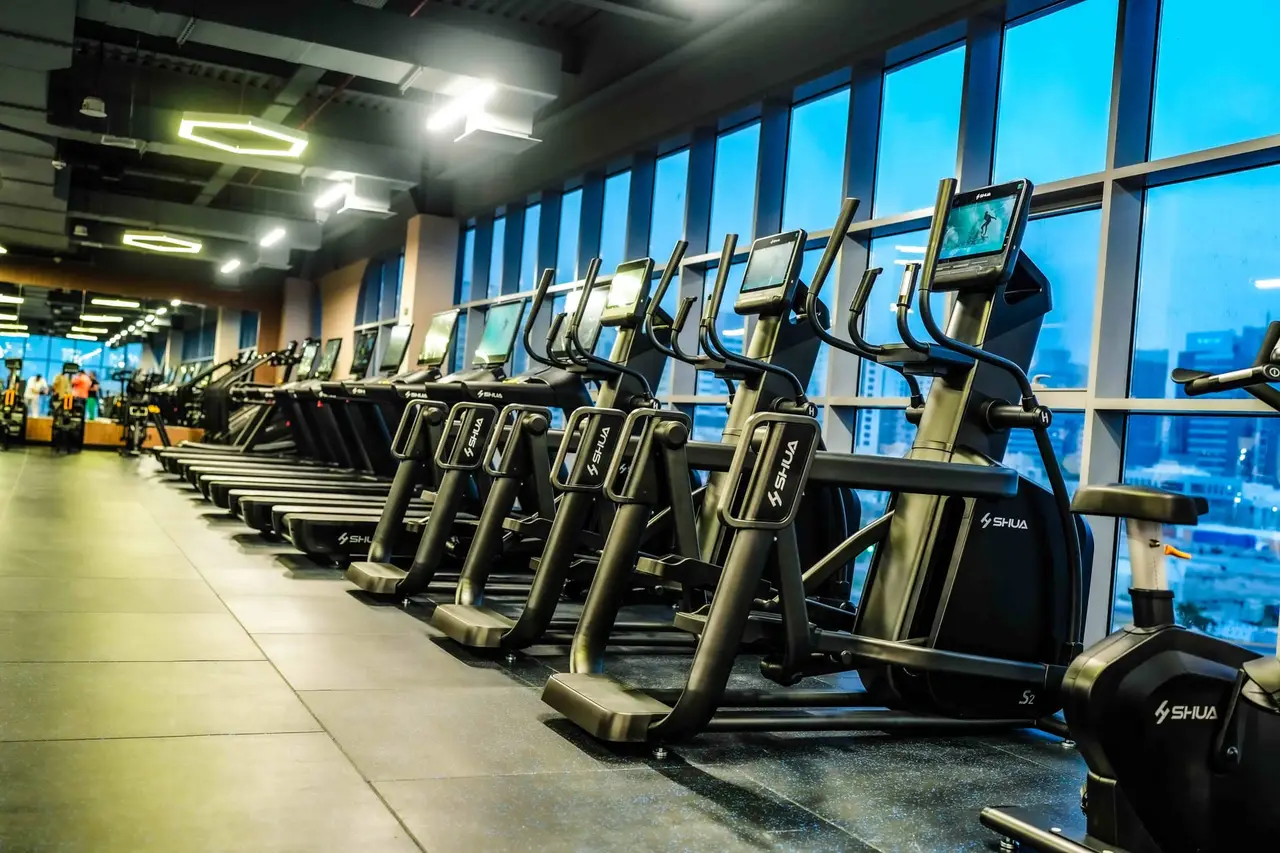
RPM's floor photos show an upright exercise bike on the cardio row, next to the treadmills and cross-trainers by the windows, and a row of spin bikes in the functional area, so you can try both kinds. Recumbent bikes and air bikes do not appear in those photos, so ask on a free guided tour whether either is on the floor, and whether any classes use the spin bikes at the hour you train. The women-only Ladies section has cardio equipment of its own, so ask what it includes. A coach in a personal training session can check your saddle set-up and fit rides into your week.
Questions, answered.
What are the benefits of an exercise bike?
It builds aerobic fitness with no landing and no balance to manage, which makes it easy to start on and easy to repeat. It pairs well with leg training, and the resistance lets you go from a gentle spin to hard intervals on the same machine.
Stationary bike or treadmill: which should I use?
The treadmill if you want to walk or run, or are training for a race; the bike if you want seated cardio that keeps the load off your feet. Many people use both in a week. The treadmill vs bike guide compares them in detail.
How long should a beginner ride a stationary bike?
Fifteen to twenty minutes at an easy, conversational effort, two or three times a week. Add five minutes at a time as rides feel routine, and wait until you can ride for half an hour comfortably before adding harder sessions.
How many calories does a stationary bike burn?
It depends on your size, the resistance, your cadence and how long you ride, so there is no single figure. The console's number is an estimate from its own formula. For a personal one, use the calories burned calculator, and compare rides on the same bike rather than across machines.
Is an exercise bike good for seniors?
It is one of the easier machines to start on, because there is no landing and little balance involved. A recumbent bike, with its backrest and low step-through frame, is often the most comfortable choice.