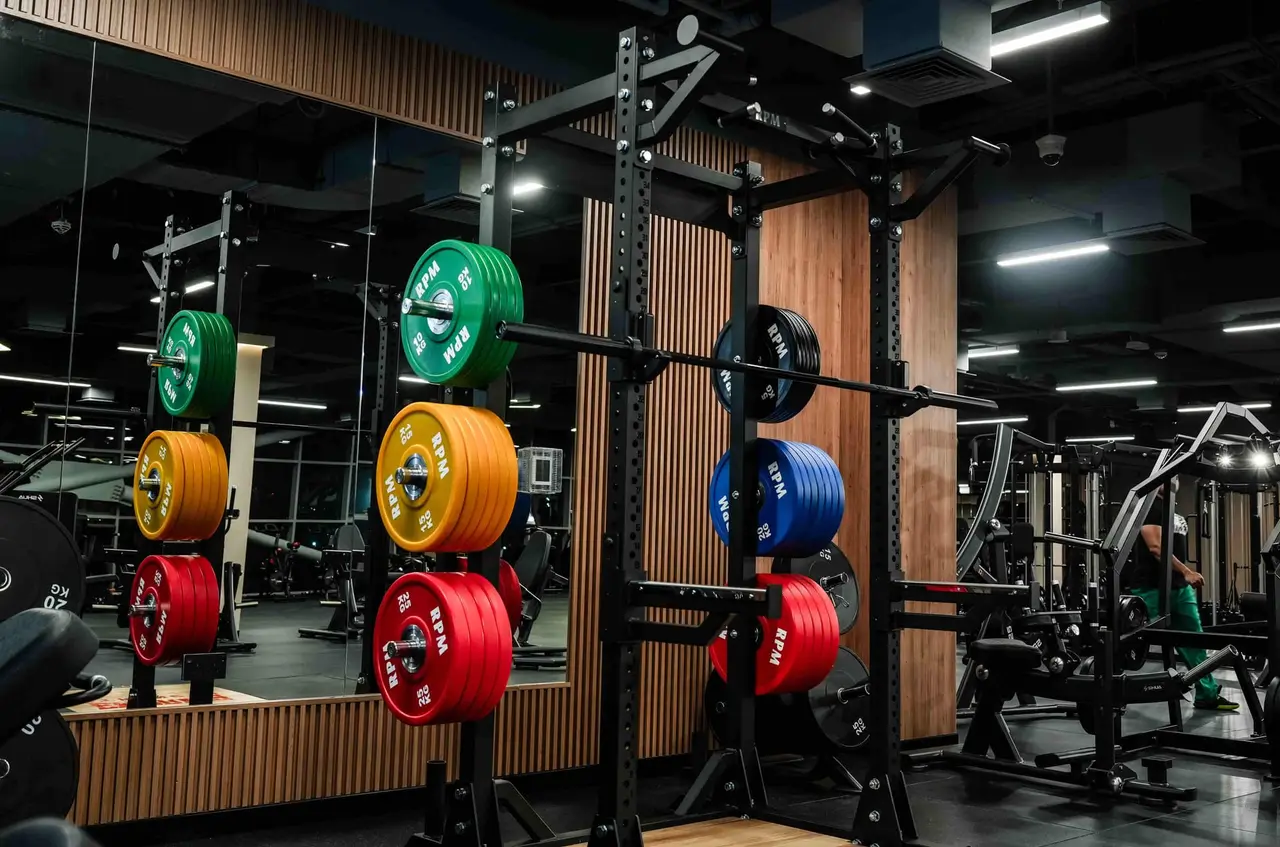
Power rack, squat rack and half rack
Gyms use the names loosely. A power rack, sometimes called a power cage, is a box of four uprights: you lift inside it, with safety pins or straps running front to back on both sides of you. A half rack has two uprights, usually with spotter arms reaching forwards, so you lift in front of the frame rather than inside it. A squat stand is two separate uprights with hooks and often no safeties at all. All of them do the same job: hold the bar at a height you can get under, and stop it if you cannot finish a rep.
The point of a rack is training heavy with an unguided barbell and nobody behind you. Squats, bench presses and overhead presses are the main lifts done in one. This page is about using a rack. For what to look for when you compare gyms, see choosing a gym with squat racks; for the bar and plates, the barbell guide; and for the rack against the guided bar, the Smith machine guide. It is one of the library's gym equipment guides.
The parts of a rack
| Part | What it does | Check before you lift |
|---|---|---|
| Uprights | The vertical posts, drilled with a column of numbered holes | Note the hole numbers you use, so you can set up the same way next time |
| J-hooks | Hooks that hold the bar at your starting height | Both on the same number, fully seated in their holes, lining intact |
| Safety pins, straps or spotter arms | Bars or straps that catch the barbell below your lowest point | Both sides at the same height and locked in place |
| Pull-up bar | A crossbar across the top of many racks | Ask first if someone is lifting inside the rack |
| Plate storage and attachments | Pegs for plates; some racks add dip handles, a landmine or a cable pulley | Load from the pegs nearest the bar and keep the floor clear |
Setting the hooks and safeties for each lift
| Lift | J-hook height | Safety height |
|---|---|---|
| Back squat | Bar at about the top of your breastbone, so you unrack with a small knee bend | A little below where the bar sits at the bottom of your deepest squat |
| Front squat | Slightly lower than for the back squat, with the bar at collarbone height | As for the back squat, tested at your front-squat depth |
| Bench press, flat bench inside the rack | Where your arms are almost straight as you lie on the bench | Just below the height of your chest with your upper back set on the bench |
| Overhead press | About collarbone height, so you step under the bar standing tall | Just below the bar's lowest point at your collarbones |
| Rack pull or pin press | Not needed | The pins become the start: the bar rests on them at the height you want to begin |
Test each setting with the empty bar: one slow rep should pass the safeties without touching them, and sinking a little lower should land the bar on them. In a power rack you lift inside the frame; on a half rack, check that the arms reach far enough forwards to sit under the bar where you will stand.
Unracking, walking out and re-racking
- Get under the bar centred, both hands the same distance from the middle, feet under the bar.
- Brace, then stand the bar up in one smooth movement. For the bench press, press it up and bring it over your chest instead.
- Take two or three short steps back, just enough to clear the hooks. More steps are wasted effort, and the walk back gets longer when you are tired.
- Set your feet, take your breath and start the set.
- To finish, walk forwards until the bar touches the uprights, then lower it onto both hooks together. Glance at one hook if you need to, but never rack one side at a time.
- If a rep fails, lower the bar onto the safeties under control. In a squat, sit down until the bar settles on the pins and step out from under it; on the bench, lower it to the pins at your chest and slide out towards your head.
Take your breath and brace before you lift the bar off the hooks, not afterwards: the walk-out is part of the set, and a loose walk-out makes the first rep harder than it needs to be.
Spotting and sharing the rack
Safeties make it possible to train alone, but a spotter still helps on the bench press and on a lifter's first heavy sets. Agree on the plan before the set starts: how many reps, whether you want help on the last one, and the word that means take it.
- Bench press spot: the spotter stands behind the head of the bench with hands close to the bar in an alternating grip, ready to guide it back to the hooks if the press stalls.
- Squat spot: the spotter stands close behind with arms under the lifter's armpits or around the chest, moving down and up with them. It takes practice, so if nobody is trained to do it, rely on the safeties.
- Between sets, let someone work in if your loads are close, and strip the bar when you finish.
- At busy times, take curls, shrugs and other lifts that do not need a rack to a fixed barbell or the dumbbells.
Exercises you can do in the rack
- Back squat: the lift most racks are bought for.
- Front squat: hooks a little lower, bar across the front of the shoulders.
- Bench press and incline bench press: a bench inside the frame and the safeties at chest height.
- Overhead press: unrack at collarbone height and press standing.
- Bent-over row and Romanian deadlift: take the bar from hooks set at mid-thigh, so you start standing instead of pulling it from the floor.
- Rack pulls and pin presses: start from the pins to train the top part of a deadlift or a press.
- Barbell lunge: unrack as for a squat, then step clear of the frame.
A rack session for the squat and press
One rack, four lifts, with the hooks coming down a step for each one.
| Exercise | Hooks and safeties | Sets × reps |
|---|---|---|
| Back squat | Hooks at breastbone height, safeties just under your depth | 4 × 5 |
| Overhead press | Hooks at collarbone height, safeties just below | 3 × 6–8 |
| Bench press | Bench inside, hooks at arm's length, safeties at chest height | 3 × 6–8 |
| Romanian deadlift | Hooks at mid-thigh, safeties lowered out of the way | 3 × 8 |
Rest two to three minutes between the heavier sets. The squat 1RM calculator and the bench press 1RM calculator estimate your maximum from a recent set, so there is no need to test it in the rack.
Mistakes in the rack
| Mistake | What it looks like | The fix |
|---|---|---|
| Hooks set too high | You rise onto your toes or half-press to get the bar off | Drop the hooks a hole or two |
| Safeties not set | The pins sit at the bottom of the rack or lie on the floor | Set them for every lift, every session, before loading the bar |
| Safeties set too high | Good reps clip the pins at the bottom | Lower them a hole and test with the empty bar |
| A long walk-out | Several steps back, so the return is long when you are tired | Two or three short steps, just enough to clear the hooks |
| Racking one side first | One end lands on its hook and the other drops | Walk into the uprights and lower both ends together |
| Leaving the bar loaded | Plates and collars left on for the next person | Strip the bar and leave the safeties at a middle height |
If your knees, back or shoulders hurt during a lift in the rack, stop and have it checked by a doctor or physiotherapist before you load it again.
Squat racks at RPM
RPM's floor photos show squat racks loaded with barbells and colour bumper plates on the training floor in Al Manhal. They do not show whether a rack is a four-post power rack or a half rack, what kind of safeties it uses, or whether there is a pull-up bar on top or a lifting platform, so we do not claim any of those. On a free guided tour, ask to see a rack and how its safeties set, and ask whether the women-only Ladies section has a rack too. A coach in a personal training session can set the hooks and safeties with you for each lift.
Questions, answered.
What is the difference between a power rack and a squat rack?
A power rack is a cage of four uprights with safeties on both sides of you, so you lift inside it. 'Squat rack' covers any frame that holds a bar at squat height, including two-post half racks with arms reaching forwards and simple stands with no safeties. For heavy work alone, what matters is that the safeties set at your depth.
Squat rack or Smith machine: which should I use?
A squat rack holds a loose barbell that you balance yourself; a Smith machine runs the bar on fixed rails. They suit different goals, and the Smith machine guide compares the two in detail.
How high should the safety pins be for the bench press?
Just below your chest when your upper back is set on the bench, so a normal rep touches your chest without touching the pins and a failed rep stops on them before it rests on you. Test it with the empty bar and adjust one hole at a time.
Can I bench press in a squat rack?
Yes, as long as a flat bench fits between the uprights and the hooks and safeties go low enough. Position the bench so your eyes are under the bar when you lie down, and set the safeties before you load the bar.
Can I use a squat rack for hip thrusts?
You can, but you rarely need to. Hip thrusts start from the floor with your upper back on a bench. If small plates make it hard to roll the bar over your hips, parking it on the lowest hooks can help, but at busy times use a bench outside the rack.
What is a power rack with cables?
A rack with a pulley built onto the frame, loaded by a weight stack or plates, so pulldowns and rows share one footprint. It is mainly a home-gym design. In most commercial gyms the rack and the cable station are separate; the cable machine guide covers that side.