What the SkiErg is, and what it trains
SkiErg is Concept2's name for its ski ergometer, and most gyms now use it for any machine of the type. A flywheel and fan sit at the top of a tall upright, two cords run down from it to the handles, and pulling the handles spins the fan; a recoil draws the cords back up. Most stand on a floor base with a platform for your feet, while some are fixed to a wall. The monitor reads like a rower's, with a 500 m split, strokes per minute and distance.
Each stroke is a pull from overhead to the thighs. The lats and the backs of the arms do the most obvious work, the abdominals draw the ribs down as you hinge, the hips drive the hinge, and the legs add a small dip at the knees. Like the rower, it spreads the load across much of the body while your heart and lungs carry the session, but the emphasis sits higher: more trunk and arms, less leg.
It suits runners and rowers who want upper-body conditioning, people preparing for HYROX, and anyone who wants hard cardio with no landing and no seat. It asks a lot of the shoulders overhead and of the trunk, so if either is painful, have it checked by a doctor or physiotherapist first, and stop if pain appears during a session. The gym equipment guides cover other machines if this one does not suit you.
Setting up: stance, damper and monitor
- Stand facing the machine, feet about hip-width apart, close enough that the handles hang just in front of your face when you reach up. On a floor-standing model, stand on the platform.
- Set the damper, the lever on the side of the fan housing. Lower numbers feel lighter and quicker, higher numbers heavier and slower. Most coaches start people in the lower middle of the range; as on a rower, it is not a difficulty dial, because your effort sets the work.
- Wake the monitor with a pull or a button and find the split, the time you would take to ski 500 metres at your current pace; lower is faster. Stroke rate and distance sit beside it.
- Take a handle in each hand with a relaxed grip and straight wrists. Reach up until your arms are long, with a soft bend at the elbows.
The stroke, step by step
- Start tall at the top, arms long and handles above your head, weight over the middle of your feet. Some skiers rise slightly onto the balls of their feet to lengthen the reach.
- Pull the handles down with the arms nearly straight, as if pressing them towards the floor in front of you, while your hips begin to hinge back.
- As your hands pass your face, hinge further and brace hard, bringing your ribs towards your hips with a small bend at the knees. Think of a crunch and a hinge, not a squat.
- Finish by pushing the handles down past your hips with straight arms, so the backs of the arms work, hands ending beside your thighs.
- Recover: let the arms rise, stand up through the hips and reach tall again. The return should take about twice as long as the pull.
Pull, crunch, push down; then arms up, hips up, tall. Breathe out hard on the pull and in on the way up. Some sessions alternate one arm at a time, as in classic cross-country skiing; learn the two-arm stroke first.
Pacing by the split
The split shows your pace in any piece, so you can set a target and hold it. If it climbs steadily through a session, you started too hard. Stroke rate matters less than the force in each pull, and a long, strong pull at a moderate rate usually beats short, hurried tugs. Because the split works the same way as a rower's, the rowing pace calculator will turn a SkiErg split into a finishing time for any distance.
| Effort | How it should feel | What to watch |
|---|---|---|
| Easy | You can talk in full sentences | A long, relaxed stroke and a steady split |
| Moderate | Short phrases only | The split holds within a few seconds across the piece |
| Hard | A few words at a time | Strokes stay long as you tire; if they shorten, ease off |
The heart rate zone calculator gives you a second way to set effort. The monitor's calorie figure is an estimate.
Mistakes to fix first
| Mistake | What it looks like | The fix |
|---|---|---|
| Arms doing all the work | The body stays upright while the arms pull, and the shoulders tire within minutes | Hinge at the hips and crunch as the hands pass your face |
| Squatting the stroke | Deep knee bends with a flat, upright back, the legs doing the work | Keep the knee bend small and let the hips and trunk drive |
| Turning it into a row | Elbows flaring and the handles coming to the chest | Keep the arms long and finish by pushing down past the hips |
| Rushing the return | Snapping back up and starting the next pull before you reach full height | Stand tall and reach before every stroke |
| Damper on the top setting | Each pull feels slow and heavy, and the lower back tires first | Bring it down to the lower middle |
| Standing too far back | Reaching forward for the handles and pulling them down at an angle | Step in until the handles hang in front of your face |
SkiErg workouts to start with
| Session | What to do | What it builds |
|---|---|---|
| Technique builder | Five rounds of 2 minutes easy and 1 minute of rest, each focusing on one part of the stroke | A stroke that holds together when you tire |
| Steady ski | 10–20 minutes at an easy, even split | Aerobic base and shoulder endurance |
| Short intervals | 10 rounds of 20 seconds hard and 40 seconds easy | Power and speed |
| Even 500s | 4 × 500 metres at the same split, with 2 minutes' rest | Pacing |
| Run and ski | A 1,000-metre treadmill run, then 1,000 metres on the SkiErg at goal pace; 2–3 rounds once you are experienced | The first transition of a HYROX race |
Start with one or two sessions a week and add time before speed. A lower-body day suits it better than a heavy back or shoulder day, since the lats and triceps take much of the work.
Training the SkiErg station for HYROX
A HYROX race is eight runs of 1,000 m, each followed by a workout station, and the SkiErg is the first of the eight: 1,000 m on the ski, straight after the first run. Every division skis the same distance. These figures come from the HYROX singles rulebook for season 2026/27; check the current rulebook for the movement standards, including where your feet must stay during the station.
Pacing matters more than raw power here. You arrive with fresh legs and race-day adrenaline, and it is tempting to ski flat out; the sled push comes next, and an over-cooked ski costs you there and on the runs that follow. Practise an even split you could repeat, and rehearse the change from running: run at race pace on a treadmill, step onto the SkiErg, settle your breathing in the first strokes, then lock into your target split.
No SkiErg? Stand-ins that help
Nothing copies the stroke exactly, but you can train its parts. The straight-arm pulldown on a cable trains the same arms-long pull for the lats, the rowing machine or an air bike builds the engine, and medicine-ball slams rehearse a hard hinge and crunch. Before race day, find a SkiErg to practise on so the stroke and pacing are familiar.
RPM offers HYROX-style training as an independent gym, not an official HYROX partner or venue. For the whole race, see the HYROX training plan and race simulations with the kit you have, and if you are choosing where to train, read what to look for in a HYROX training gym.
SkiErgs at RPM
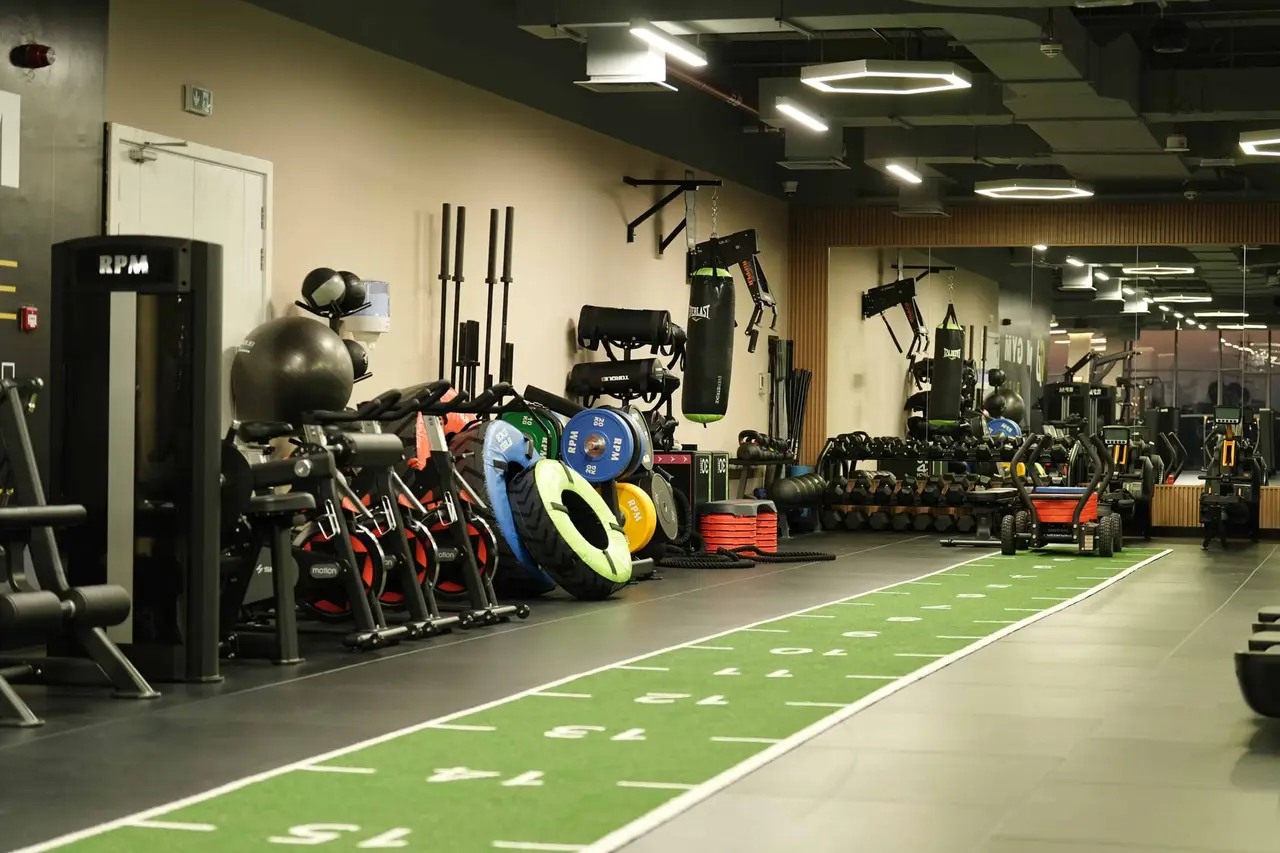
RPM's floor photos show treadmills, cross-trainers and an upright exercise bike on the cardio row, and a functional area with a turf lane, a sled, kettlebells and battle ropes; they do not show a SkiErg. Ask on a free guided tour whether one is on the floor and, if you are planning race preparation around it, whether it is usually available at the hour you train. The roster lists Asma Jamousi Zadeh for HYROX coaching in the women-only Ladies section. Ask how HYROX-style coaching works in the Mixed section, or book personal training to have a coach teach and check your stroke.
Sources
Questions, answered.
Is the SkiErg good for beginners?
Yes, once you learn the hinge. Your own effort sets the resistance, there is no landing, and a few short technique sessions are enough to make the stroke feel natural. Start with easy pieces of five to ten minutes.
What muscles does the SkiErg work?
Mainly the lats, the triceps and the abdominals, with the hips driving the hinge and the shoulders and legs helping. Your heart and lungs do the rest.
What damper setting should I use on the SkiErg?
Somewhere in the lower middle of the range suits most people. Higher settings feel heavier but tire the arms and lower back sooner without making the session better. Experiment once your stroke is consistent, and note the setting with your split, since the two go together.
How long is the SkiErg in HYROX?
1,000 m. It is the first station, after the first 1,000 m run, and every division skis the same distance. Check the current HYROX rulebook for the movement standards.
SkiErg or rowing machine: which should I use?
Neither is better overall. The rower is seated and leg-driven; the SkiErg is standing and loads the lats, triceps and trunk more. Both are HYROX stations, so race preparation needs both; for general fitness, use whichever you will train on regularly, or alternate them.