What it trains, and why the arms stay straight
Most back exercises bend the elbow, which brings the biceps in. Here the elbow stays fixed with a slight bend and only the shoulder moves: the arm sweeps from in front of your head down to your hips. That movement, shoulder extension, is one of the lats' main jobs, so they end up doing almost all of the work. The long head of the triceps, which also crosses the shoulder, assists, and your trunk works to stop the cable pulling you upright.
It goes by several names. Cable pullover, straight-arm lat pulldown and standing pullover describe the same movement; the label tends to change with the attachment, not the exercise. It suits anyone who struggles to feel their lats on rows and pulldowns, as a light primer before them, or as a finisher at the end of a back session. It is an accessory, not a replacement for a heavier vertical pull.
Setting up the cable
- Set the pulley at the top of the tower, or at least well above head height, and clip on a straight bar or a rope.
- Take a straight bar with an overhand grip about shoulder width, or one end of the rope in each hand.
- Step back one or two paces so the cable runs down to your hands at an angle rather than straight down. Feet about hip width, knees soft.
- Hinge forward a little from the hips with a flat back, so your arms can reach up and out along the line of the cable. Arms long, elbows slightly bent, hands about level with your forehead.
- Choose a light weight, far lighter than your lat pulldown. A load you can sweep through the whole arc fifteen times without the elbows bending is the right start.
How to do a rep
- Set your shoulders down, away from your ears, before anything moves.
- Keeping the elbow angle locked, sweep your hands down in an arc, as if pressing the bar towards the floor with long arms.
- Finish with the bar or rope at the front of your thighs and your upper arms by your sides, and squeeze for a moment.
- Let the hands rise back along the same arc over two or three seconds until your arms are overhead again and you feel the lats lengthen down your sides.
- Hold the same torso angle throughout; only the arms move.
Think about the elbows rather than the hands, and drive them down towards your hips. If the elbows start bending to finish a rep, the triceps have taken over and the weight is too heavy. Breathe out as you pull down and in as the arms rise.
Mistakes to fix first
| Mistake | What it looks like | The fix |
|---|---|---|
| Bending the elbows | The hands drop in front of the chest and the rep becomes a triceps pushdown | Lighten the stack and keep the slight elbow bend you started with |
| Rocking the torso | You hinge further forward on each rep to drag the bar down | Set your lean before the first rep and hold it; drop the weight if it drifts |
| Standing too close | The cable hangs straight down and goes slack near the thighs | Step back until the cable angles towards you at the start |
| Shrugging at the top | The shoulders ride up to the ears as the arms rise | Let the lats stretch, but keep space between shoulders and ears |
| Rushing the return | The stack yanks the arms up and the plates clank | Take two to three seconds on the way up |
| Going too heavy | You lean your bodyweight into the bar to start each rep | Use a load you can control for twelve reps or more |
Bar or rope, kneeling, one arm, and the lat pulldown
Each version keeps the same long-arm sweep and changes the grip, the position, or how many arms work at once.
Rope or straight bar?
The straight bar fixes both hands, which makes it easier to learn and to load evenly. The rope lets your hands separate and travel slightly past your hips at the bottom, and many people feel a stronger contraction there. Learn the pattern with the bar, then use the rope for lighter sets.
Kneeling straight-arm pulldown
Kneel facing the cable a pace or two back, with the pulley high. Kneeling takes the hips and legs out, so rocking is harder, and the line of pull suits people who find standing makes them lean into the bar. Expect to use a little less weight.
Single-arm straight-arm pulldown
Clip on a single D-handle and work one arm at a time, facing the stack or standing slightly side-on. It helps when one lat is harder to feel than the other, and the arm can sweep a little behind the hip for a longer finish. Start with the weaker side.
Straight-arm pulldown or lat pulldown?
They are partners rather than rivals. The lat pulldown bends the elbow, brings in the biceps and lets you load the lats heavily. The straight-arm version removes the biceps and works the shoulder movement alone, with a light weight. Most programmes use the pulldown as the main vertical pull and the straight-arm pulldown as a primer before it or a finisher after.
If the cable station is busy, a dumbbell pullover on a flat bench trains the same shoulder movement, though the dumbbell is hardest in the overhead stretch and the cable near the hips.
Sets, reps and where it goes in a session
| Goal | Sets × reps | How hard |
|---|---|---|
| Primer before pulldowns or rows | 2 × 12–15 | Light, stopping well short of failure |
| Building the lats | 3 × 10–15 | One or two reps left at the end of each set |
| Finisher | 2 × 15–20 | Slow three-second return; last set close to failure |
About a minute's rest between sets is enough, since the load is light and little beyond the lats gets tired.
Progress the reps first, then add the smallest weight increment the stack allows. With loads this light, one plate can be a big jump, so slowing the return or pausing at the thighs is often the better next step. Twice a week, beside your rows and pulldowns, is plenty. If the front of your shoulder hurts at the top of the arc, stop, and have it checked by a doctor or physiotherapist if it persists.
The straight-arm pulldown at RPM
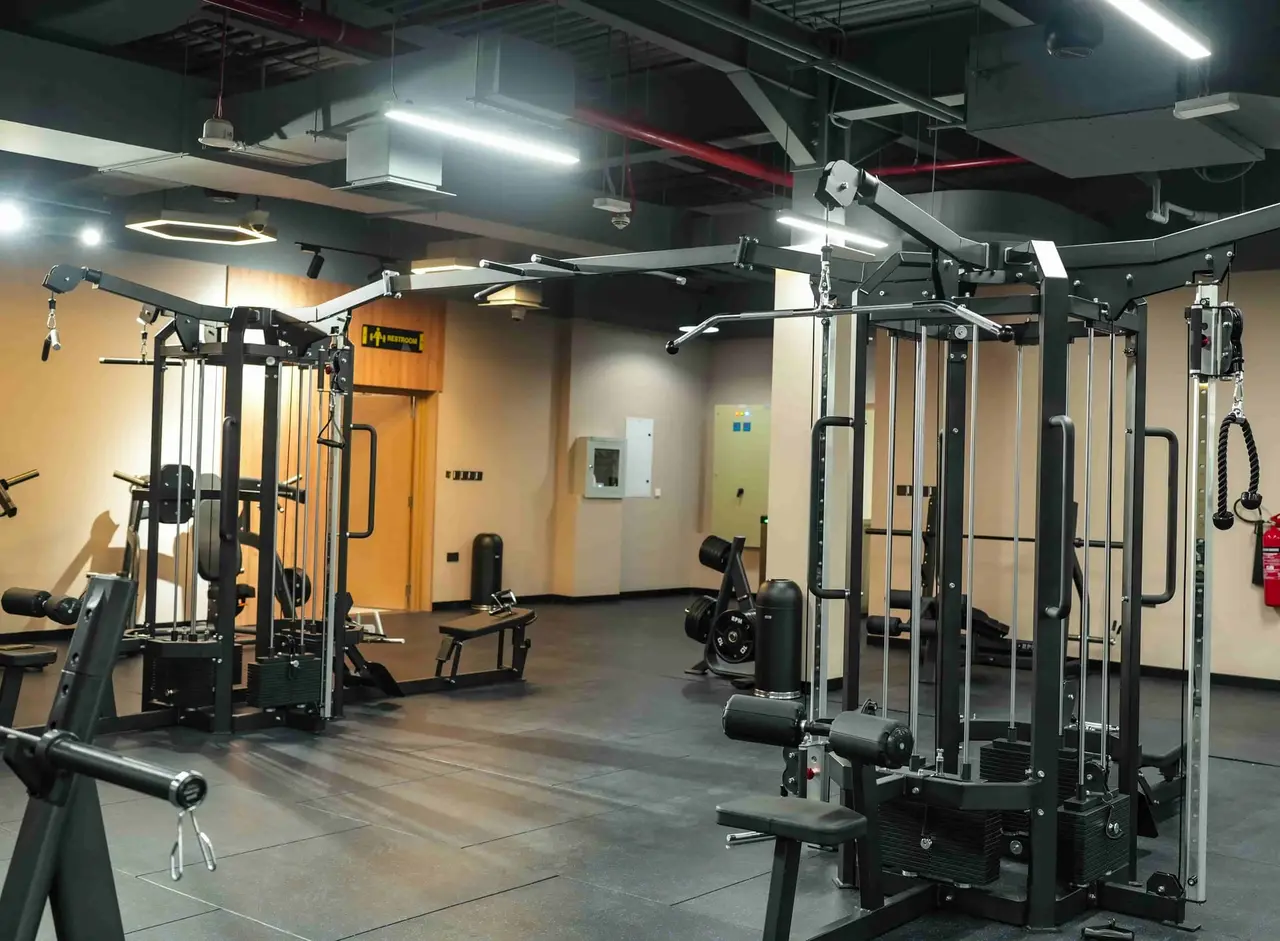
RPM's floor photos show multi-station cable towers on the training floor in Al Manhal, which is all this exercise needs. Which bars, ropes and single handles are on the rack is easy to check on a free guided tour, and a coach in a personal training session can help you feel the lats doing the work rather than the arms.
Questions, answered.
What muscles does the straight-arm pulldown work?
Mainly the lats. The long head of the triceps helps move the shoulder, and the trunk muscles brace to keep you still. The biceps do very little, which is the point of the exercise.
Is a cable pullover the same as a straight-arm pulldown?
Yes. Both names are used for the same standing cable movement, and some people keep 'pullover' for the rope version. The dumbbell pullover is its lying free-weight relative.
Straight-arm pulldown or triceps pushdown: what is the difference?
In the pushdown your upper arms stay pinned to your sides and the elbows straighten, so the triceps do the work. In the straight-arm pulldown the elbows stay fixed and the whole arm moves from the shoulder, so the lats do the work. The triceps pushdown page covers the other one.
Is there a dumbbell alternative?
The dumbbell pullover on a bench is the closest. Standing with dumbbells does not work, because a dumbbell only pulls straight down; at home, a resistance band fixed above head height comes nearer.
Why do I feel it in my arms instead of my back?
Usually because the elbows bend or the load is too heavy. Go lighter, hold a fixed soft bend and think of driving the elbows to your hips. Some triceps work is normal, since one head of the triceps crosses the shoulder. The back training guide shows which heavier pulls to pair it with.