Who the plan suits, and the race it prepares you for
This plan is for a first or second HYROX. It assumes you can already run slowly for about 20 minutes without stopping, and that you have lifted weights before, even if only for a few months. If 20 minutes of running is still out of reach, build up to it over a few weeks first and use one of the full-body plans in the workout library for strength in the meantime.
Four sessions a week cover what the race asks of you. Two runs build the engine, since running is half the race. One strength session builds the legs, grip and pulling that the sleds, carries and lunges need. The fourth, compromised running, puts runs straight after stations so you learn to run on legs that are already tired. The optional fifth session is easy cardio and nothing more.
HYROX's official race page and the 2026/27 singles rulebook describe the same format: eight runs of one kilometre, each followed by one workout station, always in the order below. Loads depend on your division, and both the format and the loads can change between seasons, so check hyrox.com before race day.
The stations in race order, and where this plan trains each one.
| Order | Station | Official work | Trained in this plan by |
|---|---|---|---|
| 1 | SkiErg | 1,000 m | Straight-arm pulldowns in Strength C; a SkiErg or battle-rope piece in linked session B |
| 2 | Sled push | 50 m | All three linked sessions; heavy pushes in Strength B |
| 3 | Sled pull | 50 m | Linked sessions A and C; rows in every strength session |
| 4 | Burpee broad jumps | 80 m | Linked sessions A and B; box jumps in Strength C |
| 5 | Rowing | 1,000 m | Rows and deadlifts; a row or bike piece in linked session C |
| 6 | Farmers carry | 200 m | Kettlebell carries in Strength A and linked session A |
| 7 | Sandbag lunges | 100 m | Lunges in Strength A and linked sessions A and C, with a kettlebell in Strength A and linked session C |
| 8 | Wall balls | 100 reps | Every linked session and the race-week opener |
Divisions change the loads, or how partners share the work, and this plan suits any of them: the guide to your first HYROX helps you choose one.
The 12 weeks and the training week
Four phases. Each keeps the same four sessions and changes what goes into them.
| Weeks | Phase | What changes | Ready to move on when |
|---|---|---|---|
| 1–4 | Base | Easy running grows; intervals at comfortably hard; every station learned at a light load | Your easy run no longer feels like a test, and you can do every station with good form at a light load |
| 5–8 | Linking | Intervals become 1,000 m repeats at race effort; heavier strength; runs paired with stations | A run straight after a station costs you little pace compared with a fresh one |
| 9–11 | Race-specific | Race-pace repeats with shorter rests; the heaviest stations before race-pace runs; one half simulation in week 10 | You hold an even race pace across linked pieces |
| 12 | Taper | About half the training, a little race pace, nothing new | Race day |
Weeks 4 and 8 are lighter: do each session with about a third less work, then carry on. If you miss a week, repeat the previous one rather than jumping ahead.
Any layout works as long as the two hardest sessions, the intervals and the linked session, do not fall on back-to-back days. With a Saturday and Sunday weekend, this one puts the longest session on Saturday.
| Day | Session | How it should feel |
|---|---|---|
| Monday | Run 1: intervals | Hard efforts, easy recoveries |
| Tuesday | Strength | Hard sets with one or two reps left |
| Wednesday | Rest, or the optional easy session | Easy enough to talk throughout |
| Thursday | Run 2: easy | Conversational from start to finish |
| Friday | Rest | — |
| Saturday | Linked session: runs and stations | The hardest session of the week |
| Sunday | Rest or a walk | — |
The optional session is 30 to 40 minutes on a spin bike or cross-trainer at an easy effort. Leave it out in weeks 4, 8 and 12.
Three effort words run through the sessions. Easy means you could talk in full sentences. Comfortably hard means a few words at a time. Race effort is the pace you plan to hold on race day: hard, but the same for every run. The treadmill pace calculator converts a goal pace into a treadmill speed.
Run on a treadmill whenever it is hot outside, which in Abu Dhabi means roughly May to September; the guide to moving your runs indoors in summer covers the switch. If you are pregnant, speak to your doctor or midwife before race-pace training. Pain during a session is a reason to stop and have it checked by a doctor or physiotherapist.
Weeks 1–4: build the base
Add a little each week rather than a lot: one more interval in Run 1, five more minutes in Run 2, a rep or two in the strength session. Week 4 is the lighter week. Everything should feel controlled, and no session should leave you too stiff for the next one.
Run 1 — intervals
On a treadmill or a flat route. Walk the recoveries so each effort starts fresh.
| Exercise | Sets | Reps | Rest | Notes |
|---|---|---|---|---|
| Easy jog, warm-up | 1 | 10 min | — | |
| Run, comfortably hard | 5–7 | 2 min | 90 sec walk | Five in week 1, then one more each week |
| Walk, cool-down | 1 | 5 min | — |
If two minutes of running is still too much, run for one minute and walk for one, and build from there.
Run 2 — easy
Slow enough to talk in full sentences the whole way. Walking for a minute when you need to is part of the session, not a failure.
| Exercise | Sets | Reps | Rest | Notes |
|---|---|---|---|---|
| Easy run | 1 | 25–40 min | — | Add five minutes a week |
| Strides, quick and relaxed | 4 | 15 sec | 45 sec walk |
Strides are short pick-ups to a fast but relaxed pace, not sprints.
Strength A — legs, hinge, grip
The movements behind the sleds, carries and lunges, at weights that leave two or three reps in hand. This is a learning block: smooth reps beat heavy ones.
| Exercise | Sets | Reps | Rest | Notes |
|---|---|---|---|---|
| Goblet squat | 3 | 10 | 90 sec | |
| Romanian deadlift | 3 | 8–10 | 2 min | Dumbbells or a barbell |
| Dumbbell row | 3 | 10 each side | 60 sec | |
| Lunges | 3 | 8 each leg | 90 sec | Kettlebell held at the chest |
| Overhead press | 2 | 8 | 90 sec | Standing, light barbell |
| Farmers carry, kettlebells | 4 | 40 sec | 60 sec | Tall posture, steady steps |
| Pallof press | 3 | 10 each side | 45 sec |
Add a rep or two each week, and raise the weight only once every set reaches the top of its range.
Linked session A — runs and stations at a light load
One round is the whole list, top to bottom. Do two rounds in weeks 1 and 2 and three in week 3, with three minutes' rest between rounds, then two again in week 4. Walk straight from the treadmill to each station, but keep the loads light and the reps tidy.
| Exercise | Sets | Reps | Notes |
|---|---|---|---|
| Run, easy | 2–3 | 400 m | |
| Sled push, light | 2–3 | 1 length | A walking pace you can hold |
| Sled pull, light | 2–3 | 1 length | Ask which attachments are kept |
| Run, easy | 2–3 | 400 m | |
| Burpee | 2–3 | 6 | With a broad jump forward each rep |
| Lunges | 2–3 | 10 each leg | Bodyweight |
| Run, easy | 2–3 | 400 m | |
| Farmers carry, kettlebells | 2–3 | 45 sec | |
| Wall ball | 2–3 | 12 | Light ball; see the stand-ins below |
Sets here are rounds.
Weeks 5–8: link running to the stations
Now the runs move up to race effort and the linked session grows. Run 2 stays as it was, growing to 40 to 50 minutes. Week 8 is lighter: three repeats in Run 1, about two-thirds of the strength sets and three run-and-station pairs instead of four.
Run 1 — 1,000 m repeats
Each repeat is the length of one race run. Hold the same pace for all of them: if the last is slower than the first, start slower next week.
| Exercise | Sets | Reps | Rest | Notes |
|---|---|---|---|---|
| Easy jog, warm-up | 1 | 10 min | — | |
| Run, race effort | 3–5 | 1,000 m | 2 min, walking or jogging | Three in week 5, then add one |
| Walk, cool-down | 1 | 5 min | — |
Strength B — heavier legs and pulling
Heavier than Strength A, with fewer reps on the first lift. Keep one or two reps in hand on the deadlift and never grind a rep out.
| Exercise | Sets | Reps | Rest | Notes |
|---|---|---|---|---|
| Deadlift | 4 | 5 | 2–3 min | Main lift |
| Bulgarian split squat | 3 | 8 each leg | 90 sec | |
| Bent over row | 3 | 8 | 90 sec | |
| Kettlebell swing | 3 | 15 | 60 sec | Hips drive, arms only guide |
| Sled push, heavy | 4 | 1 length | 90 sec | At or a little above your division's load, slower steps |
| Dead bug | 3 | 8 each side | 45 sec |
If the turf lane is busy, move the heavy pushes to the end of the linked session that week.
Linked session B — four runs, four stations
Four runs at race effort, each followed by one station at about half its race distance, in race order with some stations skipped. Rest up to two minutes after each station in weeks 5 and 6 and one minute in week 7; week 8 keeps three of the four pairs.
Weeks 9–11: race-specific work
The last build phase rehearses the hardest moments of the race: running at race pace on tired legs, above all after the sleds. Strength drops to a shorter session so the running and linked work get your freshest legs, and Run 2 becomes your longest easy run, 45 to 60 minutes.
In week 10, replace the linked session with a half simulation from HYROX race simulation workouts, which keeps the official station order and lists stand-ins. Use it to test your pacing, not to set a record.
Run 1 — race-pace repeats, shorter rests
The same distance as in weeks 5 to 8, with more repeats and less rest, so race pace starts to feel ordinary.
| Exercise | Sets | Reps | Rest |
|---|---|---|---|
| Easy jog, warm-up | 1 | 10 min | — |
| Run, race effort | 5–6 | 1,000 m | 60–90 sec walk |
| Walk, cool-down | 1 | 5 min | — |
Strength C — shorter, sharper
Fewer sets than Strength B at the same effort. The box jumps and straight-arm pulldowns carry over to the broad jumps and the SkiErg pull.
| Exercise | Sets | Reps | Rest | Notes |
|---|---|---|---|---|
| Back squat | 3 | 5 | 2–3 min | Main lift; two reps in hand |
| Single leg romanian deadlift | 3 | 8 each leg | 60 sec | |
| Inverted row | 3 | 8–10 | 60 sec | Bar in a rack at hip height |
| Straight arm pulldown | 3 | 12 | 60 sec | |
| Box jump | 3 | 5 | 60 sec | Step down, do not jump down |
| Plank | 3 | 30–45 sec | 45 sec |
Linked session C — sleds, then race pace
Two rounds with three minutes' rest between them, and a third round in week 11 if week 9 went well. The point is the run after the sleds: hold race pace even when your legs disagree.
| Exercise | Sets | Reps | Notes |
|---|---|---|---|
| Sled push | 2 | 25 m | Your division's load |
| Sled pull | 2 | 25 m | |
| Run, race effort | 2 | 1,000 m | |
| Rowing | 2 | 500 m | Or 2 min hard on a spin bike |
| Lunges | 2 | 50 m | Walking, kettlebell at the chest |
| Wall ball | 2 | 25 | |
| Run, race effort | 2 | 1,000 m |
Sets here are rounds.
Week 12: taper and race
Training drops by about half so you arrive fresh. Keep a little race pace to stay sharp and try nothing new: not shoes, not food, not a different warm-up. Read the current rulebook for your division this week, so no movement standard catches you out on the day.
| Days before the race | Session |
|---|---|
| 6 | Run 1 shortened: three 1,000 m repeats at race effort |
| 5 | Strength C with half the sets, nothing heavy |
| 4 | Rest |
| 3 | The race-week opener below |
| 2 | Rest, or 20 easy minutes on a spin bike |
| 1 | 15 minutes of easy jogging with four strides |
Race-week opener
Short and crisp. You should finish feeling you could have done far more.
| Exercise | Sets | Reps | Rest |
|---|---|---|---|
| Easy jog, warm-up | 1 | 10 min | — |
| Run, race effort | 2 | 1,000 m | 3 min |
| Sled push, race load | 2 | 1 length | 2 min |
| Wall ball | 2 | 10 | 60 sec |
| Walk, cool-down | 1 | 5 min | — |
On the day, hold back on the first run. Everyone feels fresh there, and the stations will slow anyone who started too fast.
Stand-ins when a station is missing
Most gyms lack at least one race station. Use a stand-in in training, keep the race order wherever a session follows it, and try the real machine somewhere before race day: a stand-in trains the effort, not the skill. HYROX race simulation workouts shows how to build whole simulations around missing kit; these are the swaps this plan's sessions use.
| Missing | Stand-in in this plan | What it does not copy |
|---|---|---|
| SkiErg | Battle-rope waves for about 90 seconds, or straight-arm pulldowns on a cable tower | The ski's long pull and rhythm |
| Rowing machine | A spin bike, hard, for roughly as long as your row would last | The pull, so keep the rows in your strength sessions |
| Sandbag | Walking lunges with one kettlebell hugged to the chest | A bag on the shoulders sits higher and shifts |
| Wall-ball target | Medicine-ball squat and press, or throws to a marked spot where the gym allows them | The catch and the height of the target |
| Sled pull rope | Ask which attachments are kept; otherwise heavier bent-over rows after the sled push | The hand-over-hand pull |
Sled technique and loading are covered in sled workouts.
Adjust the plan to your race
If this is your second HYROX
Use your first race's splits. If the runs fell apart, add a sixth repeat to Run 1 in weeks 9–11 and keep Run 2 long. If one station cost you the most time, give it a second slot in the linked session. Start weeks 1–4 at the top of each range, since you are not learning the movements from scratch.
If you are training for a women's division
The sessions are the same; only your division's loads differ. HYROX training for women sets out the women's divisions, their loads and where to train if you prefer a women-only space. If you train in RPM's Ladies section, ask on your free guided tour where the sled and turf lane are and how you can use them.
If you are racing Doubles
Train the full plan on your own, then from week 5 to week 11 do the linked session with your partner once a fortnight, taking turns on the stations the way you plan to split them. HYROX Doubles training covers how pairs share the work.
If some sessions happen at home
Both runs move outdoors or onto a home treadmill unchanged, and Strength A works with a pair of dumbbells or kettlebells. The sleds are the gap: keep the linked sessions and Strength B for a gym with a sled and a lane.
If you have fewer than 12 weeks
Cut the base to two weeks if you already run and lift, keep at least three weeks of linking, and never drop the taper. With fewer than eight weeks, aim to finish rather than for a time.
Training for HYROX at RPM
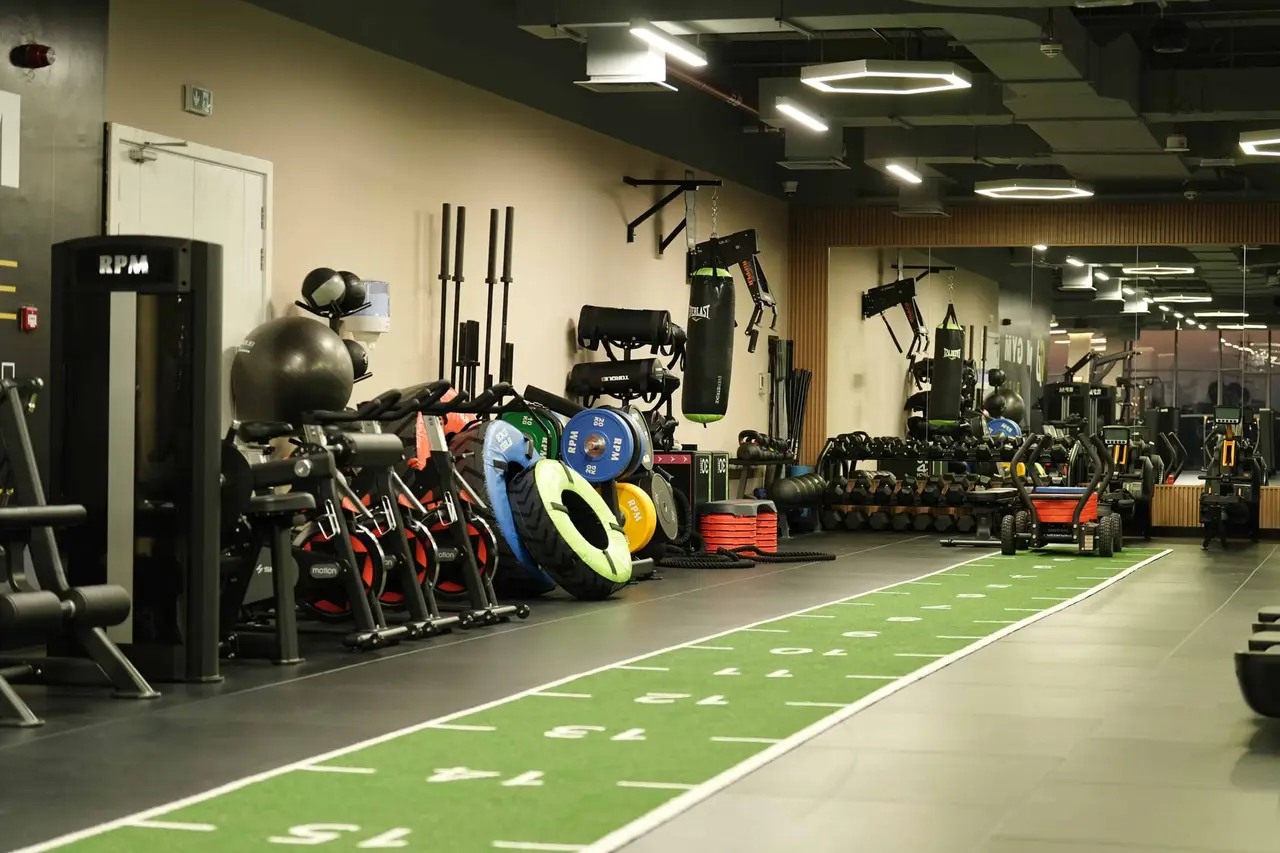
RPM is an independent gym that runs HYROX-style training; it is not an official HYROX partner, gym or venue. Its photos show a turf lane with a sled, kettlebells, medicine balls, battle ropes and soft plyo boxes on the functional floor, and treadmills on the training floor, which covers most of this plan. A SkiErg, rowers, sandbags and a wall-ball target are not confirmed, so ask about them on the free guided tour, and see RPM's HYROX page or personal training if you want a coach to set your loads.
Sources
Questions, answered.
Is 12 weeks enough to train for HYROX?
For most people who already run a little and have lifted before, yes, if the aim is to finish a first race in good shape. If you are starting with no running at all, add four to six weeks of easy running and full-body strength first. More time helps most if you are chasing a particular finish time.
How many days a week should I train for HYROX?
Four is enough for a first or second race: two runs, one strength session and one linked session. A fifth easy session helps if you recover well, and beyond five, fatigue usually builds faster than fitness at this level.
What weights are used in HYROX?
They depend on your division and can change between seasons, so take them from the current rulebook on hyrox.com. For the women's divisions, HYROX training for women lists the loads. Train lighter in weeks 1–4 and work up to yours from week 5.
Can I train for HYROX without a sled?
Partly. Heavy leg work and walking lunges build the legs, and heavy rows build the pull, but nothing copies pushing a loaded sled across a real surface, so try one several times before race day. Sled workouts covers the technique.
Should I do a full race simulation before my first HYROX?
You do not have to. This plan uses one half simulation in week 10. A full one is a very hard session and, if you do it, belongs two or three weeks before the race with easy days around it. The race simulation guide lays out each version.