What a barbell is, and what it is for
Picture a steel shaft with rough, knurled grip sections, and a thicker sleeve at each end where the plates slide on. On an Olympic bar the sleeves spin, so the plates can turn as the bar moves without twisting your wrists. Because both hands hold one implement, a barbell is the most efficient way to load the big movements heavily: the squat, the hinge, the press and the row. Strength programmes are built around it for that reason, and the numbers you lift carry over from one gym to the next in a way that machine weights do not.
The cost is skill. A barbell does not guide you, and heavy squats and presses need a rack with the safeties set. The usual path is to learn the lifts light, one at a time, and many people mix barbell work with dumbbells and machines. This page is one of the gym equipment guides; for the rack that holds the bar, see the power rack guide.
Types of bar and what they weigh
Most gym floors have more than one kind of bar. These are the ones you are likely to meet.
| Bar | Typical weight and grip | What it is used for |
|---|---|---|
| Olympic bar (men's standard) | 20 kg, about 2.2 metres long, a grip about 28–29 mm thick | Squats, deadlifts, presses and rows; the default bar in most gyms |
| Women's Olympic bar | 15 kg, a little shorter, with a thinner grip of about 25 mm | The same lifts, with a grip that suits smaller hands |
| Technique or training bar | Lighter, often 5–10 kg, sometimes aluminium | Learning the lifts before moving to the full bar |
| Fixed barbell | A set weight printed on the end, with the plates welded or bolted on | Curls, rows, presses and lunges without loading plates |
| EZ bar | A short bar with angled bends; the weight varies | Curls and skull crushers, with the wrists at a gentler angle |
| Trap bar (hex bar) | A hexagonal frame you stand inside; the weight varies | Deadlifts and carries with the load at your sides |
Home sets often use a standard bar instead: thin, fixed sleeves that take plates with a small centre hole, so Olympic plates will not fit. If a bar's weight is not marked, ask the staff rather than guessing, and log your lifts on the same type of bar each time.
Loading the bar: plates, collars and unloading
- Load the bar while it sits on the rack hooks or on the floor, never while it is on your back.
- Slide the heaviest plates on first, innermost, then the smaller ones, with the numbers facing out so you and anyone spotting can read the load.
- Load one side, then the other, a plate at a time. On a racked bar, a big difference between the two ends can tip it off the hooks.
- Push the plates all the way in against the sleeve's inner collar, then fit a collar on each end for every set, warm-ups included.
- Count the total: the bar plus both sides. The plate calculator works out which plates go on each end for a target weight.
- To unload, take off the collars, remove plates from alternate sides and put them back in their storage rather than leaving them on the bar.
Bumper plates are thick rubber plates, and the heavier ones share the same large diameter, so a bar loaded with them sits at the standard height from the floor whatever the weight. That suits deadlifts from the floor. Whether you may drop a loaded bar is a separate house rule, so ask before you do.
Barbell exercises by muscle
A barbell can train almost every major muscle. The table groups the movements most worth learning, and the pages linked beneath it take each one step by step.
| Muscle | Barbell exercises | Start with |
|---|---|---|
| Legs and glutes | Back squat, front squat, Romanian deadlift, lunge, hip thrust | Back squat |
| Back | Deadlift, bent-over row, T-bar row, rack pull, shrug | Bent-over row |
| Chest | Bench press, incline bench press, close-grip bench press, decline bench press | Bench press |
| Shoulders | Overhead press, push press | Overhead press |
| Arms | Barbell or EZ-bar curl, close-grip bench press, skull crusher | Barbell curl |
| Trunk and grip | Every standing lift, plus heavy deadlift holds for the grip | Deadlift |
Step by step: back squat, front squat, deadlift, Romanian deadlift, sumo deadlift, hip thrust, lunge, bench press, incline bench press, close-grip bench press, overhead press, bent-over row, shrug, bicep curl and skull crusher.
For a whole back session with nothing but a bar, the barbell back workout puts the rows, pulls and holds together. Women use the same barbell exercises in the same way. The women's bar, at 15 kg with a thinner grip, can feel better in smaller hands, but nothing about the lifts changes; the glute-focused strength guide builds a plan around the hip thrust, squat and Romanian deadlift.
Two full-body barbell workouts
Workout A: squat and bench
| Exercise | Sets × reps | How hard |
|---|---|---|
| Back squat | 3 × 5–8 | Stop with two reps left |
| Bench press | 3 × 5–8 | Two reps left, bar touching the chest |
| Bent-over row | 3 × 8–10 | Torso angle fixed throughout |
| Romanian deadlift | 2 × 8–10 | Stretch felt in the hamstrings |
| EZ-bar curl | 2 × 10–12 | Elbows still |
Workout B: deadlift and press
| Exercise | Sets × reps | How hard |
|---|---|---|
| Deadlift | 3 × 4–6 | Two reps left, bar close to the legs |
| Overhead press | 3 × 6–8 | Glutes tight, no leaning back |
| Front squat or lunge | 3 × 6–8 (each leg for the lunge) | Upright torso |
| Hip thrust | 3 × 8–10 | Pause at the top |
| Close-grip bench press | 2 × 8–10 | Elbows close to the body |
Alternate A and B two or three times a week, with a day between sessions. Rest two to three minutes after the heavy lifts and about a minute and a half after the rest; the full-body workout calculator can fit the plan to the days you have.
Add weight with the smallest plates available once every set reaches the top of its rep range with the same depth and bar path. When jumps start to stall, hold the load for another week, or take one lift back a little and build again.
Mistakes with the barbell
| Mistake | What it looks like | The fix |
|---|---|---|
| No collars | Plates creep along the sleeve during a set, so one end gets heavier | Fit a collar on each end before every set |
| Uneven loading | One end carries a different plate, often because two plates look alike | Match the ends plate for plate and read both before you lift |
| Too heavy too soon | The numbers climb while the depth or range shrinks | Add weight only when every rep looks the same |
| Bar drifting away | On deadlifts and rows the bar swings out in front of the feet | Keep it close enough to brush your legs |
| Gripping off-centre | One hand sits nearer the middle, so the bar tilts on presses | Use the rings marked in the knurling to place both hands evenly |
| Leaving the bar loaded | Plates left on a racked bar after the last set | Strip it and put the plates back |
If a barbell lift hurts your back, knees or shoulders, stop and have it checked by a doctor or physiotherapist before you load it again.
Barbells at RPM
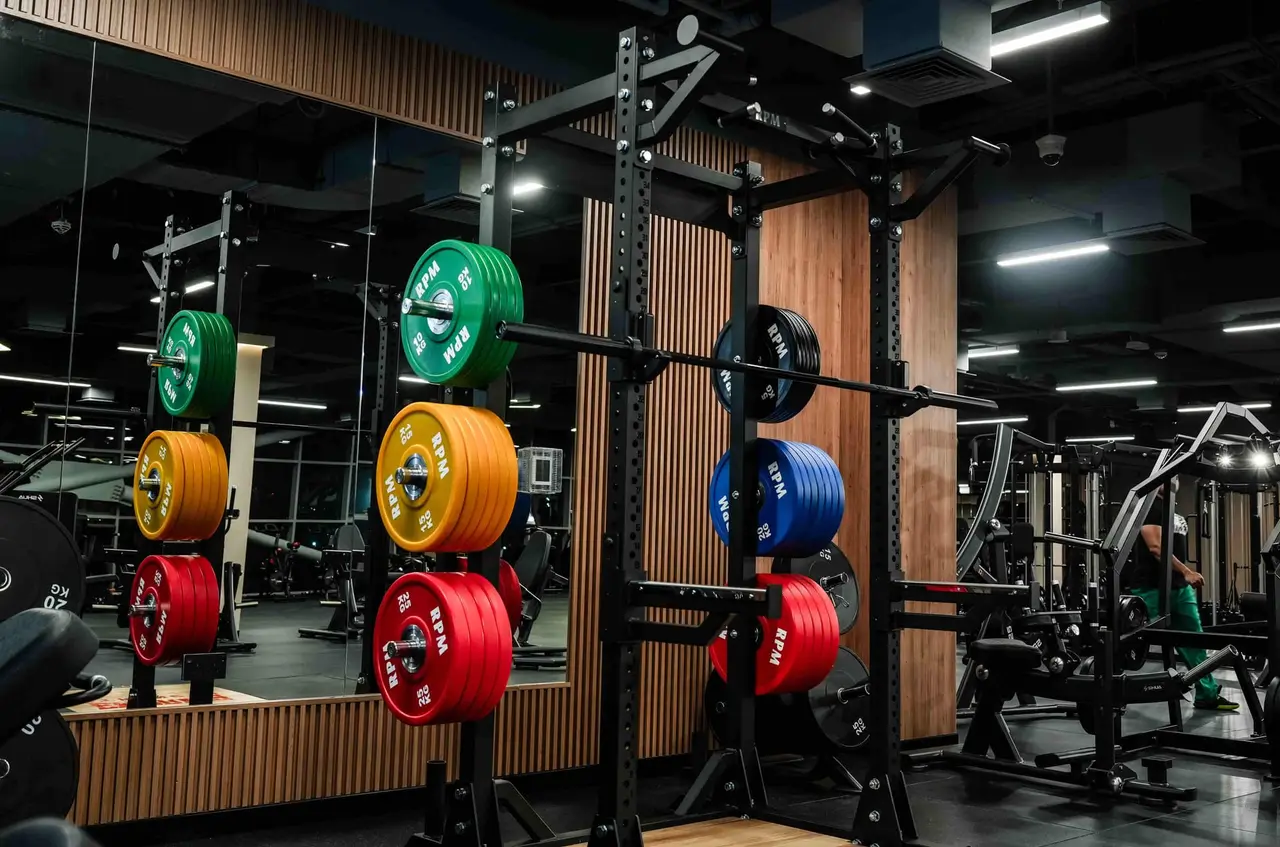
RPM's floor photos show squat racks loaded with barbells and colour bumper plates, a rack of fixed barbells that includes EZ bars, and flat benches on the training floor in Al Manhal. They do not show women's bars, technique bars, a trap bar or a lifting platform, and no photo can settle the rules on dropping weights, so ask about all of these on a free guided tour. The women-only Ladies section has its own strength equipment; ask which bars it holds. To learn the main lifts with a coach, book personal training.
Questions, answered.
How much does an Olympic barbell weigh?
The men's standard bar weighs 20 kg and the women's 15 kg. Training bars can be lighter, and fixed barbells have their weight printed on the end. If a bar is unmarked, ask rather than guess.
What is the difference between an Olympic barbell and a standard barbell?
An Olympic bar has thick sleeves, about 50 mm across, that spin, and takes plates with a large centre hole. A standard bar has thin, fixed sleeves of about 25 mm and is common in home sets. Plates made for one do not fit the other.
How long is an Olympic barbell?
About 2.2 metres for the men's bar and about 2 metres for the women's. At home that matters: you need clear space beyond each end to load plates and to walk the bar out of a rack.
Can I do barbell exercises at home?
Yes, if you have room for the bar and a way to stop it. Deadlifts, Romanian deadlifts, rows, curls and hip thrusts start from the floor; squats and bench presses need a rack with safeties. Check that your floor can take a loaded bar being set down.
Can I train my whole body with only a barbell?
Yes. A squat, a hinge, a press and a row reach every major muscle group, and the two workouts above are complete as they stand. A flat bench adds the bench press and makes hip thrusts easier to set up.
Are barbell exercises good for beginners?
Yes, once you learn them light. Many beginners spend a few weeks on dumbbells and machines, then add barbell lifts one at a time with a coach or a filmed set to check their form. The equipment guides compare the other tools.