Why narrow the grip, and who the lift suits
Moving your hands in changes the job of the elbows more than anything else. With a standard grip the forearms stand vertical and the upper arms flare a little from the body. With a close grip the elbows stay tucked by your sides and bend through a longer arc, so straightening them, which is the triceps' job, becomes a bigger share of the press. The chest still works hard, especially off the bottom, and the front shoulders help, which is why this lift loads the triceps more heavily than any isolation exercise can.
It earns its place in two kinds of programme. Lifters chasing a stronger bench use it to build the lockout, the top half of the press where the triceps finish the rep. Lifters training for arm size use it as the heavy compound movement before pushdowns and extensions. Either way, learn the regular bench press first, because the set-up is the same. The triceps guide shows where it sits among the other triceps exercises.
Setting up in the rack
- Slide a flat bench into the rack so your eyes sit under the bar, and set the J-hooks where a short push from straight arms unracks it.
- Set the safety arms just below the height of your chest at the bottom of the rep. A close-grip bar touches a little lower on the chest than your normal bench, so check the height with the empty bar.
- Grip with your hands roughly shoulder width apart, about where your forearms stand vertical when your elbows are tucked at the bottom. Wrap your thumbs around the bar.
- Pull your shoulder blades back and down, keep a natural arch, and plant your feet flat, exactly as for a regular bench press.
- Start lighter than your normal bench, because most people press a little less with the close grip. Do a few sets with the empty bar, then add small plates while every rep still looks identical.
How to do a rep
- Unrack and hold the bar over your shoulders with straight arms.
- Lower it with your elbows tucked, pointing down towards your hips rather than out to the sides, and your forearms close to vertical.
- Touch the bottom of your breastbone lightly, slightly lower than on a regular bench, without bouncing.
- Press up and slightly back towards your face so the bar finishes over your shoulders.
- Straighten your elbows completely at the top. The lockout is the part you are training, so never cut it short.
Keep the bar low in your palms, over the forearm bones, with your wrists straight. A close grip tempts the wrists to bend back and the hands to tilt outwards; if either happens, widen your grip slightly. Take a breath and brace before each rep, hold it through the press and let it out at the top.
Mistakes to fix first
| Mistake | What it looks like | The fix |
|---|---|---|
| Hands too close | Index fingers almost touching, wrists bent outwards, elbows flaring to make up for it | Move the hands out to about shoulder width |
| Elbows flaring | The upper arms drift out to the sides and it turns into a normal bench press | Tuck the elbows and lighten the bar until you can hold the position |
| Bar landing too high | The bar comes down near the collarbones | Aim for the bottom of the breastbone |
| Soft lockout | Reps stop with the elbows still bent | Finish every rep with straight arms, even if the bar has to get lighter |
| Wrists bent back | The bar rolls towards the fingers and the knuckles point at the ceiling | Set the bar in the heel of the palm, stacked over the forearm |
Wrist and elbow pain are the common complaints with this lift. If either hurts during or after a set, stop pressing and get it checked by a doctor or physiotherapist rather than working through it.
Grip width, dumbbells, the Smith machine and the JM press
These cover what people ask once they start: how close is close, and what to use instead of the barbell.
How close should the grip be?
About shoulder width. For most people that puts the index fingers near the inner edge of the knurling or just inside it, though bars differ. Hands touching in the middle, as some older programmes showed, bends the wrists and adds nothing for the triceps, and narrowing the grip further mostly makes the lift awkward rather than harder for the arms.
Close-grip dumbbell press (crush press)
Lie on a flat bench and press two dumbbells with your palms facing each other, the dumbbells touching or squeezed together over your chest. The elbows stay tucked, so the triceps work hard, and squeezing the dumbbells together keeps the chest busy. It needs no rack, lets the wrists find their own angle and suits training alone. Expect to use a lighter pair than for your normal dumbbell press.
Smith machine close-grip
The bar runs on fixed rails, so there is nothing to balance and you can rack it at any point. That makes hard sets possible without a spotter, although the fixed path does not suit every shoulder. Set the bench so the bar touches the bottom of the breastbone. The Smith machine guide covers the stops.
JM press
A hybrid of the close-grip bench and the skull crusher. With a close grip, you lower the bar towards your upper chest or chin by letting the elbows travel forward and the forearms tip back, then press it up again. It loads the triceps heavily through a short range. It is a niche lift: learn it light, once both parent exercises feel solid, because it asks more of the elbows.
If the racks are busy, the crush press above or dips give the triceps similar heavy work.
Sets, reps and where it fits
| Goal | Sets × reps | How hard |
|---|---|---|
| Building bench lockout strength | 3–5 × 4–6 | One or two reps left; the same bar path every rep |
| Building the triceps | 3–4 × 6–10 | One or two reps left, full lockout |
| Lighter technique work | 2–3 × 10–12 | Three reps left; practise the elbow position |
Rest two to three minutes between heavy sets and about two minutes between lighter ones. The plate calculator works out what to load on each side.
Do it after your main bench press on the same day, or make it the main press of a second pressing day. Once a week is enough for most people, twice if the bench press is your focus. Avoid stacking it with heavy skull crushers and dips in the same session: the elbows feel that before the muscles do. Progress as you would on the bench. When every set reaches the top of its range with a clean lockout, add the smallest plates the gym has.
The close-grip bench press at RPM
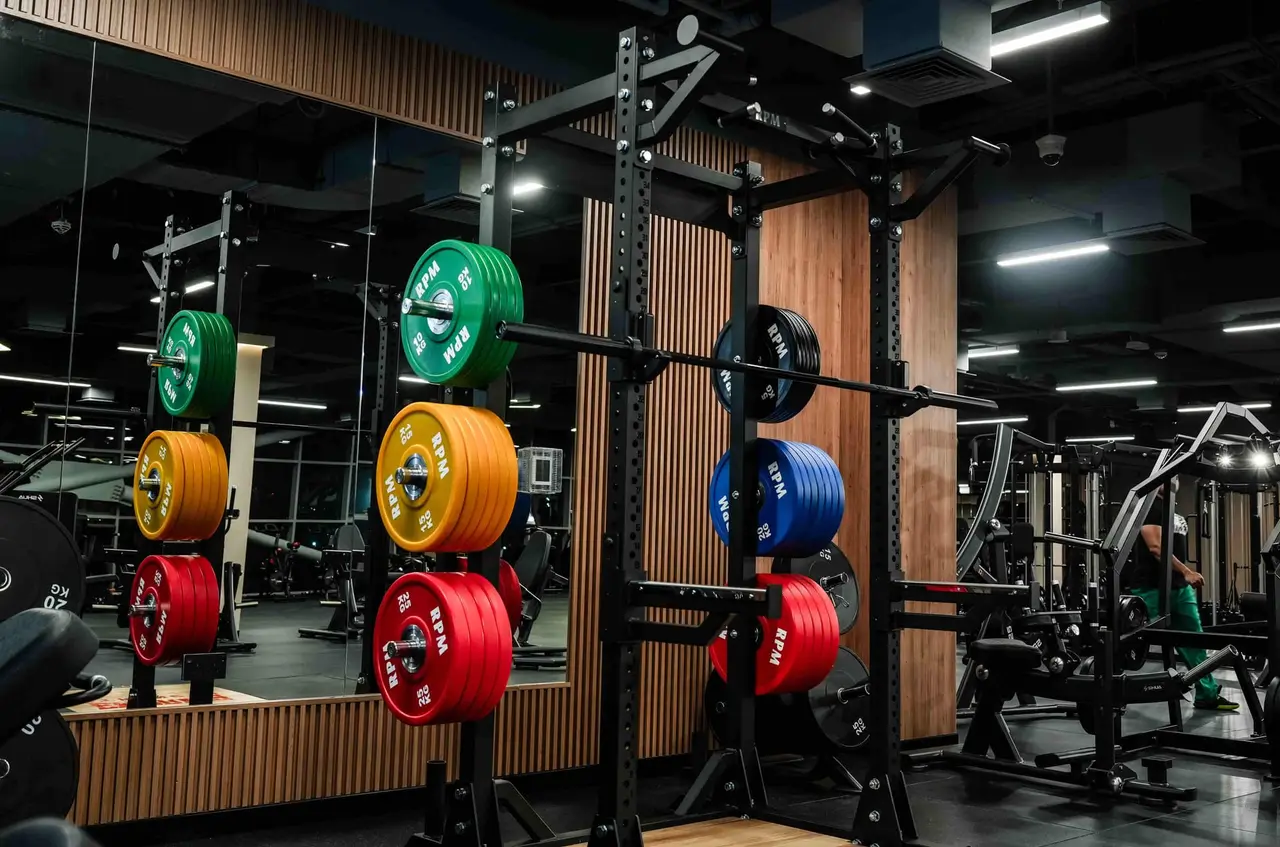
RPM's floor photos show squat racks with barbells and colour bumper plates, and flat benches, on the training floor in Al Manhal, which is everything this lift needs. Whether a flat bench fits inside a rack with the safety arms set for pressing, and whether there is a Smith machine, are worth checking on your free tour. To have a coach set your grip and safety arms the first time, book personal training.
Questions, answered.
Close-grip or regular bench press: what is the difference?
Only the grip and what follows from it. Hands at shoulder width keep the elbows tucked and shift work to the triceps; a wider grip shortens the bar's path and gives the chest more of the load. Most people lift a little less with the close grip. Strength programmes often use both: the regular grip as the main lift and the close grip as an assistance lift.
Does the close-grip bench press work the chest?
Yes. The chest still does much of the work, particularly near the bottom of the rep; the triceps simply take a bigger share than with a wider grip. It is a triceps-focused press, not a triceps isolation exercise.
Close-grip bench, skull crushers or pushdowns for the triceps?
The close-grip bench takes the heaviest load and works the chest too; skull crushers and pushdowns isolate the triceps and are easier to adjust. A typical plan opens with the press and finishes with one isolation exercise, such as the tricep pushdown.
Close-grip bench press or dips?
Both are heavy triceps presses. Dips move your bodyweight and take the shoulder deeper; the close-grip bench is easier to load in small steps and to bail out of onto safety arms. Pick the one your shoulders tolerate, or use one on each pressing day.
What can I do instead of the close-grip bench press?
With dumbbells, the crush press. On machines, a chest press with a narrow grip or a seated dip machine; on cables, pushdowns. At home, diamond push-ups, with the hands close enough that the thumbs and index fingers form a triangle, load the triceps hard.