What the machine looks like, and what it trains
Most ab crunch machines share one layout: a padded seat, a back pad, foot rollers or a footplate that hold your legs, and a moving arm that pivots at about the height of your stomach. You move the arm either by pressing your upper chest against a pad or by holding handles beside your head with your elbows resting on pads. Resistance comes from a weight stack with a pin, or on plate-loaded versions from plates slid onto a horn. Some designs also tilt the seat, so your knees rise as your chest comes down. Gyms call it the ab crunch machine, the abdominal machine or simply the ab machine.
Whatever the design, the job is a crunch: the rectus abdominis bends the trunk forwards, with the obliques helping. The machine adds load you can measure and raise in small steps, a fixed path that suits beginners, and support for your back and head. That makes it a sensible way to train trunk flexion with weight, in a core block after your main lifts, as the core training guide describes.
Setting up the seat, pads and pin
- Find the pivot. Many machines mark it with a coloured dot on the side of the moving arm, and a diagram shows where it should sit on your body, usually around the bottom of the breastbone or the navel. Raise or lower the seat until it lines up.
- Hook your feet under the rollers or set them on the footplate, so your thighs are held in place without being clamped into the seat.
- Chest-pad machines: set the pad across your upper chest, below the collarbones. Handle machines: rest your hands on the handles beside your head, elbows on the pads.
- Sit tall against the back pad with the arm in its starting position and the stack just lifted off its rest.
- Pick a light pin setting, one you could curl fifteen times with a pause. Stack numbers differ between brands, so judge by the reps, not the number.
How to do a rep on the machine
- Breathe in and brace, then start breathing out as you move.
- Curl your ribs down towards your hips, so your chest travels towards your knees and your upper back rounds.
- Keep your hips on the seat and your arms passive: they connect you to the machine, they do not move it.
- Pause for a second at the end of the curl, where your stomach feels shortest.
- Return over two or three seconds until your back is upright again, stopping just before the plates touch so the tension stays on.
The arm should move because your trunk curls, not because you tip forwards from the hips. If you feel it more in the fronts of your hips or in your arms than in your stomach, take weight off and shorten the movement. Pain in your neck or lower back is a signal to stop and get it checked by a doctor or physiotherapist.
Mistakes on the ab machine
| Mistake | What it looks like | The fix |
|---|---|---|
| Pulling with the arms | The handles come down because the arms pull, while the trunk barely bends | Rest the hands lightly; the elbows simply ride on the pads |
| Hinging at the hips | The torso tips forwards in one straight piece | Round the upper back so the curl starts at the ribs |
| Pushing with the legs | The thighs lift and drive into the rollers | Lighten the pin and let your feet rest under the pads |
| Seat at the wrong height | The pad presses on the throat or the stomach, or the movement feels jammed | Line the pivot up with your middle and test again |
| Too much weight | Short, jerky reps that rock the whole body | Drop the pin until each rep has a pause and a slow return |
| Letting the stack crash | The plates bang together at the top of every rep | Control the return and stop just short of the rest |
Chest-pad and handle versions, and the rotary torso machine
Ab machines come in a few designs. They train the same muscles; what differs is how you hold on and which way the trunk moves.
Chest-pad or handle version?
On a chest-pad machine you cross your arms and press the pad with your upper chest, so the arms cannot help at all. Handle machines are more common and work well as long as the handles are only somewhere to rest your hands. If you catch yourself pulling, cross your arms in front of the handles or switch to the pad version. Neither is harder in itself; the pin decides that.
Rotary torso machine for the obliques
A different machine: you sit with your legs locked in place, or kneel on a turning seat, hold a chest pad or handles, and rotate your trunk to one side against the stack before returning. It trains the obliques through rotation, the job a Russian twist does on the floor. Turn slowly within a comfortable range, start very light and give both sides the same reps.
If the ab machine is taken, the cable crunch does the same curl against a stack at a cable tower and is the closest substitute.
Sets, reps and moving the pin
| Goal | Sets × reps | How hard |
|---|---|---|
| Learning the machine | 2–3 × 12–15 | Light, with a pause, finishing well before the curl shortens |
| Building the abdominal muscles | 3 × 10–15 | Two reps left, every rep with a pause |
| Heavier work | 3 × 8–12 | Close to the last full curl, never with a rocking body |
Rest a minute between sets. Moving the pin one plate at a time keeps the jumps small.
Train it two or three times a week at most. When the top of your rep range feels controlled on every set, move the pin down one plate; if the reps then shorten, go back and slow the return before trying again.
Ab crunch machines at RPM
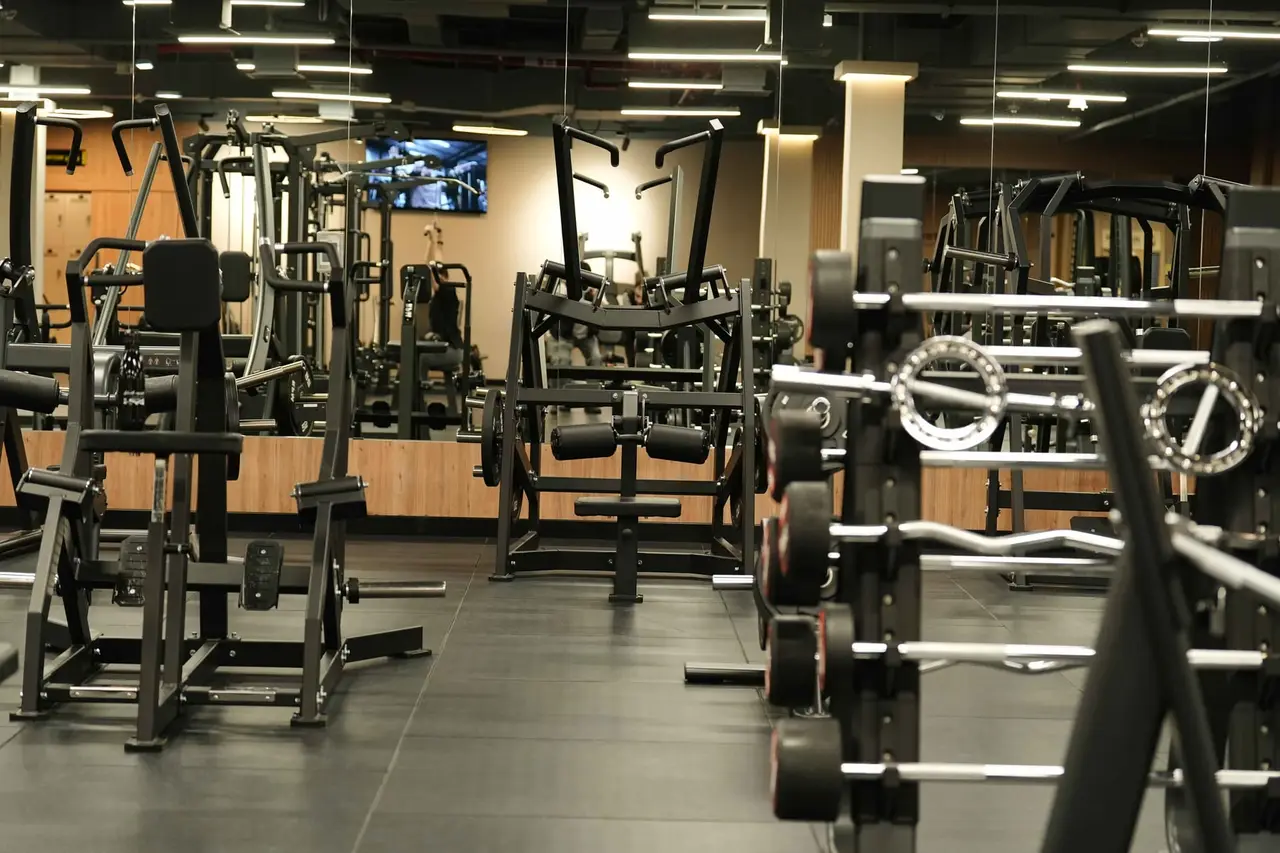
RPM's floor photos show plate-loaded machines and multi-station cable towers in Al Manhal, but they do not show an ab crunch machine or a rotary torso machine, so ask the team on your free guided tour which ab machines are on the floor. Cable crunches are possible on the cable towers the photos do show, and a personal training session is a quick way to have the seat and the pin set for you.
Questions, answered.
Is the ab crunch machine any good?
Yes, for one job: crunching against a load you can measure and increase. It is easier to learn than the cable crunch and supports your back and head. It does not train the trunk to resist movement, so pair it with a plank or a carry.
Ab crunch machine or cable crunch?
Both load the same curl. The machine fixes the path and supports you; the cable crunch lets you choose your position and range but takes more practice to keep the hips still. Many people start on the machine and add the cable version later.
Ab crunch machine or hanging leg raises?
The machine moves your chest towards your hips; the hanging leg raise moves your hips towards your chest and adds grip and shoulder work. The hanging leg raise page covers the harder option.
Is there a machine for the lower abs?
There is no separate lower-ab muscle, but stations that move the legs rather than the chest, such as the captain's chair, a knee-raise frame with a back pad, are often called lower-ab machines because the movement starts at the pelvis.
Do I need an ab machine at home?
No. A mat covers crunches, reverse crunches and dead bugs, and a dumbbell or plate adds load. Home ab gadgets put a frame around the same crunch; some people find they help keep the neck relaxed, but they add nothing your stomach muscles need.