What the bicycle adds to a plain crunch
Three things happen at once. The front abdominal muscle holds your shoulders off the floor in a small crunch. The obliques, the layered muscles at the sides of your waist, turn your ribcage so one shoulder travels towards the opposite hip. And the legs take turns straightening, which makes the deep abdominal muscles and the hip flexors work to stop your pelvis tipping and your lower back arching. A plain crunch does only the first of the three.
That mix of rotation and a moving lower body is why the bicycle turns up in so many core circuits. It needs nothing but floor space, suits beginners once the basic crunch is comfortable, and fits at the end of a session beside a hold. The core training guide covers the anti-rotation work, such as the Pallof press, that balances all this twisting.
Getting into position
- Lie on your back on a mat and settle your lower back gently into it, so a hand would not fit underneath.
- Lift your legs into a tabletop: hips and knees bent at right angles, shins parallel to the floor.
- Rest your fingertips lightly at your temples with your elbows wide. They stay there for the set; they are not handles.
- Curl your head and shoulder blades off the floor, as in a crunch, and plan to hold that height until the set ends.
- Pick a range you can control. If your lower back lifts when a leg straightens, keep the straight leg higher for now.
One rep, side by side
- Breathe out and turn your ribcage to the right, bringing your left shoulder, not just the elbow, towards your right knee as that knee draws in.
- At the same time, straighten your left leg forwards, well clear of the floor.
- Hold the turn for a moment; your left shoulder blade should be clearly lifted.
- Pass back through the middle without lowering your shoulders and repeat to the other side.
- Count one rep per side, and keep the rhythm slow enough that every turn has a visible pause.
Slow is the whole point. Each turn should take about a second and end with a short hold; at speed the legs swing, the elbows flap and the obliques do far less. Breathe out on every turn and in as you pass the middle. If the movement hurts your neck or lower back, stop and get it checked by a doctor or physiotherapist.
Bicycle crunch mistakes
| Mistake | What it looks like | The fix |
|---|---|---|
| Chasing the knee with the elbow | The elbow touches the knee while the shoulder stays on the floor | Aim the shoulder at the knee; the elbow stays wide and need never touch |
| Pulling the head | Hands grip the back of the head and jam the chin down | Fingertips at the temples, with a fist's space under the chin |
| Pedalling at speed | Swinging legs and a count that races ahead | About a second per side, with a pause at each turn |
| Lower back arching | The back lifts off the mat as a leg straightens | Straighten the leg higher, or extend it less far |
| Head dropping between reps | The head touches down every time you switch | Keep the shoulder blades up for the whole set and rest between sets instead |
Tempo, leg height and where your hands go
There is no machine to adjust, so you tune the bicycle with three settings: speed, how low the straight leg goes and where your hands sit.
Slow tempo or fast?
Slow, for almost everyone. Around a second per side with a short pause keeps the work in the obliques and shows up form problems immediately. Fast bicycles become a leg swing that mostly raises your heart rate. If you want a quicker version for a conditioning circuit, earn it with clean slow sets first, and slow down the moment your lower back lifts.
Feet higher or lower?
The lower the straight leg, the longer the lever and the harder your trunk must work to keep the lower back down. Beginners keep the extended leg high, pointing steeply towards the ceiling; as control improves, lower it gradually towards a few hand-widths above the floor. The test is simple: if your back peels off the mat, the leg is too low for you today.
Hands behind the head or at the temples?
Fingertips at the temples or just behind the ears give the least temptation to pull. Laced fingers behind the head look similar but almost always end with the hands yanking the neck forwards. If your neck still tires, cross your arms on your chest and turn the ribs alone; the shoulders travel less, but the obliques still work.
When you want rotation against a load you can measure, a cable woodchop at the cable towers or a weighted Russian twist is the next step.
How many bicycle crunches, and how to progress
| Goal | Sets × reps | How hard |
|---|---|---|
| Learning the pattern | 2–3 × 8–10 per side | Slow, with a pause on every turn |
| Building the obliques | 3 × 12–15 per side | End the set when the pause disappears or the back lifts |
| Conditioning circuits | 3 × 30–40 seconds | A steady rhythm, never faster than you can keep the back down |
Rest thirty to sixty seconds between sets. In a core block, follow bicycles with a hold such as a side plank rather than more crunching.
A few sessions a week is enough. Progress by lowering the straight leg, then lengthening the pause, then adding reps. A light plate held on the chest is possible but rarely needed, because the lever already does the job.
Bicycle crunches at RPM
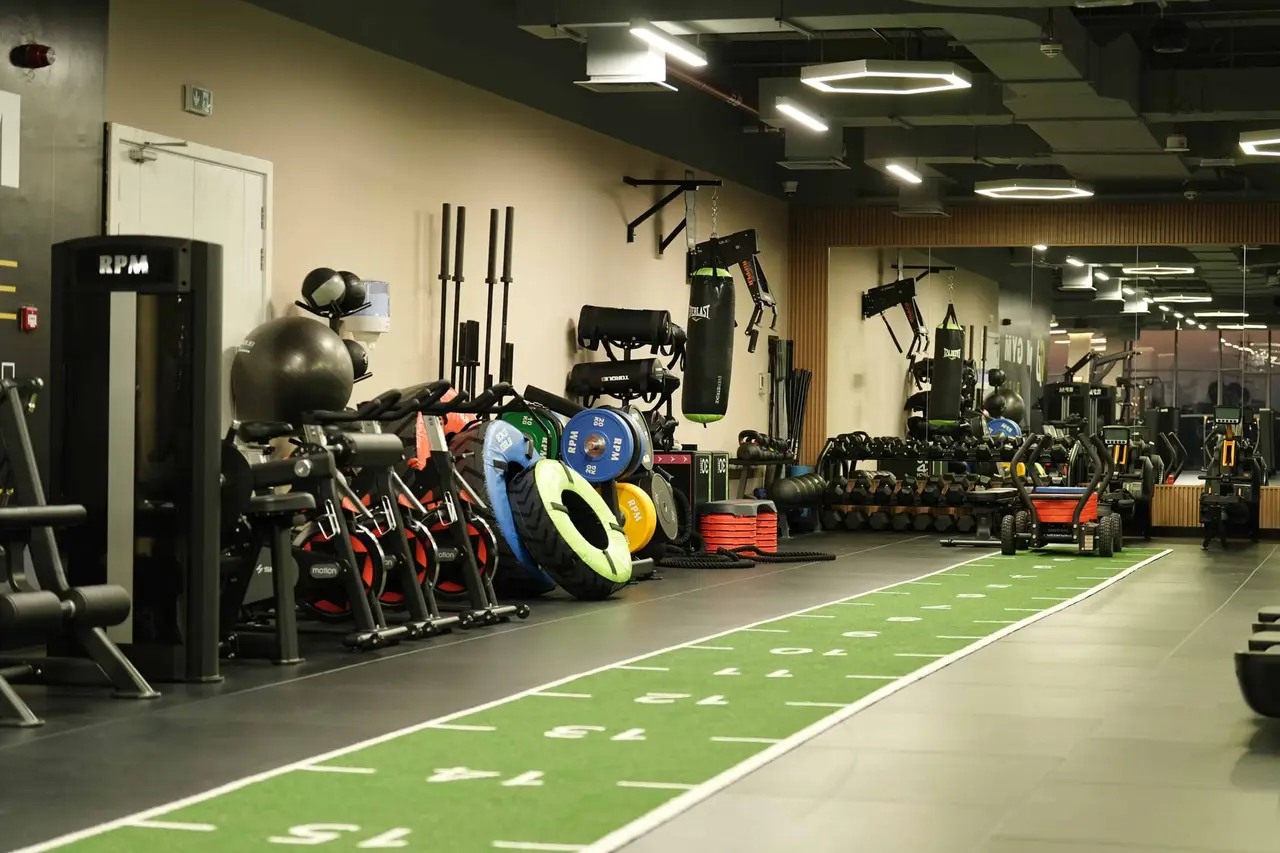
The bicycle crunch needs only a mat, so any clear floor in the Mixed or Ladies section will do. The cable towers in RPM's photos are where loaded rotation work such as woodchops and Pallof presses comes next, and a personal training session is a quick way to have a coach slow you down and check the turn.
Questions, answered.
What muscles do bicycle crunches work?
Mainly the obliques at the sides of your waist and the rectus abdominis at the front. The deep abdominal muscles and the hip flexors work to keep your pelvis still while the legs move.
Bicycle crunch or Russian twist?
Both train rotation. The bicycle is done lying down with the legs moving, so it adds lower-body control; the Russian twist is seated, easier to load with a weight and asks more of the leaned-back hold. Choose one per session; the Russian twist page covers the other.
Are bicycle crunches better than regular crunches?
Not better, broader. They add rotation and leg movement, so the obliques work more; the plain crunch is easier to do slowly and to load. Many people master the crunch first and add bicycles once the basic curl feels comfortable.
Do bicycle crunches get rid of belly fat or love handles?
No exercise removes fat from one spot. Bicycle crunches strengthen the muscles at the front and sides of your waist; whether they show depends on overall body fat, which changes with what you eat and how active you are.
What is a standing bicycle crunch?
A standing version in which you lift one knee towards the opposite elbow, alternating sides. It is easier on the neck and suits a warm-up, but the trunk works much less than on the floor because gravity is not resisting the curl.
What can I do instead of bicycle crunches?
For beginners, the dead bug uses the same alternating legs without curling or twisting. If you are pregnant or postnatal, or have been told you have abdominal separation, ask your doctor or midwife which exercises suit you.