The short answer
Think of one movement seen from two ends. On the lat pulldown you sit with your thighs locked under pads and pull a bar down to your chest. On a pull-up you hang from a bar and pull your chest up to it. The lats lead in both, helped by the biceps, the muscles between the shoulder blades and the rear shoulders. What changes is who sets the load, and how much the rest of your body has to do.
So which is better depends on the job. If the goal is pull-ups, nothing replaces practising them, and the first pull-up guide shows how to build towards the first rep. If the goal is a bigger, stronger back, both qualify, and the back training guide shows how a vertical pull fits beside rows and hinges.
Side by side
| What differs | Lat pulldown | Pull-up |
|---|---|---|
| What moves | The bar, down to you | You, up to the bar |
| Load | Any pin on the stack, in small steps | Your bodyweight, plus a belt or minus assistance |
| Learning curve | Low: sit, grip and pull | Higher: hanging, body control and enough strength to start |
| Trunk and grip | Thigh pads hold you; grip works moderately | Trunk braces against swinging; grip holds your whole weight |
| Main muscles | Lats, with the biceps and upper back | Lats, with the biceps and upper back, plus more trunk |
| Reps per set | Whatever the chosen load allows | Set by your strength relative to your bodyweight |
| Kit needed | A cable station with a pulldown seat | A bar you can hang from |
| Who it suits | Beginners, volume work, training around fatigue | Anyone with several clean reps, or who wants the skill itself |
Can one replace the other? What three studies found
Three small studies tested how closely the two lifts are linked.
- Johnson and colleagues tested 35 college men and 23 college women. Both groups lifted more relative to their bodyweight on a one-rep-max pull-up, with weight added or counterbalanced, than on a one-rep-max pulldown. Pulldown strength tracked pull-up strength well in the men, but only weakly in the women.
- Halet and colleagues tested 28 women swimmers. How many pull-ups they could do was only moderately related to their heaviest pulldown and unrelated to their pulldown reps, and the authors concluded the two should not be substituted for one another in training.
- Doma and colleagues compared chin-ups with the pulldown and found the biceps and the muscles along the spine worked harder during the lifting phase of the chin-up.
Taken together, the pulldown builds strength that a pull-up uses, but it does not teach the skill of hanging and lifting your own body, and stack numbers do not convert into bodyweight. All three studies were small and measured people at one point in time, so they say nothing about which builds more muscle over months.
Pulldown weight against your bodyweight
People often ask how much they need to pull down before a pull-up is possible. There is no reliable number. Machines differ in pulley ratio and friction, so the figure on the stack is not the true load at the bar, and the Johnson study found people handled more relative load on the pull-up than on the pulldown. Pulling your bodyweight on one machine does not mean you can do a pull-up, and some people do pull-ups while pulling down less than they weigh. Track each lift on its own terms: pulldown loads on the same machine, pull-ups as reps or added weight.
For building muscle
For growth, the deciding factors are the same on both: sets taken close to failure, enough of them across the week, and a load or rep count that keeps rising. The pulldown makes that easy to arrange, because you can pick a weight for exactly eight to twelve reps, drop it mid-set or add a little next week. Pull-ups are harder to dose. If you can do three, every set is short and heavy; if you can do fifteen, you need a belt and plates to stay in a muscle-building range. That is why many lifters do pull-ups early in a session for strength and skill, and pulldowns later for volume.
When to choose each
Lean on the pulldown when:
- You cannot yet do several clean pull-ups.
- You want a specific rep range, or to add load in small steps.
- You are tired after a hard week, or want a second vertical pull late in a session.
Lean on the pull-up when:
- You want to get better at pull-ups, for a fitness test, for climbing, or for the skill itself.
- You can do at least five clean reps and want a pull that also trains the trunk and grip.
- There is a bar but no cable station, at home or outdoors.
Using both in a week
| Where you are | Session A | Session B |
|---|---|---|
| No pull-up yet | Lat pulldown 3 × 8–12, then bar practice: hangs and slow lowering | Underhand pulldown 3 × 8–10, then a row |
| One to five pull-ups | Pull-ups 4–5 sets of 1–3, stopping before form slips, then pulldown 2 × 10–12 | Lat pulldown 3 × 8–12, then a row |
| Eight or more pull-ups | Weighted or slow-lowering pull-ups 3–4 × 4–6 | Lat pulldown 3 × 10–15 with a different grip |
Rest about two minutes after pull-up sets and about ninety seconds after pulldowns. If your shoulders or elbows ache after bar work, stop and have them checked by a doctor or physiotherapist.
Both at RPM
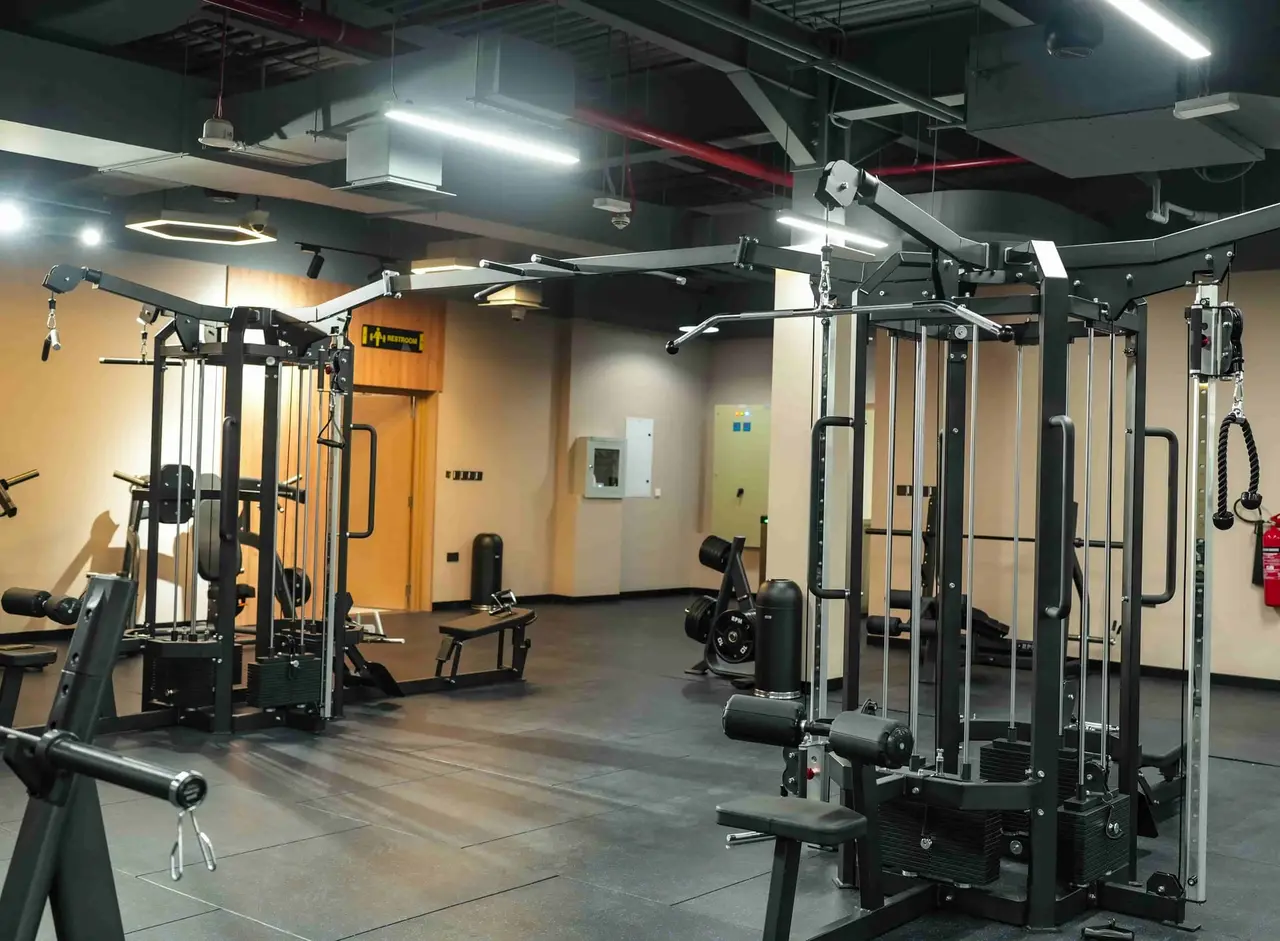
RPM's floor photos show multi-station cable towers with a pulldown seat and thigh pads in Al Manhal, so the pulldown side of this page is covered. A pull-up bar and an assisted pull-up machine are not confirmed in the photos; ask on your free guided tour where you could practise on a bar. A personal training session is a quick way to set your pulldown loads and plan the bar work.
Sources
- Johnson D, Lynch J, Nash K, Cygan J, Mayhew JL. Relationship of lat-pull repetitions and pull-ups to maximal lat-pull and pull-up strength in men and women. Journal of Strength and Conditioning Research, 2009
- Halet KA, Mayhew JL, Murphy C, Fanthorpe J. Relationship of 1 repetition maximum lat-pull to pull-up and lat-pull repetitions in elite collegiate women swimmers. Journal of Strength and Conditioning Research, 2009
- Doma K, Deakin GB, Ness KF. Kinematic and electromyographic comparisons between chin-ups and lat-pull down exercises. Sports Biomechanics, 2013
Questions, answered.
Are pull-ups better than lat pulldowns?
For getting good at pull-ups, yes. For building the lats, there is no evidence that either wins when both are trained hard; the pulldown is simply easier to load precisely.
Is the assisted pull-up machine the same as a lat pulldown?
Not quite. On the assisted machine you kneel or stand on a pad that pushes you up, so you still hang and move your body; on the pulldown your body stays still. The assisted machine is closer to a real pull-up, though both build the same pull.
Will lat pulldowns help me do a pull-up?
They build the strength, but the studies above suggest they are not enough on their own. Add hangs, top holds and slow lowering on a bar, as the first pull-up guide describes.
Which is better for a wider back?
Both train the lats, which give the back its width, so either can do it. Grip width matters less than people think: on the pulldown, research found similar lat activity across a range of widths. Hard, progressive sets matter more than the choice of exercise.
Can I do both in the same session?
Yes. Do pull-ups first while you are fresh, then pulldowns for extra sets, and count both towards your weekly back sets. Pair them with a row such as the seated cable row.