The short answer
The two lifts are one movement started from different heights. In a glute bridge you lie on your back with your shoulders on the floor and lift your hips. In a hip thrust your upper back rests on a bench, so your hips start below your shoulders and travel further before they lock out. That single difference decides how much range you get, how much load you can use and how much set-up each one takes.
Both are hip-extension exercises that are hardest with the glutes squeezed short at the top, which sets them apart from squats and Romanian deadlifts. The glute guide explains how those two ends of the range fit together in a week.
Side by side
| What differs | Hip thrust | Glute bridge |
|---|---|---|
| Set-up | Upper back on a bench, bar or weight across the hips | Lying on the floor, shoulders down, weight optional |
| Range of motion | Longer: the hips start below the bench edge | Shorter: the hips start on the floor |
| Main muscles | Gluteus maximus, with the hamstrings and quads helping | The same muscles; foot distance shifts the balance in both |
| Learning curve | Moderate: bench height, bar position and a clean lockout | Low: most people get it within one set |
| Loading | Heavy barbell or machine loads | Bodyweight up to moderate dumbbell or barbell loads |
| Joint demands | Bar pressure on the hip bones; the lower back can take over at the top | Very little; the floor supports the upper back |
| Where it fits | The main glute lift on a gym day | Warm-up, home training, high-rep finisher |
| Common faults | Arching at the top, sliding on the bench | Pushing through the toes, half reps |
How each one loads the glutes
In the thrust, the bench lifts the shoulders so the hips can sink below them at the bottom of each rep. The hip bends further, the glutes start longer and the hips travel a greater distance to lockout. That bigger range, together with a stable bench to push from, is why the thrust takes heavy loads well and has become the main glute lift in many programmes.
In the bridge, the floor stops the hips early, so each rep covers roughly the top half of a thrust. The hardest part, the lockout, is the same, which is why a paused or single-leg bridge is still hard work. Holding the top for several seconds is easy to arrange, and so are long sets with no equipment, but the short range gives the load less room to grow, so the bridge tops out sooner as you get stronger.
Foot position works the same way in both. Feet close to you put more of the work on the quads; feet further away shift it to the hamstrings; shins vertical at the top keep it on the glutes.
When to choose the glute bridge
- You are new to glute training and want to learn hip extension without a bench or bar.
- You are training at home with only the floor and perhaps a dumbbell.
- You want a warm-up before squats, deadlifts or thrusts.
- You want high-rep or single-leg sets at the end of a session.
- No bench is available, or setting up a bar is not worth it for light sets.
When the hip thrust makes more sense
- You want the glutes to handle heavy loads that keep rising over months.
- Bridges have become easy, even on one leg.
- You want a longer range in every rep.
- You have a flat bench and a barbell, a Smith machine or a hip thrust machine to hand.
Using both in one programme
They work well together: the thrust as the heavy lift, the bridge as practice, warm-up or extra volume.
| Session | Main glute lift | Glute bridge work |
|---|---|---|
| Gym day A | Barbell hip thrust, 3–4 × 6–10, one or two reps left | Warm-up: 2 × 12 bodyweight bridges with a pause |
| Gym day B | Romanian deadlift or split squat, 3 × 8–10 | Single-leg bridge, 2–3 × 10–12 each leg |
| Home day | None | Banded or dumbbell bridge, 3 × 15–20, last set close to failure |
Rest about two minutes after heavy thrusts and a minute after bridge sets. The rest-between-sets calculator gives a starting point for your goal.
Track the two separately. A weight that suits a bridge says little about a thrust, because the ranges differ. When paused single-leg bridges feel easy, the thrust is the next step.
What about the machines?
The machines follow the same split. A glute bridge machine lays you flatter for a shorter range, while a hip thrust machine props your back at bench height, and in practice many gyms label one as the other. Both swap the barbell for a padded lever or belt, so set-up is quicker and nothing rolls. The hip thrust machine page covers the pad, the belt and the foot plate.
Both at RPM
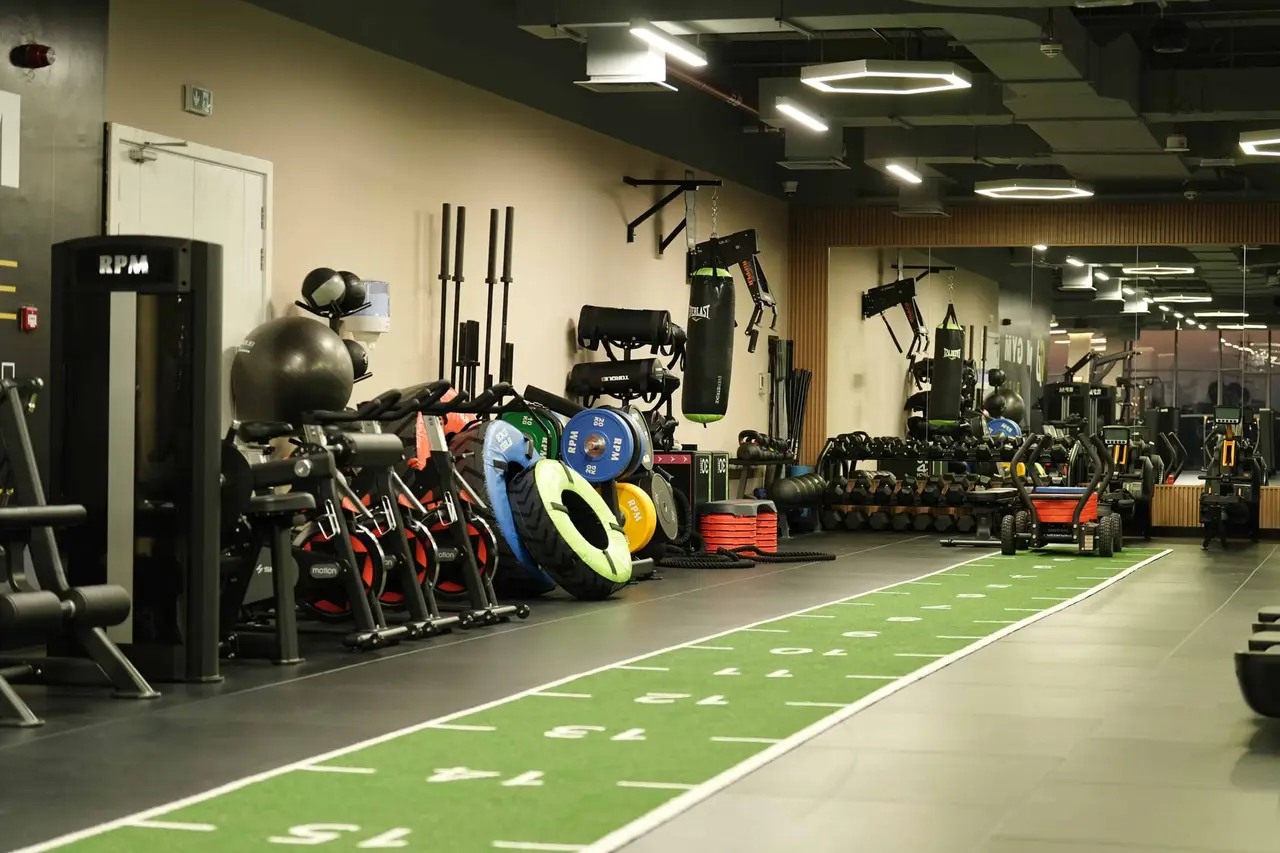
RPM's floor photos show flat benches, barbells and colour bumper plates on the Al Manhal training floor, so both the barbell hip thrust and a loaded bridge are covered, and an unloaded bridge needs only floor space. A hip thrust machine, a Smith machine and a bar pad are not in those photos; ask on your free tour. A personal training session can set your bench height and foot position with you.
Sources
Questions, answered.
Which is better for glute growth, the hip thrust or the glute bridge?
For most people in a gym, the hip thrust, because its longer range and stable bench let you keep adding load for longer. A bridge taken close to failure still builds the glutes, especially for beginners, and it is the right pick when there is no bench. There is little direct research comparing the two over months, so let your progress decide.
Do the hip thrust and glute bridge work different muscles?
No. Both mainly train the gluteus maximus, with the hamstrings helping and the quads holding the knee angle. Foot position shifts the balance in both.
Hip thrust vs Romanian deadlift: which should I do?
Both, if you can. The thrust loads the glutes at the top, with the hip straight; the Romanian deadlift loads them and the hamstrings in a deep stretch. Covering both ends of the range is the core of most glute plans.
Hip thrust vs squat for the glutes?
In a 9-week study of untrained adults, hip thrust training and back squat training built similar amounts of glute muscle, while the squat group gained more in the quads and inner thighs. Choose the squat when you want the whole leg, the thrust when you want focused glute work with less technique to learn, or use both.
Can I do glute bridges instead of hip thrusts at home?
Yes. Bridges, single-leg bridges and bridges with a dumbbell or a loaded backpack cover most of what a thrust does. Rest your shoulders on a sturdy sofa to turn a bridge into a thrust when you want more range.
Hip thrust vs Bulgarian split squat?
The split squat trains one leg at a time, with the glutes stretched at the bottom and the quads working hard; the thrust trains both glutes at the top. They complement each other, and the Bulgarian split squat page covers the stance.