What the brace does, and what it does not
Every curl bends the elbow against a load, and in every curl the same three muscles share the job: the biceps on the front of the upper arm, the brachialis underneath it and the brachioradialis on the thumb side of the forearm. The concentration curl does not reach a muscle the others miss; it limits how much the rest of the body can help. With your upper arm against your thigh and your torso leaning over it, there is no hip drive, no lean back and no elbow creeping forward to finish the rep. And with one arm working, you can see whether the biceps or the body is moving the dumbbell.
That strictness is the reason to do it, and also its limit. Because nothing helps, you will use a lighter dumbbell than on a standing curl, and one arm at a time takes twice as long. It is an accessory, usually the last curl of a session after rows, pulldowns and a heavier two-arm curl. The biceps guide shows how it fits into a week of curls and pulls.
Finding the brace position
- Sit on the end of a flat bench with your feet flat and wider than your hips, so the dumbbell has room to hang between your knees.
- Pick up one dumbbell a step or two lighter than you use for a standing curl. Your first set will show you where your real working weight is.
- Lean forward from the hips with your back long rather than rounded, until the back of your working arm rests against the inside of the thigh on the same side, roughly a hand's width above the knee.
- Let the arm hang straight with the palm facing the opposite leg. The elbow sits against the thigh, not on top of the knee, and the upper arm hangs close to straight down.
- Rest your other hand on your other thigh to prop up your torso, and leave it there for the whole set.
The rep, from straight arm to squeeze
- Curl the dumbbell up towards the front of your shoulder, not across your body to your face or chest. The upper arm stays against the thigh the whole way.
- As it rises, turn the palm a little further up, so the little finger finishes slightly higher than the thumb. That turn is the biceps' second job, and it makes the top of the rep harder.
- Stop when the dumbbell is near your shoulder and the forearm is close to upright. Squeeze for a second without lifting your torso.
- Lower over about three seconds to a straight arm, without the elbow sliding down the thigh.
- Finish all the reps on your weaker arm first, then do the same number on the other side, even if it could manage more.
Breathe out as you curl and in as you lower. The cheat that creeps in most is the leg: the thigh pushes outward against the arm to get the rep started. If your knee moves, the dumbbell is too heavy. If the elbow hurts during a set, stop and speak to a doctor or physiotherapist before you train it again.
Where concentration curls go wrong
| Mistake | What you see | What to do instead |
|---|---|---|
| Elbow on the kneecap | The elbow perches on top of the knee and rolls about as you curl | Rest the back of the upper arm on the inner thigh, just above the knee |
| Sitting up to finish | The torso rises as the dumbbell nears the top, so the shoulder does the last part | Hold the forward lean for the whole set and stop where the arm stops |
| Pushing with the leg | The knee swings out to kick the arm into motion | Keep the knee still and take a lighter dumbbell |
| Curling to the face | The dumbbell travels across towards the chin and the shoulder rolls forward | Aim for the front of the same shoulder |
| Cutting the bottom short | The arm never straightens between reps | Lower all the way to a straight elbow that is not snapped into lock |
| Wrist curling in | The knuckles fold towards you to finish the rep | Keep the wrist in line with the forearm |
Concentration curl vs preacher curl, and other one-arm options
The concentration curl is one of several ways to curl a single arm with the body taken out of it. They differ in what holds the arm still and where in the rep the load bites hardest.
Concentration curl or preacher curl?
Both brace the upper arm. On a preacher curl a sloped pad holds it out in front of you, so the stretched bottom of the rep is the hardest part. In a concentration curl the upper arm hangs close to straight down, so, as in a standing curl, the dumbbell is hardest to move partway up, when the forearm is level with the floor. The concentration curl needs only a flat bench and one dumbbell; the preacher curl needs a preacher bench or machine.
Standing, bent-over concentration curl
Stand with your feet wide, hinge forward until your torso is nearly level with the floor, rest your other hand on a bench or your knee, and let the working arm hang straight down. Curl towards your shoulder without the upper arm moving. With nothing to brace against it is harder to keep strict, so it suits lifters who already curl cleanly, and it is handy when every bench is taken.
Cable concentration curl
Set a bench a step in front of a low pulley, sit facing it with a single handle, brace your arm on your thigh as above and curl. The cable keeps pulling at the bottom, where a dumbbell goes light, and the stack moves in smaller steps than the dumbbell rack; the cable machine page explains the handles.
Neutral-grip concentration curl
Keep your palm facing in, thumb up, for the whole rep. It is a hammer curl with the brace added, which shifts more of the work to the brachialis and the forearm, and it is a good swap on a day without hammer curls.
For a no-swing curl with both arms at once, a strict standing bicep curl with your back against a wall does a similar job.
Who it suits, and who should pick something else
- It suits lifters whose curls turn into a body swing, and anyone with one arm that lags: working each side alone shows the difference and stops the stronger arm covering for the weaker one.
- If time is tight, pick a two-arm curl instead. A one-arm exercise doubles the time per set, and a strict standing curl trains the same muscles in half the time.
- If your main aim is moving the most weight with the biceps, a barbell or EZ-bar curl takes far more load.
- If sitting bent forward is uncomfortable, curl one arm at a time on the cable standing upright instead.
Sets, reps and progression
| Goal | Sets × reps (each arm) | Effort |
|---|---|---|
| Learning the position | 2 × 10–12 | Stop with three reps left; a full pause at the top |
| Building the biceps | 2–3 × 8–12 | One or two reps short of failure |
| Last curl of the day | 1–2 × 12–15 | Slow lowering; the final set close to failure |
Go straight from one arm to the other. Each arm rests while the other works, so a break of about a minute after both sides is enough.
One concentration curl exercise, once or twice a week, is plenty alongside your pulling and a heavier curl. Add reps until every set reaches the top of the range with the upper arm still, then move up one dumbbell. For a single arm the step to the next dumbbell is big, so if it is too heavy, slow the lowering or pause for two seconds at the top first. The hypertrophy volume calculator adds your curls and pulls into one weekly count.
Concentration curls at RPM
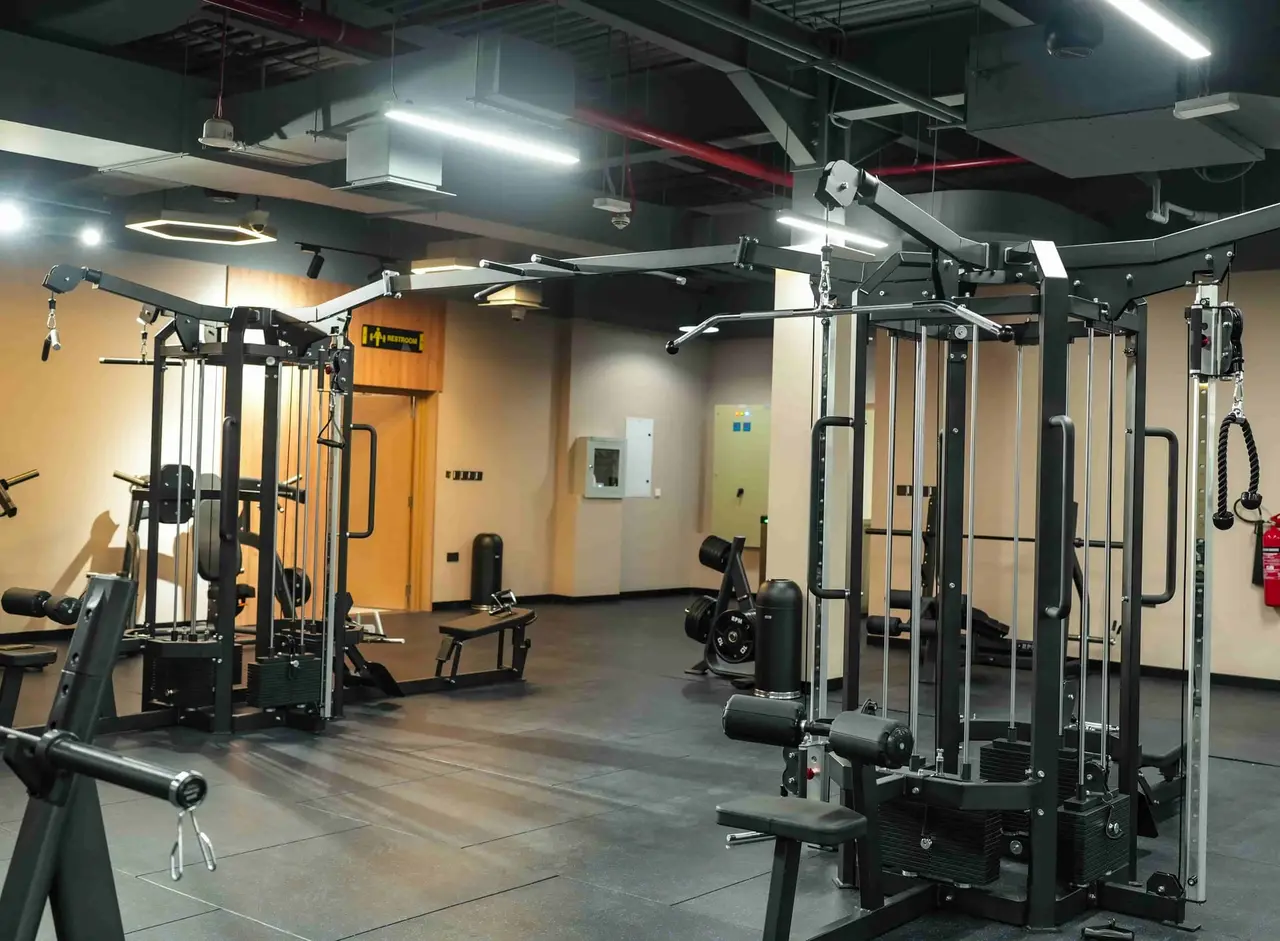
RPM's floor photos show a dumbbell rack, flat benches and multi-station cable towers on the training floor in Al Manhal, which is everything the seated, bent-over and cable versions need. If you would like a coach to check your brace position and the weight you pick, book a personal training session, or see the floor first on a free guided tour.
Questions, answered.
What muscles does the concentration curl work?
The biceps, both heads, with the brachialis underneath it and the brachioradialis in the forearm helping to bend the elbow. The forearm muscles hold the grip. Nothing else should move, which is the point of the exercise.
Is the concentration curl better than a standing bicep curl?
Not better, different. It removes every way of cheating and works one arm at a time, so it suits a second curl or a lagging arm. A standing bicep curl takes more weight and trains both arms at once. Most programmes have room for one of each.
Does the concentration curl build the biceps peak?
It trains the whole biceps, like any curl. How high the muscle rises when you flex depends mostly on its length and where it joins its tendon, which training does not change. A bigger biceps looks fuller from every angle, but no single curl reshapes it.
Concentration curl vs hammer curl?
The concentration curl is a palms-up curl with the arm braced; the hammer curl keeps the palms facing in and shifts more work to the brachialis and forearm. They pair well in one session: the hammer curl first for the heavier work, the concentration curl last.
Should I keep doing concentration curls if my elbow hurts?
No. Pain at the elbow during curls is a reason to stop and see a doctor or physiotherapist, whichever curl you are doing. Once you are cleared to train, they can tell you which versions suit you.