How the forearm muscles work
For training, the forearm's muscles fall into three groups. The flexors run down the palm side from the inner elbow; they close the fingers and bend the wrist forward, and they do most of the work whenever you hold a bar. The extensors run down the back from the outer elbow; they open the hand and pull the wrist back, and in every heavy grip they fire to stop the wrist curling under the load. The third is the brachioradialis, the thick muscle on the thumb side just below the elbow. It bends the elbow rather than closing the hand, and gives the top of the forearm much of its bulk.
Coaches split grip into three jobs. Crushing grip closes the hand around something, as on a hand gripper or a thick handle. Supporting grip holds a load that wants to drop, as in a deadlift, a row or a farmer's carry. Pinch grip squeezes between the thumb and fingers, as when you carry two plates by their smooth faces. A strong deadlift grip does not automatically mean a strong pinch.
Grip strength and forearm size are different goals
Grip strength is about holding on. Most of it is static work: the hand stays closed while the rest of the body moves the weight. That is why heavy pulling builds it so well, and why people who deadlift, row and carry regularly often out-grip people who curl a lot. It also responds to skill: wrapping the thumb fully, setting the bar low in the fingers rather than in the middle of the palm, and using chalk where the gym allows it all let you hold more.
Forearm size is about muscle growth, and muscles tend to grow most from reps taken close to failure through a long range of motion. A heavy hold keeps the forearm muscles at one length, so a strong grip and big forearms do not always go together. Direct work fills the gap: the wrist curl takes the flexors through their range, the reverse wrist curl does the same for the extensors, and the hammer curl and reverse curl load the brachioradialis. How much your forearms change also depends on things you cannot train, such as where your muscles attach, as well as on your training as a whole, your eating and your consistency.
Which movements train the forearms
Only one movement in the library lists the forearms as a primary muscle: the hammer curl, whose palms-facing grip moves work from the biceps to the brachioradialis and the muscle beneath it. Many more train the grip on the way to another target. The deadlift, the Romanian deadlift and the trap bar deadlift load the supporting grip harder than anything else in the gym. The one-arm dumbbell row and the barbell row need it on every rep, and the shrug asks you to hold a heavy weight still at the top. Loaded carries do the same while you walk.
Direct forearm work comes from four movements that do not have library pages yet. The wrist curl takes the flexors through their full range, the reverse wrist curl does the same for the extensors, the reverse curl adds the brachioradialis, and the dead hang builds grip endurance on your bodyweight. The cues further down cover how to start each one.
Which machine trains the forearms?
Few gyms have a dedicated forearm machine, and you do not need one. The closest thing is the cable station. A straight bar on the low pulley gives you wrist curls and reverse wrist curls with steady tension, a rope gives you the rope hammer curl, and the stack moves in small steps, which suits small muscles. The cable machine page shows how to set the pulley height and change attachments.
Dumbbells come next: seated wrist curls with your forearms resting on your thighs or along a bench, reverse wrist curls in the same position, hammer curls and farmer's carries. The dumbbells page covers picking a weight from the rack. A wrist roller, a short bar with a weight hanging from a cord, trains both sides of the forearm as you wind it up and down, and a hand gripper trains crushing grip; not every gym keeps them.
How much, and how often
Heavy pulling twice a week already works your grip hard. For forearm size, a practical starting point is two to six hard sets of direct work a week across two sessions: for example a set or two of wrist curls and one of reverse wrist curls or reverse curls, on top of your hammer curls. Wrist curls move through a short range, so most people use light weights for about 12 to 20 reps, a rep or two short of failure. For grip, timed holds of about 20 to 45 seconds with heavy dumbbells, a loaded bar or your bodyweight on a bar work well. The weekly sets calculator helps you add up direct and indirect sets.
Put direct forearm work at the end of the session, because a tired grip cuts your deadlifts and rows short. Add load and volume gradually: the tendons at the inner and outer elbow take time to adapt, and a sudden jump in curling or gripping work can leave them sore. An ache there that builds from session to session is a reason to stop and see a doctor or physiotherapist.
Two sample sessions
Pull day with a grip finish
A back session that trains the grip from start to finish, built from library pages: the Romanian deadlift, dumbbell row, lat pulldown, shrug and hammer curl.
| Exercise | Sets × reps | Notes |
|---|---|---|
| Romanian deadlift | 3 × 6–10 | No straps unless your grip fails before your hamstrings do |
| One-arm dumbbell row | 3 × 8–12 each side | Squeeze the handle and pause at the top |
| Lat pulldown | 3 × 10–12 | Wrap your thumbs and hold the bar firmly |
| Dumbbell shrug | 2 × 10–12 | Hold two seconds at the top of each rep |
| Hammer curl | 2 × 10–12 | The session's grip work ends here |
Short forearm block
Ten to fifteen minutes at the end of any session, once or twice a week, resting about a minute between sets.
| Exercise | Sets × reps | Notes |
|---|---|---|
| Seated dumbbell wrist curl | 2 × 12–20 | Forearms on your thighs, wrists just past the knees |
| Reverse wrist curl | 2 × 15–20 | Lighter: the back of the forearm is weaker |
| EZ-bar reverse curl | 2 × 10–12 | Overhand grip, elbows by your sides |
| Farmer's carry or dead hang | 2 × 20–40 seconds | As heavy, or as long, as you can hold with good posture |
Ask the team where on the floor you can carry and hang. For a full pull session laid out set by set, see the back and biceps workout.
Set-up cues for the wrist curl, reverse curl and dead hang
- Wrist curl: sit with your forearms on your thighs, palms up, wrists just past your knees. Let the dumbbell roll to your fingertips, close the hand, then curl the wrist up as far as it goes.
- Reverse wrist curl: the same position, palms down, with a much lighter weight. Lift the back of the hand towards the ceiling and lower it slowly.
- Reverse curl: hold an EZ bar or a pair of dumbbells overhand, palms down, and curl with your elbows pinned to your sides. Expect to use clearly less than on a hammer curl, and keep the wrists straight.
- Dead hang: grip an overhead bar about shoulder width with your thumbs wrapped, step off a box or bench, and hang with your shoulders drawn slightly down rather than shrugged up to your ears. Step down before your grip slips. The first pull-up guide uses hangs as an early step.
Mistakes that hold forearms back
- Only ever holding. Heavy pulls build grip, but forearm size also needs reps through the wrist's full range.
- Half-range, bouncing wrist curls. Let the weight roll down to the fingers and curl all the way up; the range is short already.
- Ignoring the extensors. The back of the forearm works in every grip, and a set of reverse wrist curls or reverse curls keeps the two sides closer in strength.
- Training grip before your main lifts. A worn-out grip ends your rows and deadlifts early.
- Big jumps in volume. Elbow tendons adapt more slowly than muscle, so add one set at a time, and stop for pain and see a doctor or physiotherapist.
Training forearms at RPM
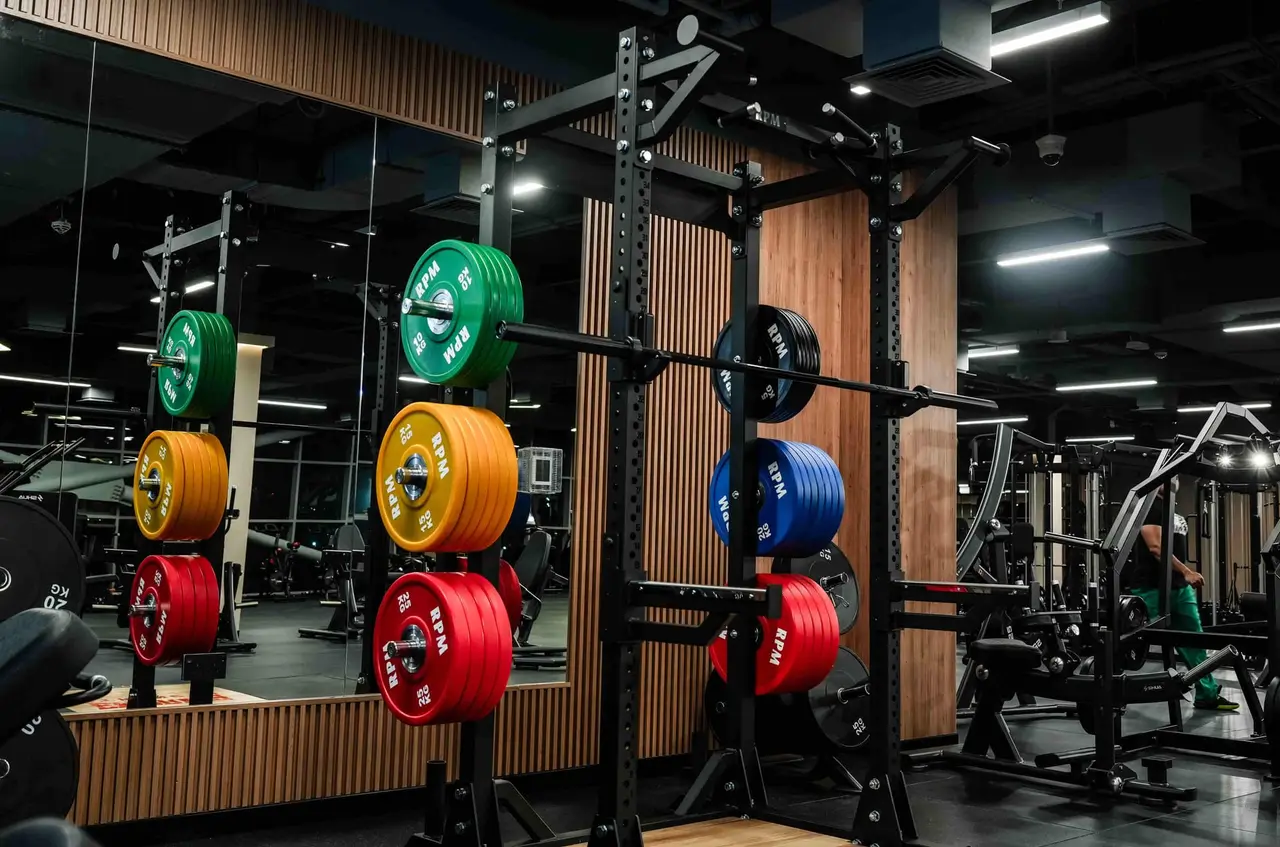
RPM's floor photos show a dumbbell rack, a rack of fixed barbells that includes EZ bars, multi-station cable towers, a squat rack with colour bumper plates, kettlebells and a turf lane, which covers both sessions above. A pull-up bar for hanging, a trap bar, farmer's handles, a wrist roller and hand grippers are not in those photos, so ask on a free guided tour what is on the floor. RPM has a Mixed section and a women-only Ladies section. Browse the exercise library for other muscles, or book personal training to build grip into your main lifts.
Questions, answered.
What are good forearm exercises with dumbbells?
Seated wrist curls and reverse wrist curls, the hammer curl, the reverse curl with an overhand grip, and the farmer's carry. A paused dumbbell shrug loads the grip hard too.
Can I train my forearms at home?
Yes, more easily than most muscles. A filled backpack or two heavy shopping bags make a farmer's carry, squeezing a tennis ball or a soft gripper trains crushing grip, and a broom handle with a cord and a weight tied to it makes a wrist roller. Wrist curls work with anything you can hold.
Should I use lifting straps?
Use them on your heaviest back sets if your grip fails before your back does, and lift without them on warm-ups and lighter work so your hands still get trained. If you strap often, add some direct grip work at the end of the session.
How long does it take to build bigger forearms?
There is no reliable timeline. Forearms respond like other muscles to steady, hard training over months, and how much they change depends on your build, training, eating and consistency. Track your weights and reps rather than measuring your arm every week.