What a treadmill is for, and who it suits
The belt moves under you and you keep up with it, so the machine sets the pace rather than your legs. That makes it the easiest cardio machine to start on: walking is a movement you already know, and one machine covers a gentle walk, a steep uphill walk, a steady run and sprint intervals. Speed decides how fast you travel; incline tilts the deck so that every step also lifts you a little, which raises the effort without going any faster.
It suits walkers, runners with a road race in mind, people coming back to exercise and anyone who likes numbers they can repeat: the same speed and incline next week tells you exactly whether the session has become easier. Running on it still means a landing on every stride, so if a knee, hip, shin or Achilles hurts when you run, drop back to walking, and if the pain stays, stop and have it checked by a doctor or physiotherapist. This page is one of the library's equipment guides; if you are deciding between machines, cross-trainer or treadmill covers that choice.
The console: what each control does
Consoles look different from brand to brand, but nearly all of them have the same six controls.
| Control | What it does | Tip |
|---|---|---|
| Safety key | A magnet or clip on a cord; pulling it off the console stops the belt at once | Clip it to your waistband before you press start, every time |
| Start and stop | Start runs the belt at its slowest speed; stop slows it gradually to a halt | Find the red emergency stop as well, which halts the belt faster |
| Speed up and down | Changes speed in small steps | Hold the button, or tap it, and let each change settle before the next |
| Incline up and down | Tilts the deck from flat to a climb | Change it while walking rather than in the middle of a fast run |
| Quick keys | Numbered buttons that jump straight to a speed or an incline | Handy for intervals; read the number before you press it |
| Programmes | Preset hill, interval and heart-rate sessions | Stay in manual mode until you know your own speeds |
Speed on gym machines here is usually shown in kilometres per hour, and incline as a grade: a reading of 5 means the deck rises five units for every hundred it runs forward. To turn a target race time into a belt speed, use the treadmill pace calculator; to convert grade into degrees or the height you climbed, use the treadmill incline calculator.
Getting on, getting going and getting off
- Stand astride the belt with a foot on each side rail, the flat strips either side of it. Clip on the safety key and press start.
- Once the belt is turning at its slowest, hold a handrail with one hand and step on with a normal walking stride. Let go when you have the rhythm.
- Walk easily for three to five minutes before you raise anything. Then change one setting at a time, a step or two at a time.
- To move from walking to running, raise the speed until walking starts to feel awkward, then break into a relaxed jog. Keep the first runs short.
- To finish, bring the speed down to a slow walk for two or three minutes and let your breathing settle.
- Press stop and keep walking while the belt slows. Step off only when it has stopped completely, holding the rail: the first steps on solid floor can feel strange.
If you stumble, grab the handrails and put your feet back out on the side rails. If you drift too far back, the safety key pulls out and stops the belt, which is the whole point of wearing it. Never jump onto a moving belt or step off backwards.
Walking and running form on the belt
The belt carries your feet backwards for you, so treadmill form is mostly about staying centred and relaxed. Keep to the middle of the belt, roughly an arm's length from the console: too far forward and your toes catch the motor cover, too far back and you drift towards the end. Look ahead rather than down at your feet or the screen, keep your shoulders loose and let your arms swing as they would outside.
- Walking: land on the heel and roll through to the toes with steps of your normal length. Over-long strides on a fast belt feel like braking.
- Running: take short, quick steps that land under your body rather than out in front of it. If you can hear every footfall slap the deck, shorten the stride.
- Incline: lean very slightly from the ankles, not the waist. If you need to hold on to keep up, the slope or the speed is too high; the incline walking guide builds the slope up in stages.
- Hands: gripping the rails changes your stride and takes weight off your legs, so the session is easier than the console suggests. Let go, or slow down until you can.
Curved and self-powered treadmills
A curved treadmill has no motor. The belt runs over a slatted deck shaped like a shallow bowl, and you drive it yourself: move up the front of the curve and it speeds up, drift back towards the bottom and it slows. There is no speed button, so the pace comes entirely from your effort. Short sprints on one are very demanding, and holding an even jogging pace is harder than on a motorised belt.
How do you use a curved treadmill?
Hold the side rails, step onto the lowest part of the curve and start walking; the belt moves as soon as you push. Walk or jog a little further up the front to go faster and move back towards the bottom to slow down. To stop, ease back and shorten your steps until the belt comes to rest. Run tall with short, quick steps landing on the middle of the foot, because the curve punishes heavy heel strikes.
Treadmill workouts for every stage
Start at the top and move down the table as each session becomes routine. Walkers can stay with the first row and add incline; runners use the rest.
| Session | What to do | How it should feel |
|---|---|---|
| First walks | 20–30 minutes at a brisk pace on the flat or a low incline, three times a week | Breathing a little harder, still able to talk in full sentences |
| Walk–jog | After a five-minute walk, alternate 1 minute of jogging with 2 minutes of walking, six to eight times | Jogs easy enough that you are happy to start the next one |
| Progression run | 20–30 minutes, raising the speed one step every five minutes and finishing at a pace you could only just hold | Easy at the start, comfortably hard at the end |
| Fartlek | Within a 25-minute run, add six to eight surges of 20 to 60 seconds whenever you feel ready, easing back between them | Playful: no fixed numbers, just faster and slower |
| Strides | At the end of an easy run, four to six efforts of 15–20 seconds at a quick, relaxed pace, walking until fully recovered between them | Fast but smooth, never a flat-out sprint |
From week to week, change one thing at a time: the time first, then the speed or the incline. Keep hard runs to one or two a week and make the rest easy. The heart rate zone calculator gives you effort targets, and cardio for beginners sets out a complete first eight weeks.
Mistakes to fix first
| Mistake | What it looks like | The fix |
|---|---|---|
| Skipping the safety key | The cord dangles from the console | Clip it on before you press start |
| Standing on the belt at start-up | A lurch as the belt moves off under your feet | Stand on the side rails until it is turning |
| Hanging on the rails | Straight arms and a backward lean, especially on an incline | Lower the slope or the speed until a fingertip touch is enough |
| Crowding the console | Toes clipping the motor cover, short choppy steps | Drop back to about an arm's length from the front |
| Jumping to a high speed | A quick key pressed from a walk, then a scramble to keep up | Raise the speed a step at a time, or check the number first |
| Stepping off a moving belt | Hopping sideways while it is still turning | Slow down, press stop and wait until it halts |
Treadmills at RPM
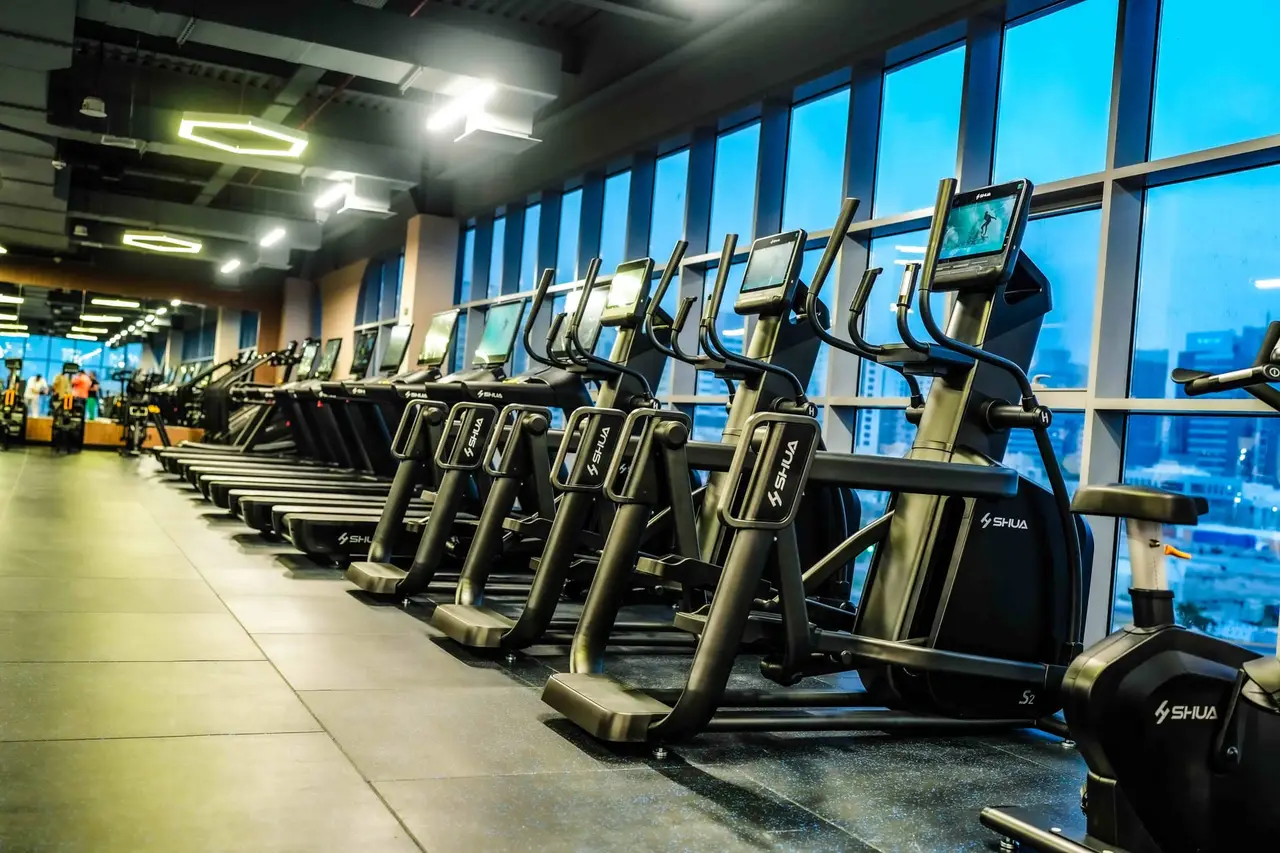
RPM's photos of its cardio area show a row of treadmills facing tall windows, with cross-trainers and an upright exercise bike beside them. Photos cannot tell you each machine's top speed, incline range or programmes, so check those on a free guided tour, and ask about a curved treadmill if your training uses one, since none appears in the photos. The women-only Ladies section has cardio machines of its own; ask which ones. A coach in a personal training session can set your first speeds and inclines with you.
Questions, answered.
How long should a beginner walk on a treadmill?
Twenty to thirty minutes of brisk walking, three times a week, is a sensible start, with a few easy minutes at each end. Add five minutes when a session feels routine, and only then start raising the incline or speed.
Is the treadmill good for weight loss?
It can be a useful part of it, mainly because walking is something most people can do often and for a long time. Weight change depends on your overall activity and eating over weeks, and no treadmill session targets belly fat in particular. The console's calorie figure is an estimate; the calories burned calculator gives you a personal one.
What are the benefits of treadmill workouts?
They build aerobic fitness with a movement you already know, let you control the pace and slope exactly, and keep your walking or running going indoors through the hottest months. Because the settings are repeatable, they also make progress easy to see.
Should I use the incline on a treadmill?
Yes, once flat walking feels easy. Incline raises the effort without speed, which suits people who do not want to run. Start low, add a step at a time, and keep your hands off the rails; if you have to hold on, the slope is too steep.
What is the 12-3-30 treadmill workout?
A steep, slow walk that spread on social media: incline 12, a speed of 3 miles an hour, for 30 minutes. It is a demanding goal rather than a first session, and the incline walking guide shows how to build up to sessions like it.