What cables do well for the glutes, and what they do badly
The cable pulls along its own line rather than straight down, so you can aim the resistance at the angle the glutes work against: behind you for a kickback, between your legs for a pull-through, across your body for side work. Tension stays on through the whole arc, the stack moves in small steps, and most of the movements work one leg at a time, which shows up a weaker side quickly.
The limits are just as real. The stack, the pulley ratio and your balance cap the load, so a cable will never match a barbell hip thrust or Romanian deadlift for heavy work. Single-leg sets take twice as long, an ankle strap can dig in, and one station shared at a busy hour slows the session down. The glute guide covers every tool for the glutes; this page assumes the cable station is what you have, and shows how to get the most from it.
Choosing the load on a pin stack
Stack numbers do not transfer between machines. Many columns run the cable through extra pulleys, which halve or quarter the weight you feel, so a pin number on one tower can feel nothing like the same number on the next. Choose the first load by reps: a weight you can move twelve times with a pause and two reps still in hand. Write down the station and the pulley height alongside the weight.
Glute work on cables suits moderate loads, and the jump from one pin to the next is often large by comparison, especially on single-leg movements. When the next pin is too much, stay where you are and add reps, slow the lowering, add a pause, or start each rep a step further from the stack, before you move up.
The movements, grouped by the job they do
Seven movements cover the glutes on one station. Group them by where in the rep they are hardest and a session almost writes itself.
- Top of the range, glutes squeezed short: the standing cable kickback, with the leg straight or the knee bent, and the kneeling kickback on all fours, a cable-loaded version of the donkey kick.
- The stretch, glutes and hamstrings long: the cable pull-through, facing away from a low pulley with a rope between your legs, and the cable Romanian deadlift, which follows the hinge taught on the Romanian deadlift page with a short bar or two handles.
- Squat and lunge patterns, shared with the quads: the cable goblet squat, holding a handle at your chest from a low pulley as in the goblet squat, and the cable reverse lunge, with the stepping pattern of the lunge.
- The side of the hip: standing cable abduction with an ankle strap, the single-leg cousin of the hip abduction machine.
Pulley height, attachment and the cue for each
| Movement | Pulley and attachment | The cue |
|---|---|---|
| Standing cable kickback | Low pulley, ankle strap | Lean slightly forward and drive the heel back without arching |
| Kneeling cable kickback | Low pulley, ankle strap, on all fours | Push the foot towards the ceiling; hips stay square |
| Cable pull-through | Low pulley, rope between the legs | Hips back, then snap them forward to stand tall |
| Cable Romanian deadlift | Low pulley, short bar or two handles | Push the hips back with soft knees; keep the cable close |
| Cable goblet squat | Low pulley, one handle held at the chest | Sit between the heels and let the cable counterbalance you |
| Cable reverse lunge | Low pulley, a handle in one or both hands | Long step back, front shin close to vertical, drive through the front heel |
| Standing cable abduction | Low pulley, ankle strap on the outside leg | Lift out and slightly back; trunk stays upright |
Buckle the strap just above the ankle bone, padded side in, with the ring facing the pulley, and check that the clip has closed before each set. The cable machine page covers pulley adjustment and the other attachments.
Two cable-only glute sessions
Session A: a full glute day on one station
For a day when the cable station is all you use. Work from the biggest movement to the smallest, and start single-leg sets on the weaker leg.
| Exercise | Sets × reps | Coaching note |
|---|---|---|
| Cable pull-through | 3 × 10–12 | Pause for a second at the top with the glutes squeezed |
| Cable reverse lunge | 3 × 8–10 each leg | Long step back, torso tipped slightly forward |
| Standing cable kickback | 3 × 12–15 each leg | No swinging; stop the heel just behind the body |
| Standing cable abduction | 2–3 × 15 each leg | Slow on the way down, hold the top for a beat |
Session B: after a barbell lift, or when short of time
Use it after a hip thrust or a barbell Romanian deadlift, or on its own as a short session.
| Exercise | Sets × reps | Coaching note |
|---|---|---|
| Cable Romanian deadlift | 3 × 10–12 | Stop when the hamstrings are stretched, not when the bar reaches the floor |
| Cable goblet squat | 3 × 12 | Heels down, as deep as you can control |
| Kneeling cable kickback | 2 × 15 each leg | Hips square to the floor |
| Standing cable abduction | 2 × 15–20 each leg | Take the last set close to failure |
Each session is 11 to 13 sets. Rest about a minute between sets, a little longer after the pull-throughs and lunges.
Progressing when the pin jumps are big
Work to a rep range rather than a fixed number: 10 to 15 suits most of these movements. Stay on a weight until every set reaches the top of the range with clean reps, then move up one pin and drop back to the bottom of the range. If that jump costs more than three or four reps, use the steps in between: a three-second lowering, a one-second hold at the hardest point, an extra set, or a start position further from the stack. Single-leg work gives you room too, since the same pin is harder when one leg does it all.
Over months, the stack will run out of load for the pull-through and the Romanian deadlift before it does for kickbacks and abduction. That is the time to add a barbell or a hip thrust machine for the heavy end and keep the cables for the rest. The hypertrophy volume calculator helps you count the week's glute sets.
Cable glute mistakes
- Swinging the kickback. Momentum and an arching lower back move the strap, not the glutes. Lower the pin and pause at the top.
- Standing too close. The stack touches down between reps and the glutes get a rest; step back until it stays lifted.
- Squatting the pull-through. Deeply bent knees turn a hinge into a squat; push the hips back and keep the shins nearly vertical.
- Leaning into abduction. Tipping the trunk away from the stack lets the side of the waist do the lifting.
- Rushing the weaker side. Start with the weaker leg and match its reps on the other.
- Pushing through back or hip pain. Stop the movement, and have pain that persists checked by a doctor or physiotherapist.
Cable glute training at RPM
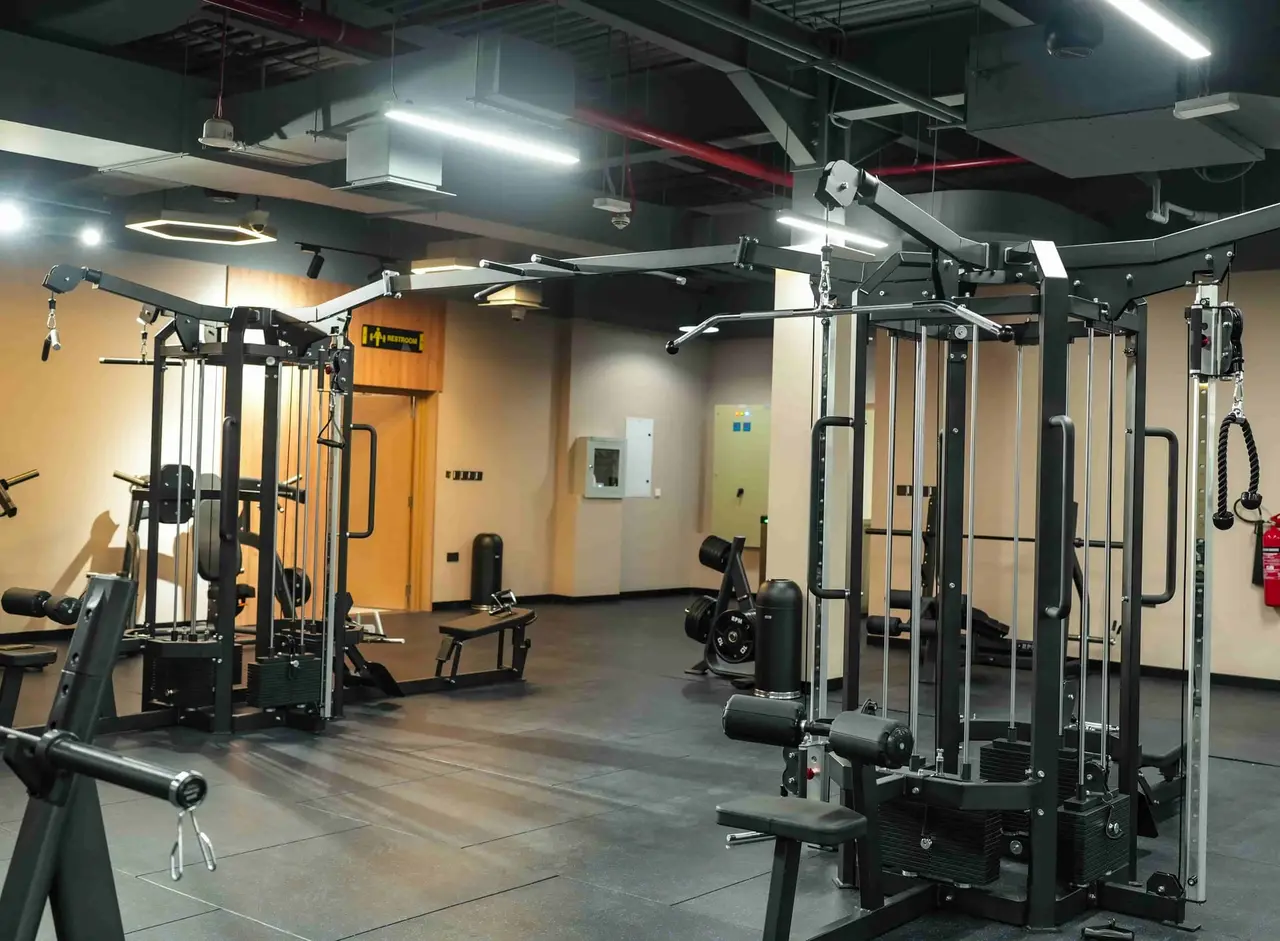
In RPM's photos of the Al Manhal training floor, the multi-station cable towers have pulleys at the top of each frame, pulldown seats, and a rope and single handles clipped on. The photos cannot tell you whether a column slides down to floor height or whether an ankle strap is kept at the station, and most of this page depends on both, so ask on your free tour, in the Mixed section and in the women-only Ladies section. To learn these movements with a coach, book personal training or a female personal trainer.
Questions, answered.
What gym machines are good for the glutes?
The hip thrust machine, the leg press with the feet high, the cable station, the abduction machine and the back extension bench all train the glutes, each in a different part of the range. The glute guide compares them; this page covers the cable station alone.
Can you build your glutes with cables only?
Yes, especially as a beginner or intermediate, as long as the load and reps keep rising over months. Strong lifters eventually need heavier loads for the stretch and the top position than a stack can give, which is when a barbell lift joins the cable work.
Which cable glute exercises need an ankle strap?
Kickbacks, kneeling kickbacks and standing abduction; without a strap they are awkward to set up. Pull-throughs, cable Romanian deadlifts, goblet squats and reverse lunges use a rope, a bar or a handle instead.
Are cable glute exercises good for men?
Yes. The glutes do the same job in everyone, and the same movements, sets and progressions apply. Men often skip direct glute work; a few sets of pull-throughs and kickbacks after a leg day fill that gap.
Can I do cable glute exercises at home?
Only with a home cable machine or a pulley set-up. Without one, a resistance band anchored low copies kickbacks, pull-throughs and abduction at lighter loads.