What it trains, and why the bench changes the row
Lying on the pad changes one thing that matters: your trunk has nothing left to do. On a bent-over row the hamstrings and the muscles beside your spine hold a hinge for the whole set, and they often tire before the back does. With your chest supported, all of the effort goes into the pull. The muscles between the shoulder blades, the middle and lower trapezius and the rhomboids, draw the blades together; the lats pull the upper arm back; and the rear shoulders and biceps help the elbow finish behind you.
It also takes cheating off the table. You cannot lean back or drive with the hips, so the weight you use is the weight your back can actually row. That makes it a good fit for anyone whose lower back limits their rows, for the second row of a session after heavier lifts, and for lifters who want strict mid-back work. In a back training plan it works as the horizontal pull beside a vertical one such as the lat pulldown.
Setting up the incline bench
- Set an adjustable bench to a low-to-moderate incline, somewhere around a 30- to 45-degree backrest. Much steeper and the row turns into a shrug; much flatter and your feet struggle to reach the floor.
- Place a pair of dumbbells on the floor either side of the front of the bench, roughly under where your shoulders will be.
- Straddle the bench and lie face down with the top edge of the pad at your upper chest and your chin just clear of it. Stand on the balls of your feet behind the seat, or rest your knees on it, whichever keeps your chest pinned without sliding.
- Pick up the dumbbells with a neutral grip, palms facing each other, and let your arms hang straight below your shoulders.
- Start lighter than your one-arm row: each hand carries its own dumbbell and nothing helps you get it moving. A pair you can row twelve times with a pause at the top is about right.
Rowing a clean rep
- From the hang, let your shoulder blades spread apart so the upper back starts stretched. Your chest stays on the pad.
- Start the pull by drawing the shoulder blades towards each other, then drive both elbows up and back.
- Row until the dumbbells sit beside your lower ribs and your elbows are just behind your torso.
- Hold for a one-count with the blades squeezed and your shoulders away from your ears.
- Lower over two to three seconds to a long arm, without letting the dumbbells touch the floor between reps.
The cue that matters most is chest on the pad. If your breastbone peels away to finish a rep, your lower back has joined in and the set is over. Breathe out as you row and in as you lower; with the pad pressing on your chest, a short breath at the bottom of each rep is easier than one big one.
Mistakes to fix first
| Mistake | What it looks like | The fix |
|---|---|---|
| Lifting the chest off the pad | The torso rises to meet the dumbbells on the last reps | Use a lighter pair and end the set when the chest can no longer stay down |
| Craning the neck | The chin juts up to watch the mirror | Rest the chin just over the pad edge and look at the floor ahead |
| Shrugging the weight up | The shoulders rise towards the ears while the elbows barely move back | Set the blades low first, then pull the elbows back |
| Bench too steep | You are nearly upright and the row feels like a shrug | Lower the backrest a notch or two so the torso is closer to the floor |
| Sliding down the pad | Your feet slip back and each set finishes lower on the bench | Plant your feet or kneel on the seat, and reset between sets |
| Cutting the stretch | The dumbbells stop halfway down and the blades never spread | Lower to a straight arm every rep; a lighter pair beats half reps |
Seal row, row machines and elbow position
The versions below change what holds you or where your elbows travel. All of them stay horizontal pulls for the upper back and lats.
Seal row on a raised flat bench
You lie flat on a bench set high enough that your arms hang straight without the weights touching the floor, holding a barbell or two dumbbells. With the torso horizontal it cannot creep upright, which makes this the strictest row there is. It needs a purpose-built high bench or a bench fixed on a stable stand; never balance a bench on plates or boxes. Ask whether one is on the floor before planning around it.
Chest-supported row machine
Many gyms have a plate-loaded or pin-loaded row with a chest pad and handles, sometimes built as a T-bar with a pad. It does the same job on a fixed path with quicker loading, and lets you push close to failure without dumbbells to manage. Set the seat so the handles line up with your lower chest and the pad sits on your breastbone. The T-bar row page covers the bar-and-handle version.
Elbows wide or tucked?
Tucked elbows, a hand's width from your sides with palms facing, let the upper arm travel back past the torso, and most people feel more of the lats that way. Elbows flared out towards shoulder height with an overhand grip shorten the pull and shift the work to the upper back and rear shoulders. Pick one for a training block, or use tucked elbows for heavier sets and wide for lighter ones.
If every incline bench is taken, the one-arm dumbbell row gives similar support on a flat bench, and the seated cable row braces you through your feet and the seat instead.
Sets, reps and progression
| Goal | Sets × reps | How hard |
|---|---|---|
| Learning the movement | 2–3 × 12 | Stop with three clean reps left |
| Building the upper back | 3–4 × 8–12 | End each set with one or two reps in reserve, chest still down |
| Rear shoulders and upper back | 2–3 × 12–15, elbows wide | A light pair and a one-second hold at the top |
Rest about a minute and a half between sets. Because nothing else tires first, you can usually repeat the same reps from set to set.
Use double progression: keep the same pair until every set reaches the top of the rep range with a pause, then move up one pair and build back up from the bottom of the range. If the next pair is too big a jump, add a slower lowering or a two-second hold first. Place it after your main lifts, or first in a back session when your lower back needs an easier day. If your shoulder or lower back hurts during the row, stop and get it checked by a doctor or physiotherapist.
The chest-supported row at RPM
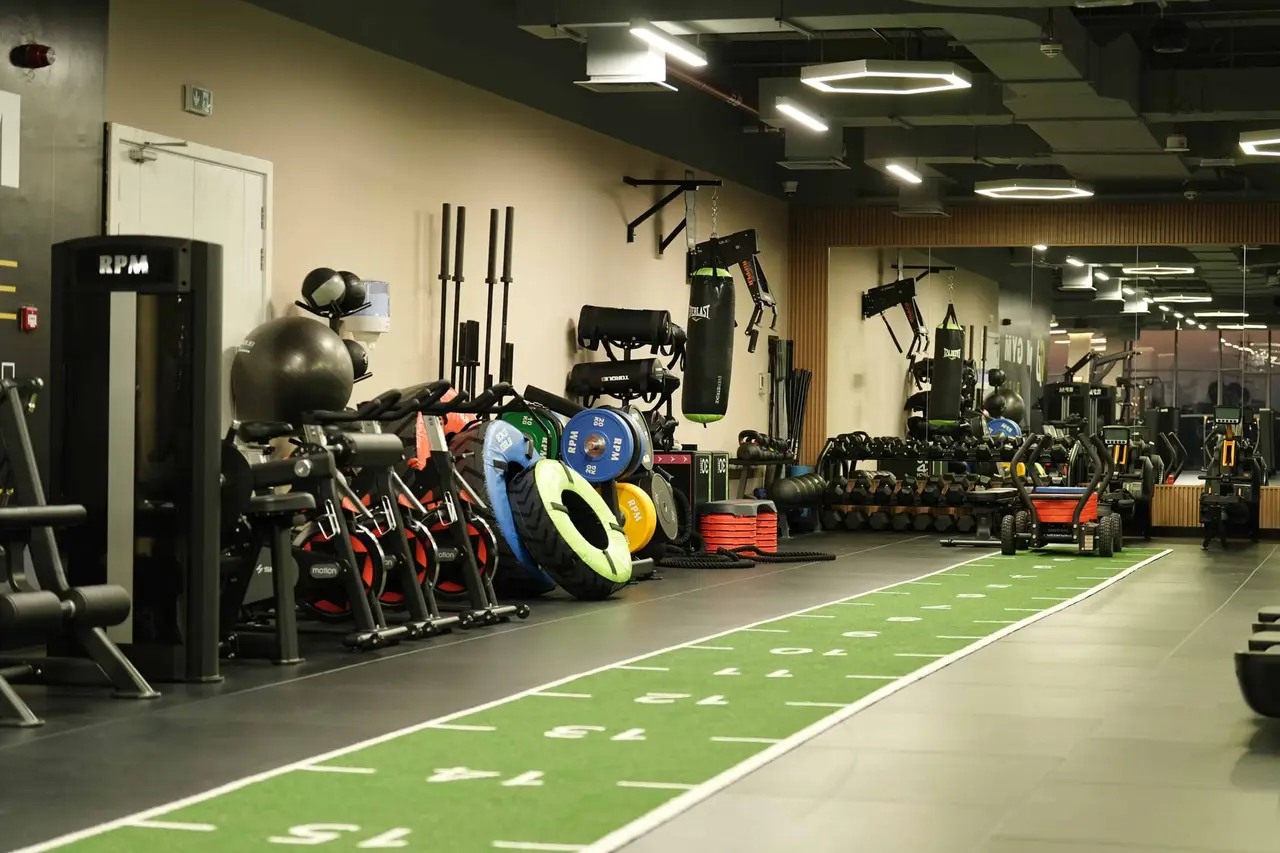
RPM's floor photos show a dumbbell rack and flat benches on the training floor in Al Manhal, but not an adjustable incline bench, a seal-row bench or a chest-supported row machine. Ask what is on the floor in the Mixed and Ladies sections on your free guided tour. A coach in a personal training session can set the bench angle with you and pick your first pair.
Questions, answered.
What muscles does the chest-supported row work?
The upper back first: the middle and lower trapezius and the rhomboids between your shoulder blades, which is why people call it a mid-back row. The lats, rear shoulders and biceps help.
Chest-supported row or bent-over row?
The supported row isolates the pull; the bent-over row trains the pull and the hinge together and lets you load a barbell heavier. If your lower back is the limit, or you deadlifted earlier that day, choose the supported version.
Is it better than a seated cable row?
Neither is better; they hold you differently. On the cable row your trunk keeps you upright against the pull, and the cable stays loaded at the stretch. On the bench the pad holds you, and the dumbbells load the top of the rep hardest. Rotating them across training blocks works well.
What can I do instead without an incline bench?
The one-arm dumbbell row on a flat bench is the closest match. A two-dumbbell bent-over row works if your hinge is solid, and at home a tripod row with one hand on a sturdy chair does the job.
Is the chest-supported row good for building the back?
Yes. It is one of the most direct ways to load the upper back hard, because nothing else gives out first. Pair it with a vertical pull and a hinge, as the back training guide lays out.