What the T-bar row trains, and what the pivot changes
Like any row, the T-bar row is pulled by the upper back, the muscles between the shoulder blades, and the lats, with the biceps and rear shoulders assisting while the lower back, glutes and hamstrings hold the hinge. What sets it apart is the anchor. Because one end of the bar is fixed, the bar cannot drift away from you, the handle travels in a predictable arc, and you hold it with a close, palms-facing grip right under your chest. Most people can row noticeably more on a T-bar than on a straight barbell, with the torso a little more upright.
The name covers several set-ups. The classic T-bar station is a plate-loaded lever with a floor pivot, handles at the loaded end and often footplates. A landmine row uses an ordinary Olympic bar with one end in a landmine sleeve or a corner. A chest-supported T-bar machine adds an angled pad you lie against, which removes the hinge altogether. The standing versions suit lifters who can already hold a flat back in a hinge; the back training guide shows where a heavy row like this sits beside a pulldown and a hinge in the week.
Setting up the bar and your stance
- Load the open end with smaller plates where you can. Large-diameter plates hit your chest before your elbows finish the pull; several smaller ones give the same weight with a longer range.
- On a landmine or corner set-up, straddle the bar facing the plates, feet about shoulder-width apart, and hook a V-handle, the close-grip handle from the cable station, under the bar just behind the plates. On a station, stand on the footplates and take the handles.
- Unlock your knees and push your hips back until your torso sits at about a 45-degree angle to the floor, back flat.
- Brace your trunk, set your shoulders slightly back and let your arms hang straight, with the plates just off the floor.
- Start with one or two plates. The right weight is the one that lets you hold your torso angle for ten reps, not the heaviest one you can move.
How to do a rep
- From straight arms and a braced trunk, drive your elbows back past your sides.
- Pull the handle towards your lower chest or upper stomach, keeping your chest up to meet it.
- Squeeze your shoulder blades together and hold for a moment at the top.
- Lower under control until your arms are straight and your shoulder blades spread, without letting the plates touch down.
- Keep your torso angle and your hips exactly where they started for the whole set.
Breathe in at the bottom and brace before each pull; breathe out as the plates come down. The plates should stop at your chest because your elbows have finished, not because the plates have hit you. If your lower back hurts during or after the set, stop and have it checked by a doctor or physiotherapist before loading the row again.
Mistakes to fix first
| Mistake | What it looks like | The fix |
|---|---|---|
| Standing up through the set | Each rep starts more upright until the row becomes a shrug | Take a plate off and end the set when the angle changes |
| Heaving with the legs and hips | The knees and hips snap to throw the plates up | Keep the lower body still; pull only with the back and arms |
| Rounding to reach the handle | The lower back curves at the bottom of the rep | Hinge less deeply and brace before every rep |
| Big plates, short pulls | The plates hit the chest with the elbows still in front | Swap to smaller plates for a full pull |
| Neck craned up | The head lifts to watch the mirror | Look at the floor a little ahead of the plates |
Chest-supported machine, landmine and grip choices
Three decisions come with the T-bar row: which set-up to use, how to rig it without a station, and which handle to hold.
Chest-supported T-bar machine
You lie face down against an angled pad, feet on a platform, and row a lever loaded with plates. With your chest supported the lower back is out of the job and the hinge cannot break down, so the upper back can be pushed close to its limit. It is a good choice on days your lower back is tired or when you want high-rep back work. Set the pad height so the handles hang at arm's length.
Landmine row with a barbell in a corner
With no T-bar station, put one end of an Olympic bar into a landmine sleeve or, where the gym allows it, into a corner where it cannot slide, and load the other end. Ask the staff first, since a bar end can mark walls and floors. Row with a V-handle under the bar, or grip the bar with both hands just behind the plates. A one-arm version, standing side-on to the bar, lets each side work alone.
V-handle or wide grip?
The V-handle puts your hands close together with the palms facing, keeps the elbows near your sides and gives the longest pull, which many people feel most in the lats. Wide handles, on stations that have them, flare the elbows out, shorten the pull and bring the upper back and rear shoulders in more. Neither is better: choose by what you want to train, or alternate them between training blocks.
If there is no T-bar set-up, or it is busy, the bent-over row is the closest free-weight version, the chest-supported row gives the supported option with dumbbells, and the seated cable row trains the same muscles sitting down.
Sets, reps and progression
| Goal | Sets × reps | How hard |
|---|---|---|
| Learning the row | 3 × 8–10 | Light; the torso angle never changes |
| Building muscle | 3–4 × 8–12 | Two reps left, with a pause at the chest |
| Strength | 4 × 5–6 | Heavier, every rep from straight arms with no hip drive |
Rest two minutes between heavy sets and about ninety seconds between lighter ones.
Put the T-bar row early in a back session, after a vertical pull or in place of the barbell row, and keep it away from the end of a heavy deadlift day, when the muscles that hold your hinge are tired. Add one small plate at a time once every set reaches the top of the range with the angle held. Most programmes need only one heavy row like this per week, beside a lat pulldown and a lighter row.
The T-bar row at RPM
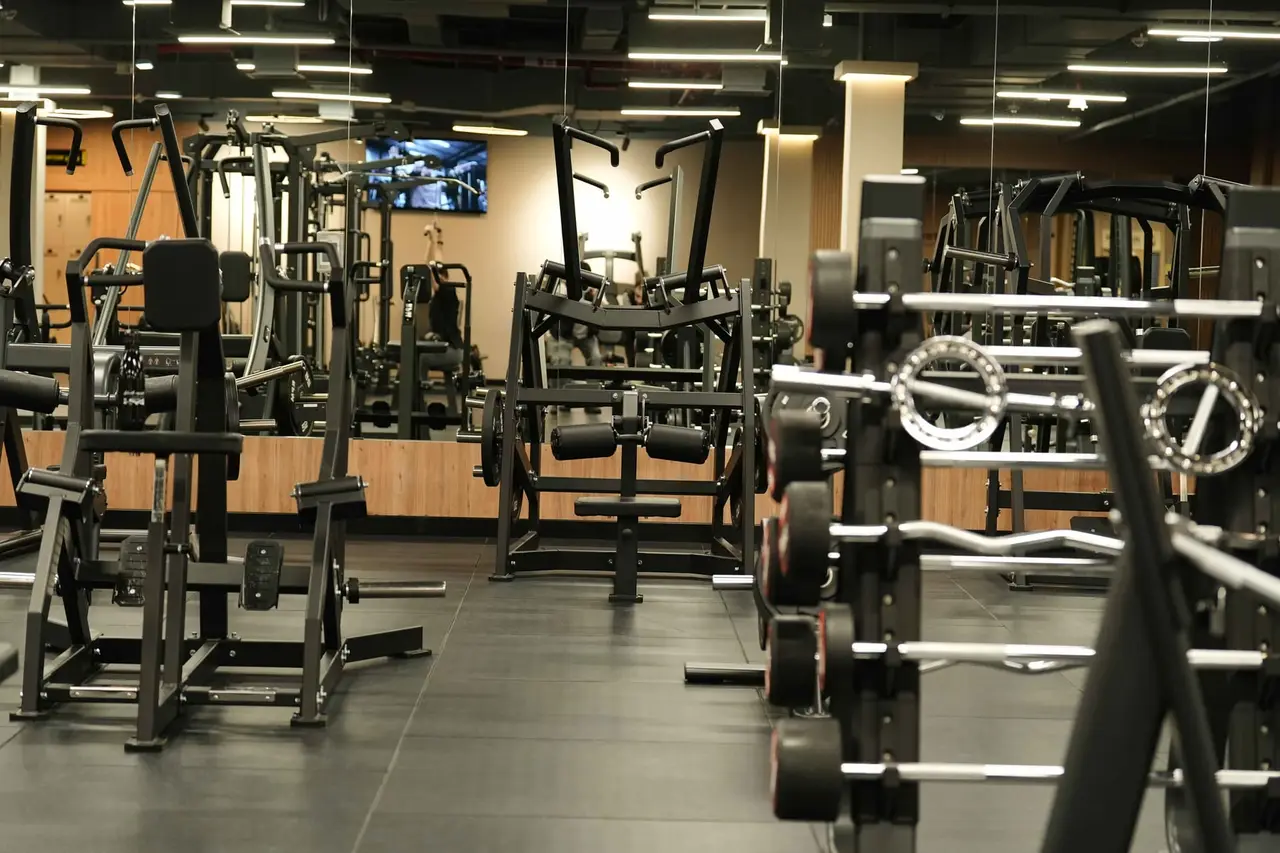
A T-bar station, a landmine attachment and a chest-supported T-bar machine do not appear in RPM's photos of the Al Manhal floor, so ask on your free tour which of them you can use and where a bar may be anchored. The photos do show barbells with colour bumper plates for the bent-over row and cable towers for seated rows. A coach in a personal training session can watch your hinge on whichever row version is available.
Questions, answered.
What muscles does the T-bar row work?
The upper back and lats do the pulling, with the biceps and rear shoulders assisting. The lower back, glutes and hamstrings hold the hinge, except on the chest-supported machine.
T-bar row or bent-over barbell row?
The T-bar's fixed pivot keeps the bar from drifting, so most people row more weight with a slightly more upright torso. The barbell row asks more of your balance and your hinge. Both are heavy horizontal rows; use one as the main row of a training block and swap later.
T-bar row or seated cable row?
The seated row supports your torso and keeps tension through the whole rep, so it is easier to learn and suits higher reps. The T-bar row adds the hinge and heavier loading. Many back sessions use one of each.
What can I do instead of a T-bar row?
A landmine row with a barbell in a corner is the nearest copy. Without one, use a bent-over row, a chest-supported dumbbell row, a one-arm dumbbell row or a seated cable row with a V-handle.
T-bar row or lat pulldown?
They are different pulls. The T-bar row is horizontal and builds the upper back and lats; the pulldown is vertical and trains the lats through a longer overhead range. A complete back week includes one of each.