What the inverted row trains, and who it suits
The inverted row is a row turned upside down: instead of pulling a weight towards you, you pull yourself towards a fixed bar. The upper back and lats do the pulling, the biceps and rear shoulders assist, and the glutes and trunk hold your body in a straight line, like a plank that moves. A 2009 study that compared three rows in seven healthy young men found that the inverted row produced the highest activation of the lats, the upper back and the hip extensors of the three, with the lowest load on the lower spine. Seven people is a small sample, so read that as a description of a trade-off, not a ranking.
That trade-off is the reason to use it. Because the bar height sets the difficulty, a beginner can start almost upright and an experienced lifter can row with the feet raised. It is a standard step for people working towards their first pull-up, a back exercise for days when the lower back has done enough, and an easy way to add rowing volume at the end of a session. The back training guide lists it among the horizontal pulls.
Setting up the bar
- Set a barbell on the hooks of a squat rack at about hip height for your first sets. Higher makes the row easier; lower makes it harder. Check that the bar sits fully in both hooks before you hang from it; the power rack guide covers hooks and pins.
- Lie under the bar so it lines up with your lower chest when your arms are straight.
- Grip overhand, hands a little wider than your shoulders, thumbs wrapped around the bar.
- Put your heels on the floor with your legs straight, or bend your knees and plant your feet for an easier start.
- Lift your hips until your body forms one line from heels or knees to shoulders: glutes squeezed, ribs down, neck in line.
- Choose the height at which you can do eight to ten reps with that line intact, and note the hook position so you can find it next time.
How to do a rep
- Hang with straight arms and your shoulders drawn slightly away from your ears.
- Pull your shoulder blades back, then drive your elbows back at roughly a 45-degree angle from your body.
- Bring your lower chest to the bar. Your body rises as one piece, without the hips sagging or leading.
- Pause for a second at the top with your chest touching or nearly touching the bar.
- Lower under control until your arms are straight again.
Your hips give the game away. If they sag first, or rise to meet the bar before your chest does, the level is too hard: raise the bar a notch. Breathe out as you pull and in as you lower. Shoulder or elbow pain, rather than effort in the back, is a reason to stop and have it checked by a doctor or physiotherapist.
Mistakes to fix first
| Mistake | What it looks like | The fix |
|---|---|---|
| Hips sagging | The body bends at the hips and the chest never reaches the bar | Squeeze the glutes, or raise the bar until you can hold the line |
| Chin chasing the bar | The neck stretches forward so the chin can touch | Lead with the chest and keep the head in line |
| Half reps | The elbows bend only partway, at the top or the bottom | Use a height you can pull from straight arms to the chest |
| Shrugging | The shoulders rise towards the ears during the pull | Set the shoulder blades back and down before each rep |
| Elbows flared straight out | The upper arms point sideways at shoulder height | Angle the elbows down towards your ribs |
Bent knees, straight legs, feet raised and straps
Each variation changes how much of your bodyweight you lift, which is how you progress without adding a plate.
Bent knees or straight legs?
With your knees bent and feet flat, your body is shorter and more of your weight rests on your feet, so the row is easier. Straight legs with only your heels down make you lift more of your weight. Start with bent knees if a straight-leg row at hip height gives you fewer than six clean reps.
Feet-elevated inverted row
Rest your heels on a flat bench or a box so your body is level with the floor or slightly head-down. This is the hardest bodyweight version and suits people who can do fifteen or more clean straight-leg reps. Beyond it, slow the lowering to three seconds or add a pause at the top before reaching for a weighted vest.
Suspension-trainer row
Instead of a bar, you hold the handles of suspension straps anchored overhead. Your hands can turn as they pull, which many people find kinder to the wrists and elbows, and you change the difficulty by walking your feet forward or back. The straps sway, so the trunk works harder to keep you steady.
If every rack is in use, a Smith machine bar, where a gym has one, can be set at any height for the same row. Otherwise the seated cable row and the chest-supported row train the same muscles, and the lat pulldown adds the vertical pull.
Sets, reps and progression
| Goal | Sets × reps | How hard |
|---|---|---|
| Learning the row | 2–3 × 6–10 | High bar; stop with two or three reps left and the body straight |
| Building muscle | 3–4 × 8–15 | Lower the bar or raise the feet once 15 is easy |
| Pull-up preparation | 3–5 × 5–8 | The hardest level at which you can hold a straight body, with a pause at the bar |
Rest about ninety seconds between sets.
Progress through the levels in order: lower the bar one hook at a time, then straighten the legs, then raise the feet, then slow the lowering. Write down the hook number each session, because it is the inverted row's version of the weight on the bar. Two sessions a week work well, either as the main row for a beginner or as a second row after a heavier one.
Inverted rows at RPM
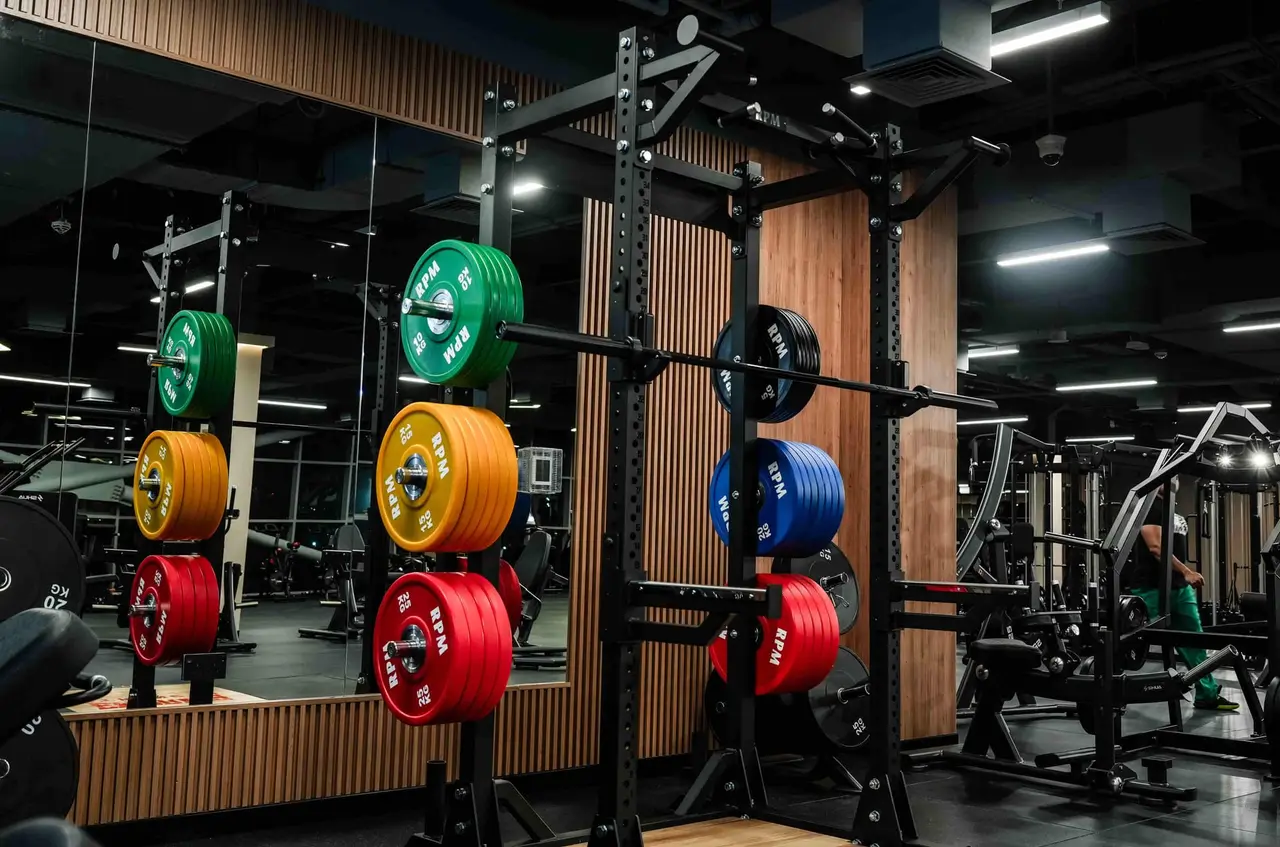
The inverted row needs a bar and a rack, and RPM's photos of the Al Manhal floor show squat racks with barbells. Ask a member of staff which rack you can use for it at busy times. Suspension straps and a Smith machine are not in those photos, so ask about them on your free tour. If you are using inverted rows to build towards a pull-up, a personal training session can set the progression for you.
Sources
Questions, answered.
What muscles does the inverted row work?
The upper back and lats do most of the work, with the biceps and rear shoulders assisting. The glutes and the trunk work to hold your body straight.
Is the inverted row the same as the Australian pull-up?
Yes. Australian pull-up, bodyweight row and inverted row are three names for the same exercise: pulling your chest to a bar while you hang beneath it.
Inverted row or pull-up: which should I do first?
If you cannot yet do a pull-up, start with inverted rows. They train many of the same muscles at a load you can control and build the shoulder-blade strength a pull-up needs. Once you can do pull-ups, keep both: the pull-up is vertical, the inverted row horizontal.
Inverted row or bent-over row?
Both are horizontal rows. The bent-over row lets you add load in small steps but makes your lower back hold a hinge; the inverted row uses your bodyweight with the lower back barely loaded. Many back sessions pair one heavy row with one lighter one, and the inverted row suits the second slot.
Can I do inverted rows at home?
Yes, with suspension straps anchored over a sturdy door or a low bar at an outdoor gym. Avoid improvised set-ups such as tables or chairs that could tip under your weight.
Inverted row or lat pulldown?
The pulldown is a vertical pull with adjustable weight; the inverted row is a horizontal pull with your bodyweight. They do not replace each other, and a week that includes one of each covers both directions.