The answer in brief
The elbow does the same job in each of these exercises, so the muscle is the same: all three heads of the triceps work every time. The difference is the shoulder. The tricep pushdown keeps the upper arm down by your side. The skull crusher holds it in front of you as you lie on a bench, pointing up and tipped slightly back. The overhead tricep extension raises it fully, beside your head. Moving the arm through those positions changes how stretched the long head is while it works, and that is the real reason to choose one over another.
In short: the pushdown for the simplest set-up and the easiest loading, the overhead extension for the stretch, and the skull crusher as a free-weight middle ground that takes a good load. For presses such as dips, see the dips and pushdown comparison; for the whole muscle, the triceps guide.
Side by side
| What differs | Skull crusher | Tricep pushdown | Overhead extension |
|---|---|---|---|
| Upper arm | In front, pointing up and slightly back from a bench | Down by your side | Raised beside your head |
| Long head of the triceps | Part-way stretched | Not stretched; the lateral and medial heads take the larger share | At its most stretched, taking a larger share than usual |
| Body position | Lying on a flat bench | Standing at a high pulley | Seated or standing; facing away from the stack with a rope |
| What you hold | An EZ bar or two dumbbells | A rope, straight bar or V-bar on the cable | One dumbbell, a rope on a low pulley or an EZ bar |
| Load | Moderate; keep sets at eight reps or more | Heavier than an overhead extension on the same cable | About a third lighter than at the side, in the study below |
| Shoulder range needed | Arms angled back past vertical | Very little | Arms fully overhead without discomfort |
| Level | Intermediate | Beginner | Beginner |
What the arm position changes
The lateral and medial heads run from the upper arm bone to the elbow, so the position of your shoulder does not change their length. The long head is different: it starts on the shoulder blade, just below the socket, and crosses the shoulder before it reaches the elbow. Raise the arm and you pull that head longer before the elbow even bends; lower the arm to your side and you give it slack. The higher your arm, the more stretched the long head is at the bottom of each rep, and the larger its share of the work.
That puts the three exercises on a line: the pushdown at the short end, the overhead extension at the long end and the skull crusher in between. Where exactly depends on how far your upper arms tip back: lowering the bar behind your head moves it towards an overhead extension, while keeping the arms vertical moves it towards the pushdown. No arm position switches a head off, so each of the three trains the whole muscle.
What a 12-week study found
One training study tested the two ends of that line directly. Maeo and colleagues had 21 adults train both arms with cable elbow extensions twice a week for 12 weeks: one arm overhead, the other with the arm at the side, much like a pushdown. The study reports that the overhead arm lifted about a third less weight throughout, yet its triceps grew about one and a half times as much in the long head, and about 1.4 times as much in the other two heads and in the muscle as a whole.
Two points are worth taking from it. The advantage was not confined to the long head, which suggests the stretched position helped the whole muscle in that study. And the lighter loads did not hold the overhead arm back, so an overhead extension does not need to match your pushdown numbers to be worth doing.
It is one study of 21 people, and it did not test a lying position. Because the skull crusher's arm angle sits between the two it compared, it is reasonable to expect a result in between, but that is an inference, not a finding. The sensible reading is to include overhead work, not to drop pushdowns.
Matching the exercise to you
Pick the pushdown if…
You are new to triceps training, you want the easiest exercise to load and progress, you are finishing a pressing day when your elbows and shoulders have already worked hard, or you want to superset it with a curl. It is also the one to use if raising your arms overhead, or lying with them angled back, is uncomfortable.
Pick the overhead extension if…
You can raise your arms fully overhead without discomfort and want the long head trained in its stretched position, the position the study links with more growth. It suits the middle of a triceps session, after your presses, and earns a slot every week if your shoulders allow it.
Pick the skull crusher if…
You train with free weights and a bench, you want some stretch without the full overhead position, or you like a bar you can load fairly heavily in strict sets of eight to twelve. Its weak point is the elbow, so it suits people who keep the lowering slow and do not stack it on top of heavy close-grip pressing.
If any of the three causes pain in the elbow or shoulder rather than effort in the back of the arm, stop that exercise and have it checked by a doctor or physiotherapist before you train it again.
Sharing them across a week
Two arm positions a week cover the triceps; the third adds variety. Three ways to arrange them:
| Plan | How it runs |
|---|---|
| Two sessions, two positions | Day A: pushdown, 3 × 10–15, after your presses. Day B: overhead extension, 3 × 8–12, after your presses |
| One arm day, all three | Skull crusher 3 × 8–12, then overhead rope extension 2 × 12–15, then pushdown 2 × 15–20 to finish |
| Rotating by training block | Keep an overhead extension every week; alternate the skull crusher and the pushdown every four to six weeks |
Rest about a minute to ninety seconds between sets and stop each one with one or two reps left. Presses add triceps work too; the hypertrophy volume calculator counts both.
Within a session, put the most demanding exercise first. The skull crusher needs the most control and the overhead extension the most range, so both come before the pushdown, which is still easy to do well when the triceps are tired. Track each exercise on its own numbers: the same muscle lifts different weights in each position.
Swapping within the same arm position
When the bench, the rack or the cable is taken, keep the arm position and change the tool:
- Arm overhead: one dumbbell held in both hands, a rope on a low pulley with your back to the stack, or an EZ bar overhead. If all three are busy, a skull crusher lowered behind the head comes closest.
- Arm in front: an EZ bar, two dumbbells with the palms facing, or one dumbbell held in both hands, all on a flat bench.
- Arm at your side: a rope, bar or V-bar on the cable, a single-arm reverse-grip pushdown, a band anchored high, or a tricep kickback with one light dumbbell.
All three at RPM
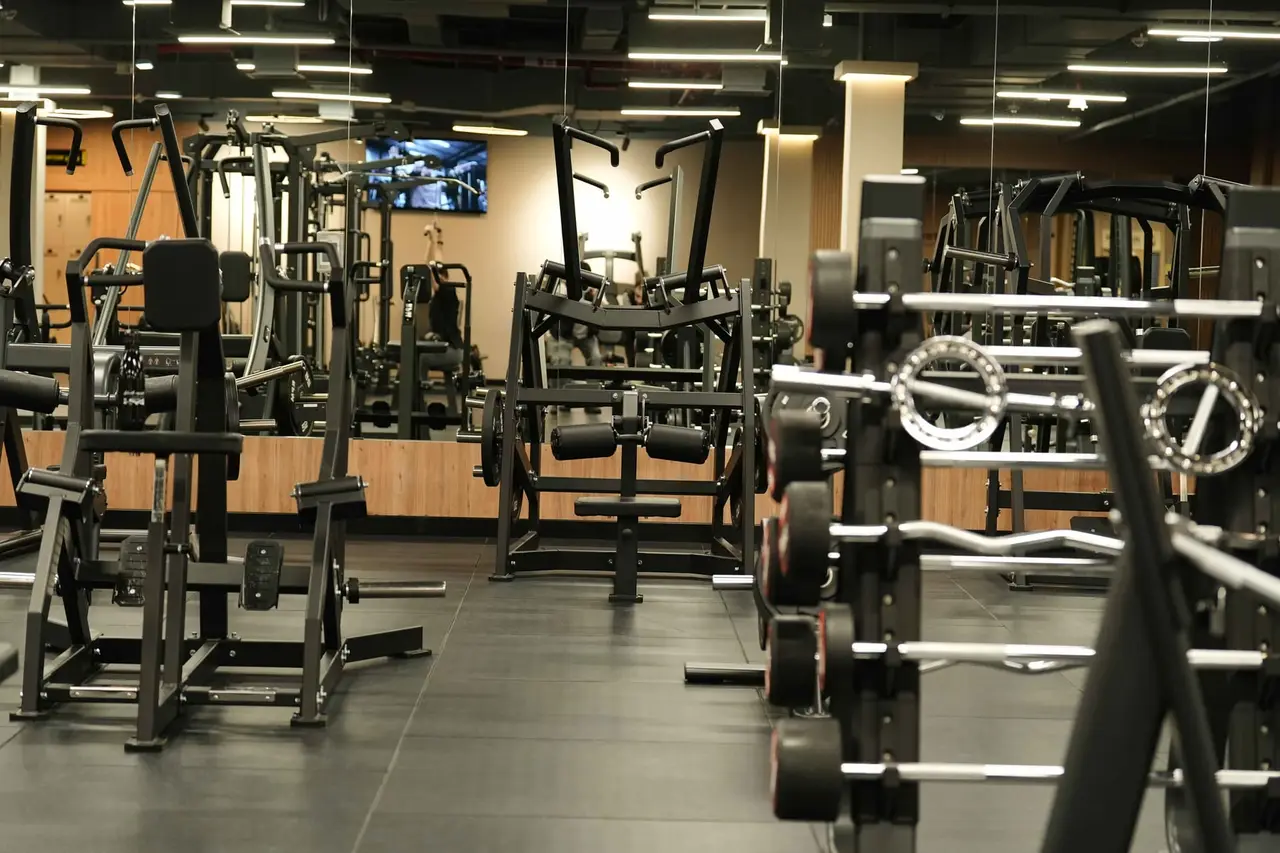
RPM's floor photos show a rack of fixed barbells that includes EZ bars, a dumbbell rack, flat benches and multi-station cable towers on the training floor in Al Manhal, so all three exercises can be done there. Ask on your free tour which attachments each cable station carries, whether a pulley sets low enough for the rope overhead extension, and whether a bench adjusts if you want an incline skull crusher. A personal training session can check your arm angle and elbow position on each one.
Sources
Questions, answered.
Which of the three works the long head the most?
The overhead extension, because the arm is fully raised and the long head starts at its most stretched. The skull crusher comes next, especially when lowered behind the head, and the pushdown last, though all three train every head.
Do I need the skull crusher, pushdown and overhead extension?
Not all three. Two are enough if one has your arm overhead and the other has it at your side or in front; the third adds variety, or a swap when the equipment is busy.
Why do I lift so much less on overhead extensions?
The long head is working from a stretched position, where it is weaker, and the study above reports loads about a third lower overhead. Track the two separately; the lighter number is not a sign of a weak arm.
Is a skull crusher an overhead extension?
Not quite. Lying on a bench, your arms point up in front of you rather than overhead, so the long head is stretched less. Letting the bar travel behind your head, or using a low incline bench, moves the skull crusher closer to an overhead extension.