The answer in brief
Watch the two from the side and the difference is plain. In the back squat the bar sits on your upper back, your knees travel forward and your hips sink between your heels while the torso stays fairly upright. In the deadlift the bar starts on the floor in your hands, your hips sit much higher and your torso leans well forward, and most of the lift is the hips swinging from bent to straight. Coaches call the first a knee-dominant pattern and the second a hip hinge, and a balanced lower-body week holds one of each.
So "which is better" has no single answer: what matters is which one your goal depends on, which to put first and how to fit both into your week. This page compares the barbell back squat with the conventional deadlift; the leg training guide shows how both sit beside single-leg work and machines.
Side by side
| What differs | Squat | Deadlift |
|---|---|---|
| Pattern | Knees and hips bend together; torso fairly upright | Hips hinge back; knees bend less; torso leans well forward |
| Where the bar starts | On your upper back, lifted out of a rack | On the floor, held in your hands |
| Muscles doing most | Quads and glutes, with the inner thighs helping out of the bottom | Glutes, hamstrings and the muscles along the spine; the quads help the bar off the floor |
| Upper body | The upper back makes a shelf for the bar; the trunk braces | Grip, lats, traps and upper back keep the bar against your legs |
| First half of each rep | Lowering: you descend before you stand | Lifting: every rep starts from a dead stop |
| Where heavy reps stall | Just above the bottom, on the way up | Usually off the floor or near the knees |
| What you need | A rack with safety arms set below your depth, a bar and plates | A bar, plates and floor space; no rack |
| Typical load | Usually less than your deadlift | Usually more than your squat |
Which builds more: muscle, strength and what carries over
For muscle, the two divide the legs between them. The squat takes the knees through a long range under load, so it asks far more of the quads, with the glutes and inner thighs working hard in the bottom half. The deadlift loads the hips and back: the glutes and hamstrings straighten the hips, the muscles beside the spine hold your back still, and the upper back and forearms hang on to a heavy bar for the whole set. The quads mainly help break the bar from the floor.
For strength, each lift mostly improves itself. In a 2020 study, 25 resistance-trained men lifted three times a week for six weeks with either the deadlift or the parallel squat as their only heavy lower-body lift, plus jumps. The deadlift group improved its deadlift more, the squat group its squat, and jump performance rose by a similar amount in both.
A 2009 analysis of 25 lifters at a regional powerlifting competition points the same way: at each lift's sticking point the hip, knee and ankle angles and the bar speed were clearly different, and the authors concluded there is no direct cross-over between the two. For a stronger squat, squat; for a stronger deadlift, deadlift. Both studies were small and neither measured muscle growth, so read them as evidence about strength, not size.
Which is harder: skill, effort and recovery
The harder one to learn is usually the squat. You unrack a loaded bar, walk it out, keep your heels down and reach depth with a flat back, and stiff ankles or hips show up at once. The deadlift has fewer moving parts, but its one demand is strict: a flat back while a heavy bar leaves the floor. A rounding back is hard to see from inside the lift, so film a set from the side or ask a coach to watch.
The harder one to recover from is often said to be the deadlift. A 2019 study tested that belief in ten resistance-trained men doing eight sets of two reps at 95% of their one-rep max on each lift. The deadlift loads were heavier, yet the drop in quad strength and in the nervous system's drive to the muscle did not differ between the lifts, and the squat left the quads themselves more fatigued. It was one session in ten men, measured for half an hour afterwards, but it is a reason to plan by how your sessions actually go rather than by a lift's reputation.
Do you need both? Match the lift to the goal
| Your goal | Main lift | Supporting lift |
|---|---|---|
| General strength and muscle | Both, each heavy once a week on different days | A lighter version of the other pattern |
| Bigger quads | The squat, or another deep knee-bending lift | A lighter hinge such as the Romanian deadlift |
| Glutes and hamstrings | The deadlift or the Romanian deadlift | A squat or leg press for the front of the thigh |
| Powerlifting | Both, with the bench press: all three are tested | Variations aimed at your weakest point |
| Still learning | Goblet squat and Romanian deadlift | The barbell versions once both patterns are consistent |
Short of time? Two lower-body sessions a week, one built on each lift, cover both patterns; the two-day gym plan is laid out that way.
Fitting both into your week
Give each lift its own day as the main lift and, where you can, leave a day between the heavy squat and the heavy deadlift:
| Days a week | Squat | Deadlift |
|---|---|---|
| Two | Day 1: heavy back squat, then a light Romanian deadlift | Day 2: heavy deadlift, then a goblet or front squat |
| Three | Day 1: the back squat is the main lift | Day 3: the deadlift is the main lift; day 2 keeps the legs light |
| Four, upper and lower | Lower day 1 is squat-led | Lower day 2 is deadlift-led |
For heavy work, 3–5 sets of 3–5 reps with one or two reps left suits both lifts, and one heavy deadlift session a week is enough for most people. The three-day and four-day plans set out full sessions.
If both land in one session, start with the lift you most want to improve while you are fresh, and keep the second lighter with fewer sets. If the two goals are equal, follow the order of a powerlifting meet: squat first, deadlift last.
When one lift is off the table
Every rack is taken
The deadlift needs no rack, so swap the order and pull first. If you still want a squat pattern that day, a goblet squat or the leg press loads the same muscles without one.
You cannot reach the bar with a flat back
Raise the bar on blocks or stacked plates so it starts higher, or hinge from standing with a Romanian deadlift, which never goes to the floor. A trap bar deadlift, where a gym has the hexagonal bar, starts you more upright.
Your heels lift or your back rounds before squat depth
Squat to a box just above that point, raise your heels on small plates, or use the goblet squat for a few weeks while you build range.
One of them causes pain
Stop that lift and speak to a doctor or physiotherapist first. The right substitute depends on the cause.
Squats and deadlifts at RPM
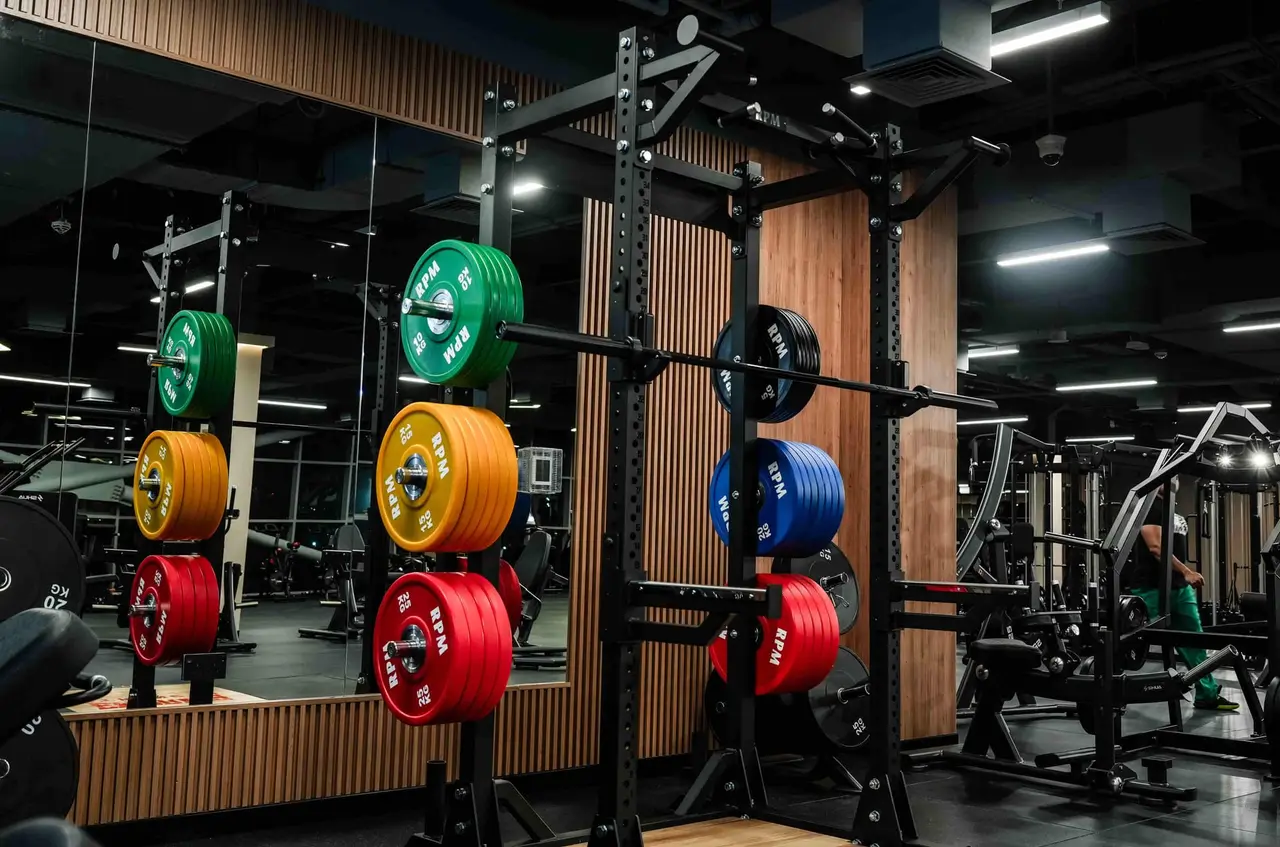
RPM's floor photos show a squat rack, barbells and colour bumper plates on the training floor in Al Manhal, which covers both lifts. Whether there is a trap bar or a dedicated lifting platform is not confirmed, so ask about both on your free guided tour. To have a coach set your squat depth and your deadlift start position before the weights climb, book a personal training session.
Sources
- Nigro F, Bartolomei S. A comparison between the squat and the deadlift for lower body strength and power training. Journal of Human Kinetics, 2020
- Barnes MJ, Miller A, Reeve D, Stewart RJC. Acute neuromuscular and endocrine responses to two different compound exercises: squat vs. deadlift. Journal of Strength and Conditioning Research, 2019
- Hales ME, Johnson BF, Johnson JT. Kinematic analysis of the powerlifting style squat and the conventional deadlift during competition: is there a cross-over effect between lifts? Journal of Strength and Conditioning Research, 2009
Questions, answered.
Can the deadlift replace squats, or the squat replace deadlifts?
Not fully. The squat leaves the hamstrings and grip lightly trained, and the deadlift works the quads mainly in the first part of the pull. If you drop one, replace it with a lift from the same pattern: a leg press or split squat for the squat, a Romanian deadlift or hip thrust for the deadlift.
Which should I learn first?
Neither barbell lift is a first-day exercise. Learn the squat pattern with the goblet squat and the hinge with the Romanian deadlift, then move to the barbell versions once every rep of both looks the same.
Squat or deadlift for glutes?
Both train them: the squat most in the bottom half of a deep rep, the deadlift as you drive your hips through to stand. If the glutes are your main goal, add a hip thrust; the glute exercises page builds a week around them.
What about the front squat, sumo deadlift or Romanian deadlift?
Each changes one lift, not the choice between them; see front squat vs back squat, sumo vs conventional deadlift and Romanian deadlift vs deadlift.
How should I compare my squat and deadlift numbers?
Track each lift against itself; there is no fixed ratio to hit. The squat 1RM calculator and deadlift 1RM calculator estimate a max from a recent hard set.