The answer in brief
Both exercises straighten the elbow against resistance, and that is about where the likeness ends. In dips you lower and press your own body between parallel bars, so the shoulder moves as well as the elbow, and the chest and front shoulders share the work. In the tricep pushdown your upper arms stay pinned at your sides while you push a cable down, so only the elbow moves and the triceps work alone. One is a compound press, the other an isolation exercise, and that difference decides most of what follows: the load, the skill, the demand on the shoulder, the rest you need and where each one sits in a session.
Technique lives on each exercise's own page, and the triceps guide shows where both fit beside your other presses and overhead work.
Side by side
| What differs | Dips | Tricep pushdown |
|---|---|---|
| Kind of exercise | A compound press: shoulders and elbows both move | Isolation: only the elbows move |
| What you lift | Most of your bodyweight, plus any weight hung from a belt | A cable stack, set with the pin |
| Muscles doing the work | Triceps, lower chest and front shoulders, with the shoulder-blade muscles holding you steady | Triceps; the trunk only holds your stance |
| Where the upper arm goes | From behind your body at the bottom back to your side | Stays at your side throughout |
| Demand on the shoulder | High: the bottom of the rep loads the front of the shoulder with the arm behind you | Low: the shoulder barely moves |
| What ends the set | Whichever of the triceps, chest or shoulders tires first | The triceps |
| Making it easier | Assistance, a band or slow lowering reps | One step lighter on the pin |
| Making it harder | More reps, then small plates on a belt | One step heavier on the pin |
| Level | Intermediate | Beginner |
| Rest between hard sets | About two minutes | About a minute |
| Kit | A dip station, or a flat bench for bench dips | A high pulley with a rope, straight bar or V-bar |
Why a press and an isolation exercise feel so different
In a dip, the triceps straighten the elbow while the chest and front shoulders drive the upper arm forward from behind the body. Three muscle groups share one heavy load, which is why a set of eight dips can feel more like a hard bench set than an arm exercise. The flip side is that the set ends when the weakest link gives out. For many people that is not the triceps at all: the shoulders or the chest fade first, and the triceps finish the set with reps still in them.
A pushdown removes that problem. Nothing else can help, so the triceps decide when the set ends, and you can take them close to failure with a load that barely touches the rest of your body. The cost is that a pushdown builds no pressing strength. Dip numbers tell you how your whole pressing chain is doing; pushdown numbers tell you about the triceps alone, so track them separately.
The difference also shows in what each one costs a session. Hard dips tire the chest and front shoulders, so heavy dipping just before a bench session costs you bench reps, and dips need the two minutes' rest any press needs. Pushdowns recover in about a minute, leave your presses almost untouched and fit neatly into a superset with a curl.
Where the long head fits in
The triceps has three heads, and the long head is the only one that crosses the shoulder as well as the elbow. It is stretched most when your arm is raised overhead, and neither of these exercises takes it there. In a pushdown the upper arm stays by your side, and at the bottom of a dip it sits behind your body, which shortens the long head at the shoulder rather than lengthening it. Both still train all three heads; neither trains the long head in its stretched position.
That is why a plan built only on dips and pushdowns still leaves a gap, and why the usual third exercise is an overhead tricep extension. If you are choosing between the isolation exercises themselves, the skull crusher, pushdown and overhead extension comparison sets out what each arm position changes.
Who each one suits
Dips are the better pick if…
You want one exercise to cover pressing and triceps on a short session or a bodyweight day; you can already hold yourself at the top of the bars with straight arms and your shoulders down; you want a lift you can keep loading with a belt for months; and the bottom of the rep feels like effort in the triceps and chest, not a pinch at the front of the shoulder. Upright dips with the elbows tucked put more of that work on the triceps, but they remain a press.
The pushdown is the better pick if…
You are new to triceps work; you already bench or overhead press heavily and want triceps volume without more chest and shoulder fatigue; you want to add load in small steps and take sets close to failure; or dips bring discomfort at the front of the shoulder. In that last case, stop dipping and have the shoulder checked by a doctor or physiotherapist before you choose a replacement.
Putting both in one week
Count dips as one of the week's presses and pushdowns as direct triceps work, and the plan follows from there. Three ways to lay it out:
| Set-up | Dips | Tricep pushdown |
|---|---|---|
| One push session a week | Second press, after the bench: 3 × 6–10 | To finish: 2–3 × 12–15 |
| Two upper-body sessions | Day A, as the main press: 3–4 × 6–12 | Day B, after a bench or overhead press: 3 × 10–15 |
| Building up to dips | Assisted or slow lowering reps: 3 × 3–6 | Straight after: 2 × 12–15 |
Stop each set with one or two reps left. Count every set of dips towards both your pressing and your triceps work; the hypertrophy volume calculator counts direct and indirect sets for you.
Order matters. Do the dips first, while your triceps are fresh: pushdowns first would leave the triceps tired, cut your dip reps short and make those numbers hard to compare from week to week. If you dip and bench in the same session, keep the dip sets on the low side, since both presses draw on the same muscles.
When the bars or the cable are taken
Swap like for like: a press for a press, an isolation exercise for an isolation exercise. Replacing dips with pushdowns for a few weeks keeps the triceps busy but quietly drops a press from your week.
- No dip station: the close-grip bench press is the closest heavy press for the triceps, and bench dips on a flat bench work if your shoulders are comfortable with the depth.
- Every cable station taken: an overhead dumbbell extension or a tricep kickback isolates the triceps with a single dumbbell, and a band anchored high copies the pushdown.
- Neither: push-ups with the hands closer than shoulder width press with the triceps doing much of the work, and the push-up guide shows how to build up to them.
Dips and pushdowns at RPM
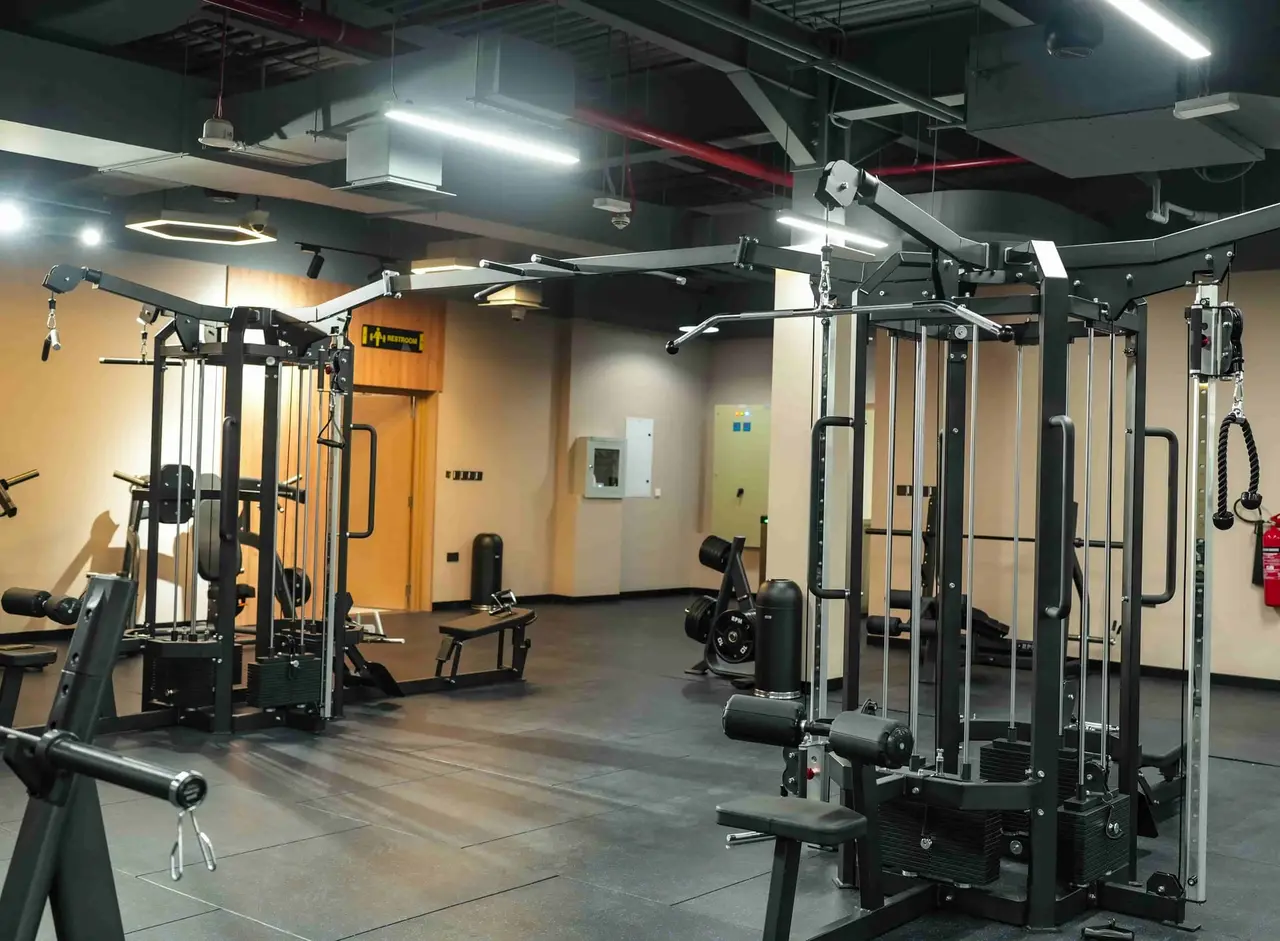
RPM's floor photos show multi-station cable towers and flat benches on the training floor in Al Manhal, so the pushdown and bench dips are covered. The photos do not show a dip station or an assisted dip machine, so ask on your free tour what the floor has for dipping, and which attachments the cable stations carry. A personal training session is a quick way to have a coach judge your dip depth and your elbow position on the cable.
Questions, answered.
Dips or pushdowns: which builds bigger triceps?
Neither on its own. Dips load the triceps heavily but share the load with the chest and shoulders; pushdowns let you take the triceps close to failure with nothing else limiting the set. Most plans that aim for size use a press such as dips plus isolation work, and add an overhead extension for the long head.
Can pushdowns replace dips?
For the triceps, largely. For pressing strength and the lower chest, no: a pushdown is not a press. If you drop dips, keep another press in the week, such as the bench press or the close-grip bench.
Can dips replace pushdowns?
If you do enough of them, upright dips give the triceps plenty of work. You lose the small load steps and the chance to work the triceps hard without tiring the chest and shoulders, and every set asks more of the shoulder.
Which should a beginner start with?
The pushdown. It is rated beginner, the cable guides the path and the load changes in seconds. Start dips with assistance or slow lowering reps once a straight-arm hold at the top of the bars feels steady.
What if dips bother my shoulders?
Stop dipping rather than pushing through, and have the shoulder checked by a doctor or physiotherapist before you train it again. Pushdowns ask far less of the shoulder, but whether to use them in the meantime is a question for that check.