What the decline changes, and whether you need it
Lowering your head below your hips turns the press so your arms drive towards your hips rather than straight up from your chest. The lower, larger part of the chest lines up with that direction, the front shoulders do a little less than on a flat bench, and the bar travels a shorter distance because your chest sits higher relative to your hands. That shorter path is why many lifters handle as much on a decline as they do flat, or more.
It is an option, not a requirement. In a 2016 study of 14 trained men pressing at four bench angles, the lower chest worked about as hard on a flat bench as on a slight decline, both beat a steep incline, and the upper chest was no more active on the decline. A flat bench press therefore already trains the lower chest well. The decline earns its place for variety, for lifters whose shoulders like the angle, or as a second press after a flat or incline one, the way the chest training guide arranges its week.
Setting up the decline bench
- Choose a slight decline. Fixed decline benches with their own uprights are usually set at a modest angle; on an adjustable bench, a notch or two below flat is plenty.
- Sit on the seat and hook your lower legs under the roller pads before you lie back. They are what holds you in place, so adjust them until your knees are bent and your hips cannot slide towards your head.
- Lie back so your eyes are under the bar or just behind it, and check that the hooks need only a short push to clear.
- Ask a spotter to stand behind your head. On a decline the bar starts over your face, and a missed rep cannot be rolled down your body as it sometimes can on a flat bench.
- Grip slightly wider than your shoulders, as on a flat bench, with your thumbs wrapped, and pull your shoulder blades back and down into the pad.
- Start with the empty bar and build up in small steps. The decline feels lighter than it is until you lower the first rep.
A rep from hand-off to sitting up
- Take the hand-off and settle the bar with your arms straight and vertical, roughly over your upper chest.
- Lower it down and slightly towards your hips until it touches the bottom of your breastbone, elbows tucked a little in from your sides.
- Touch lightly, without letting the bar sink into your ribs.
- Press it back along the same line until your arms are straight again.
- After the last rep, let the spotter guide the bar into the hooks, then unhook your legs and sit up slowly; getting straight up from a head-down position can leave you briefly light-headed.
Breathe in and brace before each descent, and breathe out through the top half of the press. If lying head-down makes you dizzy, press on a flat bench instead.
Mistakes to fix first
| Mistake | What it looks like | The fix |
|---|---|---|
| Pressing without a spotter | The bar wobbles over your face on the unrack and the last rep has no way out | Use a spotter for every work set, or press inside a rack with the safety arms set just below your chest |
| Bar landing too high | It drifts towards the collarbones or the neck | Aim for the bottom of the breastbone with the forearms vertical |
| Legs not locked in | You slide towards the head of the bench as the set goes on | Reset the roller pads so your knees are bent and pinned before you lie back |
| Too steep a decline | The range shrinks to almost nothing and your face feels flushed | Go back to a slight angle; a steeper one adds discomfort, not chest work |
| Bouncing off the ribs | A fast rebound at the bottom of each rep | Touch and press, or pause briefly on the chest |
| Sitting up too fast | Light-headedness as you get off the bench | Sit up slowly and wait a moment before you stand |
Dumbbell, angle and machine versions
The decline can be pressed with dumbbells or on a guided machine, and the angle itself is a choice. These are the versions people ask about most.
Decline dumbbell press
Dumbbells let each arm move on its own and turn the wrists, but getting them into position is the awkward part: the knee kick-up does not work with your legs hooked under pads. Hold the dumbbells on your thighs as you hook in, then hug them to your chest as you lie back, or have a partner hand them to you once you are settled. To finish, bring them back to your chest and sit up with them, or lower them to the floor beside you.
How steep should a decline be?
Slight is enough: roughly fifteen to thirty degrees below flat, which on most adjustable benches is the first notch or two. A steeper bench shortens the range further and makes lying head-down less comfortable, with nothing obvious gained for the chest.
Decline press on a Smith machine or a machine
On a Smith machine, place a decline bench under the bar so it meets your lower chest and set the stops just above that point. The rails remove the balancing and the hooks let you rack the bar anywhere, which helps when there is no spotter. Some gyms also have a decline chest press machine, a seated press whose handles travel forward and slightly down. The Smith machine guide and the chest press machine page cover their settings.
With no decline bench at all, dips and a high-to-low cable crossover both work the chest along a similar downward line, and push-ups with your hands raised on a bench copy the decline angle with no kit.
Sets, reps and where it fits
| Goal | Sets × reps | How hard |
|---|---|---|
| Learning the decline | 3 × 8–10 with a light bar | Three or four reps left, spotter in place |
| Building muscle | 3–4 × 6–10 | One or two reps left |
| Second press of the day | 2–3 × 8–12 | Two reps left, after your flat or incline press |
Rest two minutes or a little more between the heavier sets. Keep a separate log line for the decline: its numbers run close to or above your flat bench and tell you little about it.
One decline press a week is plenty, and only if it replaces or follows a flat or incline press rather than adding a third heavy press on top. Add the smallest plates when every set reaches the top of its range with the bar touching the same spot on every rep.
The decline bench press at RPM
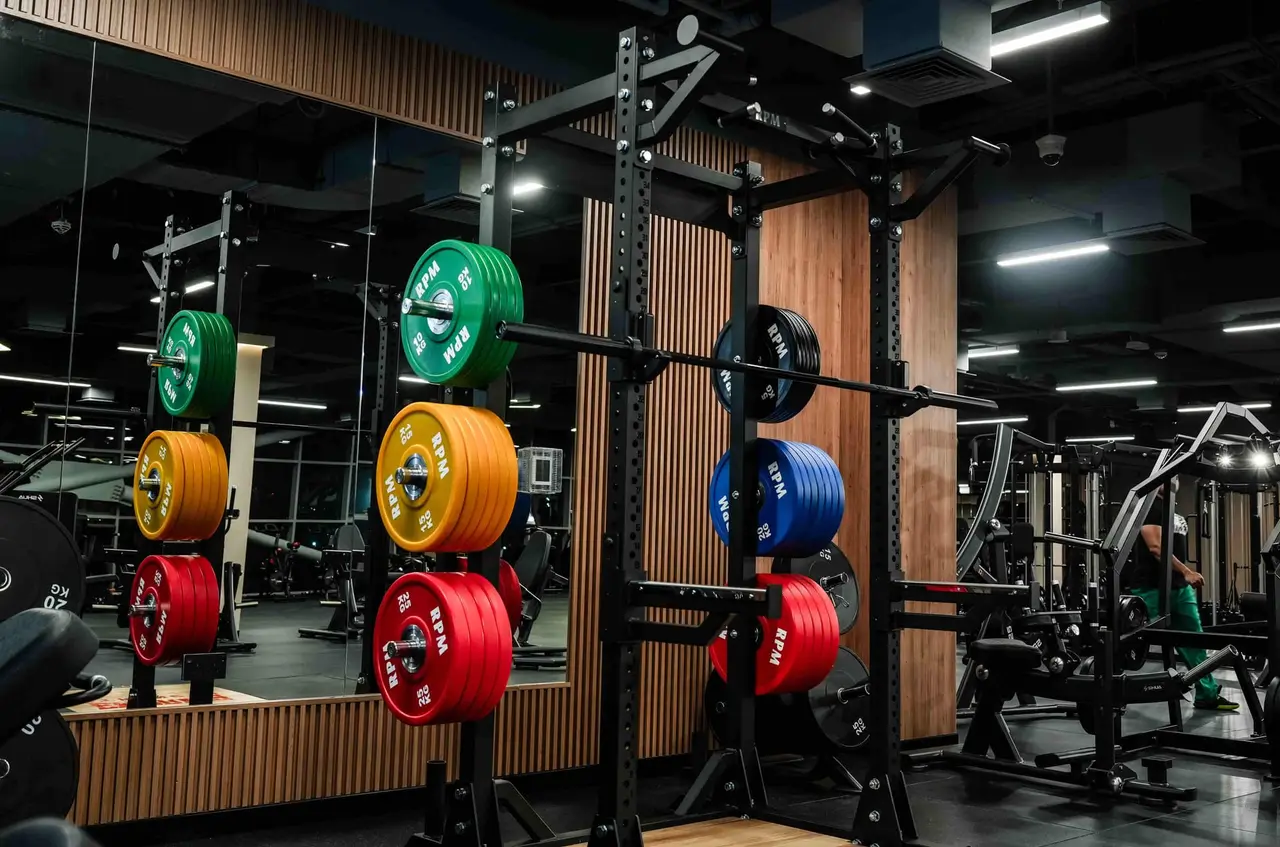
RPM's floor photos show squat racks with barbells and colour bumper plates, and flat benches, on the training floor in Al Manhal, but no decline bench. Ask on your free tour whether one is available before planning around it, and ask about a dip station at the same time; if neither is there, the flat press and the cable work above cover the same muscles. A coach in a personal training session can spot your decline sets and check the bar path.
Sources
Questions, answered.
What part of the chest does the decline bench press target?
The lower fibres most, along with the rest of the chest, the triceps and, less than on a flat bench, the front shoulders. The lower chest also works hard on a flat bench, so the decline shifts the emphasis rather than reaching something new.
Decline or flat bench press: which should I do?
Flat, for most people, as the main press: it trains the whole chest, needs no special bench and is easier to spot. Add the decline if you enjoy it, if your shoulders feel better on it, or for variety in a second chest session, as the chest training guide suggests for extra presses.
Decline bench press or dips?
Both press along a downward line and load the lower chest and triceps. Dips move your bodyweight and ask more of the shoulders at the bottom; the decline press goes up in small plate jumps with your back supported. If dips hurt your shoulders, stop and have them checked by a doctor or physiotherapist.
Why can I lift more on the decline than on the flat bench?
The bar travels a shorter distance, and the angle puts the large lower part of the chest and the triceps in a strong position. Log the two as separate numbers rather than reading the gap as proof that one is stronger.
Decline or incline bench press?
They aim at opposite ends of the chest: the incline tilts the work towards the upper chest and shoulders, the decline towards the lower chest. Most programmes need a flat press and possibly an incline; the decline is optional. The incline, flat and decline comparison sets out all three.