What a devil press is, and what each half trains
Each rep has two halves: a burpee with your hands on the dumbbell handles, then a double-dumbbell swing from the floor to straight arms overhead, driven by the hips. The dumbbells go back to the floor and the next burpee starts from there.
The burpee half works the chest, front shoulders, triceps and trunk. The swing half is a hip hinge: the glutes and hamstrings drive it and the upper back and shoulders steer the dumbbells overhead. Going from the floor to arms overhead every few seconds means your breathing gives out long before any one muscle, so this is a conditioning move, not a way to build maximum strength or size.
It is a staple of functional-fitness workouts and conditioning circuits, usually as reps for time or a few reps every minute. It is not one of the eight HYROX race stations. For the heavier lifts that build its pieces, the exercise library lists hinges, presses and squats by muscle and equipment.
Choosing the dumbbells and the space
- Start lighter than you think: a pair you could press overhead ten times without strain, because the swing fails first when the dumbbells are too heavy.
- Use dumbbells whose heads sit flat. Your hands push up from the handles, and a dumbbell that rolls in the plank loses the rep.
- Clear a strip of floor about your own length plus a step, with room overhead and nobody within reach of the swing.
- Set the dumbbells side by side, about shoulder-width apart, handles parallel and pointing forwards, and stand just behind them with your feet a little wider than your hips.
How to do a devil press, rep by rep
- Bend down and take a handle in each hand, knuckles over the handles so your wrists stay straight.
- Jump or step back into a plank on the dumbbells and lower your chest to the floor between them under control.
- Push back up, then jump your feet forwards so they land flat and wide, outside the dumbbells.
- Set the hinge: hips back, back flat, chest over the dumbbells, arms long. This is the start of a deadlift, not the bottom of a squat.
- Hike the dumbbells back between your thighs, then snap your hips forwards so they float up in one arc close to your body.
- As they pass your face, punch your arms straight, biceps by your ears. Lower them in front of you, set them down and start the next burpee.
Breathe in on the way down and out as you push up, then breathe in as you set the hinge and out hard as the hips snap. If your wrists, shoulders or lower back hurt, stop and speak to a doctor or physiotherapist before you carry on.
The swing: a hinge and an arc, not a curl and a press
The swing is where most devil presses go wrong. Tired lifters stand up first, curl the dumbbells to the shoulders and press from there, turning one fast movement into three slow ones. In a good rep the dumbbells never stop at the shoulders: they leave the floor, travel back between the legs and come up in one arc, powered by the hips.
- Shins near vertical at the bottom. If your knees shoot forwards and your hips drop, you are squatting the dumbbells up.
- A high, close hike, with the wrists near the tops of the thighs rather than down by the knees, and the back flat.
- Light at the chest. If your shoulders are hauling the dumbbells past your chest, the hip snap came too early or too soft.
New to the hip snap? Learn it with the kettlebell swing, the same hinge stopped at chest height. The lockout matches the end of a push press: arms locked, head through.
Mistakes to fix first
| Mistake | What it looks like | The fix |
|---|---|---|
| Rounded back on the swing | The spine curls as the dumbbells leave the floor or pass between the legs | Feet outside the dumbbells, hips back, chest up, a lighter pair |
| Curling and pressing | You stand, curl the dumbbells to your shoulders, then press | One arc from the hips, arms long until the dumbbells pass your chest |
| Pressing out with bent elbows | The dumbbells finish in front of your face and the lower back arches | Lock the elbows, biceps by your ears; go lighter if you cannot |
| Flopping onto the dumbbells | The body drops in one slap onto the floor or the dumbbell heads | Lower with your arms, or put your knees down first |
| Feet landing between the dumbbells | A narrow stance turns the swing into a squat | Jump wider so your feet land outside them |
Easier versions while you learn
Scale either half on its own, and move up one step at a time.
Step back instead of jumping
Step your feet back into the plank one at a time and step them back in. If lowering your chest is hard, put your knees down first or hold the plank for a breath instead. Nothing lands with force, so this suits beginners and anyone returning after a break.
One dumbbell
One hand on a single dumbbell, the other flat on the floor: do the burpee, then swing that dumbbell overhead with one arm. Your trunk has to resist the twist; change hands every rep or set and keep the count even.
Dumbbell clean and press instead of the swing
If the overhead arc is not ready, drive the dumbbells up to your shoulders with your hips, catch them with soft knees, then press or push press them overhead. Unlike the curl-and-press fault, the clean still comes from the hips; you simply choose to stop at the shoulders.
Devil press vs burpee, thruster and man maker
Devil press vs burpee
The burpee needs no equipment and ends in a jump. The devil press adds two dumbbells and a loaded swing, so each rep takes longer and tires the grip, the shoulders and the backs of the thighs far more.
Devil press vs thruster
A thruster drives the weight up from the shoulders out of a full front squat, so the quads lead. The devil press lifts it from the floor with a hip hinge, so the glutes and hamstrings lead, and it adds the burpee.
Devil press vs man maker
Definitions vary, but a man maker usually adds a renegade row on each side in the plank and finishes with a clean and press or a thruster instead of the swing. Get your devil presses clean before you add the rows.
Who it suits, and when to choose something else
- It suits people who already do tidy burpees and a flat-backed kettlebell swing and want a short, hard conditioning move.
- If your back rounds when you lift a weight off the floor, build the hinge first with the Romanian deadlift and the kettlebell swing.
- If you have a heart, lung or other medical condition, ask your doctor first. If you are pregnant or have recently given birth, ask your doctor or midwife.
Reps, EMOMs and pacing a set
| Format | How it is commonly done | What to aim for |
|---|---|---|
| Learning the movement | 3–4 sets of 5, step-back version | Every rep the same shape |
| Reps for time | 15–30 reps with a light pair | Sets of 5 with short breaths, broken early |
| EMOM (every minute on the minute) | 10–12 minutes, 3–6 reps each minute | The same reps every minute, with rest left over |
| Intervals | 6–8 rounds of 30 seconds on, 60 seconds off | The last round looks like the first |
| Finisher after strength work | 2–3 sets of 6–8 | A steady pace and no rushed swings |
These are common ways coaches use the devil press, not a prescription.
Sets are usually lost in the first ten reps, so start slower than feels necessary, rest standing over the dumbbells rather than in the plank, and break a set of twenty into fives before you are forced to. When the dumbbells stop locking out or your back rounds, rest or switch to an easier version.
Progress the version first, then the reps, then the rounds, and only then the weight. Once or twice a week is plenty, but not the day after heavy deadlifts. Energy use depends on your size, pace and how long you keep going, so this page gives no calorie figure.
Devil presses at RPM
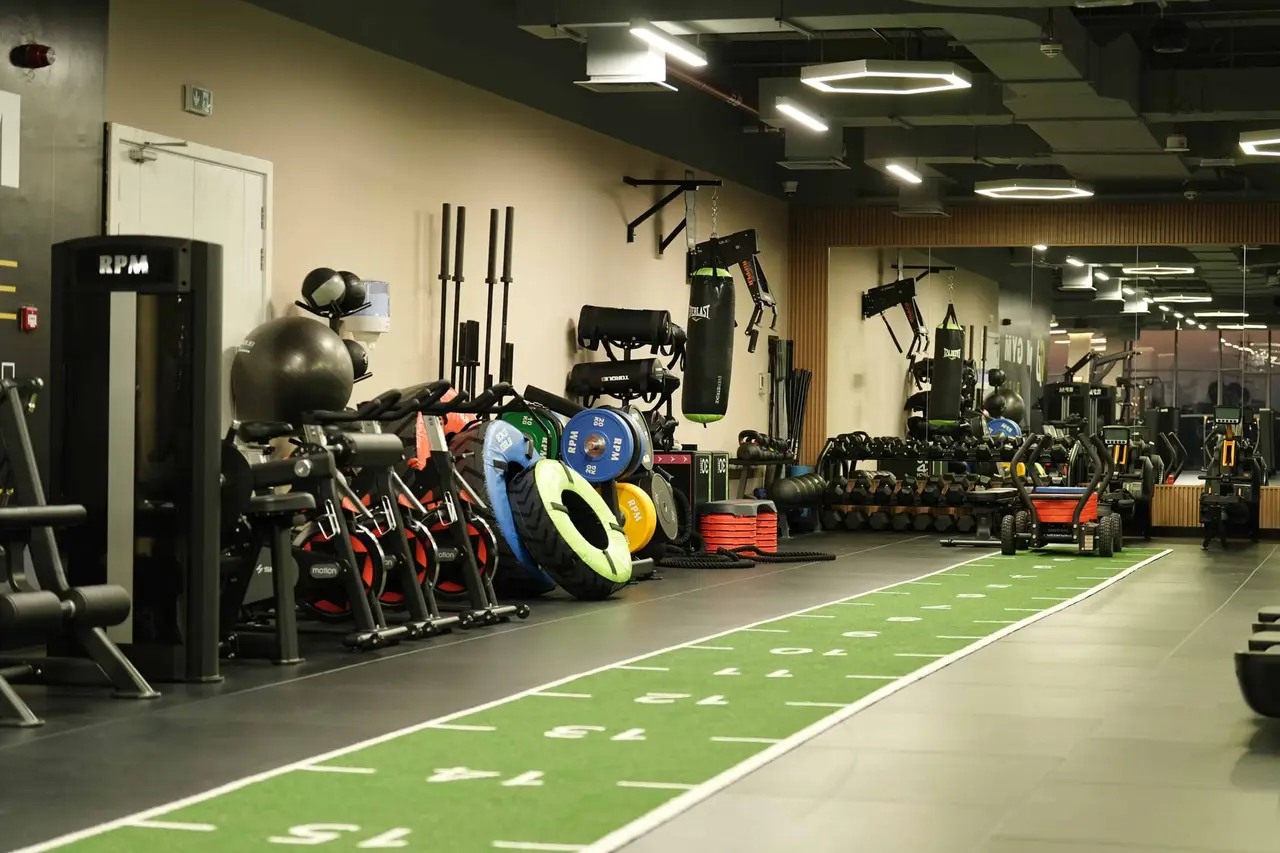
RPM's floor photos show a dumbbell rack and the turf lane in the functional area in Al Manhal, which covers every version on this page. Ask on your free guided tour which dumbbell sizes are on the rack and where you can swing a pair overhead when the floor is busy. For a coach to check your hinge, lockout and pacing, book personal training or see functional training at RPM.
Questions, answered.
What muscles does the devil press work?
The whole body: the chest, shoulders and triceps in the burpee, the trunk in the plank, and the glutes, hamstrings and shoulders in the swing. Over a set, the heart and lungs work hardest.
What weight should I use for devil presses?
A pair you could press overhead about ten times is a sensible start, and many people go lighter for long sets. If the dumbbells stop locking out or your back rounds on the swing, the pair is too heavy.
Is the devil press part of HYROX?
No. The eight HYROX race stations include burpee broad jumps and wall balls, but no devil press. For race practice, see HYROX-style training at RPM.
What can I do instead of devil presses?
Alternating burpees and kettlebell swings covers both halves without the overhead finish, and a dumbbell thruster keeps the overhead work with a squat instead of a hinge. If the reason is pain, see a doctor or physiotherapist rather than looking for a workaround.