What the push press is for
The push press sits between two kinds of lift. Like the overhead press, it takes a barbell from the front of the shoulders to straight arms overhead, and the front and side shoulders and the triceps finish the job. Unlike it, the first part of the lift comes from the legs: the quads and glutes straighten the knees and hips fast enough to launch the bar, and the arms take over once it is moving. Your trunk has to stay stiff throughout, or the drive leaks away through a soft middle before it reaches the bar.
That gives it two uses. It is a power exercise, because the dip and the drive only work when they are quick. And it overloads the top half of a press: the legs get a heavier bar past the slowest point just above the head, then the shoulders and triceps have to lock it out. Coaches use it for sports that produce force from the ground up, and lifters use it to handle loads above their strict press. It is an intermediate lift, usually learned once the strict press is comfortable, so the lockout and the bar path are already familiar. The shoulder exercise guide shows how it fits with the rest of your shoulder work.
The rack position and the set-up
- Set the bar on the rack hooks at about collarbone height, so you can lift it out with a small bend of the knees.
- Take a full grip just outside shoulder width, thumbs round the bar, forearms close to vertical.
- Let the bar rest on the front of your shoulders and collarbones, with the elbows slightly in front of it. If the bar sits only in your hands, the dip sinks into your arms instead of carrying the bar.
- Step back and set your feet about hip width apart, toes forward or turned out a little, weight across the whole foot: the stance you would jump from.
- Brace with a full breath into your stomach, ribs down and glutes tight, and hold it until the bar is overhead.
- Start with the empty bar. Once the timing is right most people push press clearly more than they strict press, but build up to that rather than starting there.
Dip, drive, press: one rep
- Dip: bend your knees and let them travel forward over your toes, torso upright, heels down. Keep it short, about as deep as you would bend before a standing jump and far shallower than a quarter squat.
- Turn it round at once. The bottom of the dip is a rebound, not a pause.
- Drive: straighten your knees and hips hard, pushing through the whole foot. The bar should leave your shoulders because your legs threw it, not because your arms started pressing.
- Press: as the bar passes your face, move your head back out of its way and press up until your elbows lock, then bring your head through so the bar finishes over your shoulders and the middle of your feet.
- Lower the bar to your shoulders under control, softening the knees a little as it lands so your legs take the weight. Stand tall, reset the brace, and dip for the next rep.
The cue to remember: dip straight down, drive straight up. If your hips push back or your weight tips onto your toes in the dip, the bar goes forward and you spend the rep chasing it. Your heels may lift for a moment at the top of the drive; leaving the floor is a jump, and bending the knees again to catch the bar is a push jerk.
Mistakes to fix first
| Mistake | What it looks like | The fix |
|---|---|---|
| Dipping forward | The hips go back, the chest drops and the weight moves to the toes | Keep the torso upright and send the knees forward, not the hips back |
| Dip too deep or too slow | A quarter squat with a pause before the drive | Shorten the dip and change direction straight away |
| Pressing too early | The elbows bend before the legs have finished driving | Let the legs straighten fully; the arms join as the bar leaves the shoulders |
| Bar held in the hands | Low elbows, and the bar sinks during the dip | Lift the elbows a little so the bar rests on the shoulders |
| Leaning back to finish | The ribs flare and the lower back arches at the top | Squeeze the glutes, push the head through and take weight off |
| Landing the bar on stiff legs | The bar drops onto the collarbones with a jolt | Meet it with soft knees, then stand and reset |
If your shoulders, wrists or lower back hurt during or after the lift, stop and speak to a doctor or physiotherapist before you press overhead again.
Push press, strict press, push jerk and thruster
All four finish with a barbell overhead. They differ in how much the legs do and how the lift ends.
| Lift | What the legs do | How it finishes | Used for |
|---|---|---|---|
| Strict press | Nothing; the knees stay locked | The arms press the whole way | Shoulder and triceps strength, and the base for the rest |
| Push press | A short dip and drive start the bar | The arms press it to lockout with the legs straight | Power, and heavier loads overhead |
| Push jerk | The same dip and drive, harder | You drop under the bar and catch it on bent knees with locked arms | The heaviest overhead loads; more skill |
| Thruster | A full front squat instead of a dip | The arms press out of the squat in one movement | Conditioning as much as strength |
Dumbbell and kettlebell push press
Rest a dumbbell on each shoulder, palms facing in or forward, and use the same dip and drive. Each arm finishes on its own path, and many people find the freer lockout more comfortable. One dumbbell or kettlebell at a time adds a sideways pull your trunk has to resist; switch arms each set.
Most people can learn the push press in a session or two; the jerk adds a catch that is a skill of its own. The thruster page covers the squat version, and the landmine press page includes a one-arm landmine push press: the same dip and drive, pressed at an angle.
Who should learn it, and who should wait
- It suits lifters who already press a barbell well and want more power or heavier overhead work, and athletes whose sport drives from the ground up.
- If you are new to the barbell, learn the strict press first: the push press adds speed to a position you should already own.
- If you cannot get your arms straight overhead without arching your lower back, use the seated shoulder press or the landmine press until that changes.
- If you have shoulder, wrist or lower-back pain, ask a doctor or physiotherapist before you add a fast overhead lift.
Sets, reps and progression
| Goal | Sets × reps | How hard |
|---|---|---|
| Learning the timing | 3–4 × 3–5 | Empty bar or light; every dip the same depth |
| Power | 4–6 × 2–3 | Moderate weight, fast; stop when the bar slows |
| Strength | 3–5 × 3–5 | Heavier than your strict press, one or two reps left |
Rest two to three minutes between sets so every rep stays quick. The plate calculator works out the loading.
Keep sets short: once the bar slows or the dip starts to change shape, the set has done its job. Put the push press first in an upper-body or full-body session, while you are fresh, and follow it with strict pressing or lighter shoulder work. Add the smallest plates when every set moves well, and when a jump stalls, keep the load and add a set. Once or twice a week is plenty, counted as one of your pressing movements.
The push press at RPM
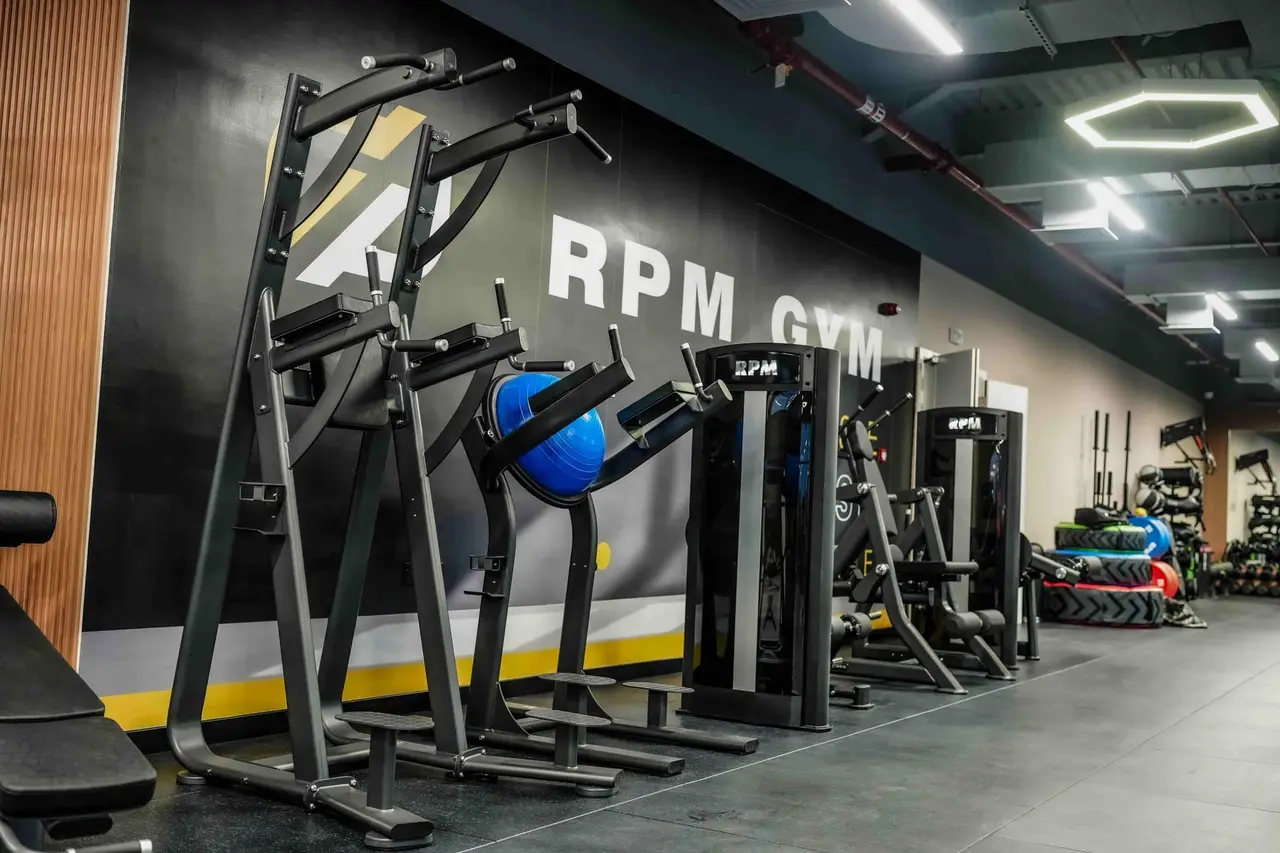
RPM's floor photos show squat racks with barbells and colour bumper plates on the training floor in Al Manhal, which is what the barbell push press needs, and a dumbbell rack for the dumbbell version. Before you push press heavy, ask on your free guided tour where you can lift overhead and how the gym prefers bars to be lowered. A personal training session is the quickest way to get the dip and the timing right.
Questions, answered.
What muscles does the push press work?
The front and side shoulders and the triceps finish the lift, and the quads and glutes start it with the dip and drive. The upper back and trunk hold the bar in place and keep you upright.
Push press vs overhead press: which should I do?
They train different things. The strict overhead press builds pressing strength through the whole range; the push press adds the legs, so it moves more weight and trains power. Most programmes that use the push press keep the strict press as well.
What is the difference between a push press and a push jerk?
Both start with the same dip and drive. In the push press you finish with your arms while standing tall. In the push jerk you drive harder, drop under the bar and catch it on bent knees with locked arms, then stand up. The jerk moves more weight but takes more skill.
How deep should the dip be?
Short, about the bend you would make before a standing jump, with your torso upright and heels down. A deeper dip turns into a squat, slows the drive and usually tips you forward.
Can I do a push press with dumbbells?
Yes. Rest one on each shoulder and use the same dip and drive. You will lift less in total, but each arm works on its own and the path overhead is freer.