What thrusters train, and why they feel so hard
Every rep asks the largest muscles in the body and some fairly small ones to work in a single line. The quads and glutes lower you into a deep squat and drive you out of it; the shoulders and triceps finish the press; the upper back stops the weight rolling forward at the bottom; and the trunk keeps you rigid while the load changes direction twice. So much muscle works on each rep, with nowhere to rest between them, that breathing becomes the limit long before strength does. That is the main reason people use thrusters: a lot of work in very little time.
The load is the trade-off. Your press decides how heavy a thruster can be, so the weight is always far lighter than you could front squat. That makes it a conditioning and power exercise rather than the way to build maximum leg strength; the front squat and the back squat do that job. Use thrusters in circuits, at the end of a session, or as the main lift of a short conditioning day. The leg exercises guide shows where they sit among the other leg patterns.
Barbell or dumbbells: setting up
- Take the bar from a rack set at about collarbone height. Grip just outside your shoulders with your whole hand, not the fingertips of a front squat, because you have to press from this grip.
- Let the bar sit on the front of your shoulders with the elbows pointing forward and a little down: lower than in a front squat, higher than in a strict press.
- Step back and set your feet about shoulder width apart, toes turned out slightly, as for your usual squat.
- Start with the empty bar, or with a weight you could strict press about ten times. The press, not the squat, sets the limit.
With dumbbells, rest one end of each on the front of each shoulder, palms facing each other and elbows forward. Each arm finds its own path, and many people whose wrists or shoulders dislike the barbell rack position are more comfortable this way. One dumbbell or kettlebell at a single shoulder makes the trunk fight to stay square; swap sides between sets.
How to do a rep
- Brace, lift the elbows a fraction and sit straight down into a full squat, hip crease below the top of the knee, heels flat.
- Drive up hard. As your hips and knees straighten, the weight should feel almost light at your shoulders.
- Press as your legs finish: the bar leaves your shoulders on the momentum of the stand and your arms carry it to lockout. Move your head back to let it pass, then bring your head through.
- Finish with straight arms, straight legs and the weight over the middle of your feet. That lockout ends the rep.
- Bring the weight back to your shoulders and, as it lands, let your knees bend into the next squat. In a set, the landing starts the next rep.
Breathe out at the top and take a quick breath as the weight comes down: one breath a rep. Late in a set the elbows drop and the chest falls first, and that is the moment to rest. If your knees, shoulders or lower back hurt, stop and speak to a doctor or physiotherapist before you carry on.
Mistakes to fix first
| Mistake | What it looks like | The fix |
|---|---|---|
| Squatting, then pressing | A pause at the top of the squat and a separate arm press | Start the press as the legs finish driving, so it is one movement |
| Elbows dropping at the bottom | The weight rolls forward and the upper back rounds | Lift the elbows before you sit and lighten the load |
| Shallow squats | The depth shrinks as the set goes on | Touch a box or a mark; cut reps before you cut depth |
| Bar looping round the face | The press drifts forward and finishes in front of your head | Head back, bar straight up, head through |
| Heels lifting | The weight tips onto the toes in the bottom | Push through the whole foot; a slightly wider stance helps |
| Crashing into the next squat | The weight drops onto the shoulders with straight legs | Meet it with soft knees and ride it down |
Thruster, push press, wall ball and other versions
Several squat-and-push movements look alike. What separates them is how deep the legs go and whether you keep hold of the load.
Thruster vs push press
The push press starts the bar with a short dip of the knees; the thruster starts it with a full squat. The push press moves more weight and trains power for the press; the thruster works the legs far harder and suits conditioning.
Thruster vs wall ball
With a wall ball you let go of a soft ball and catch it as it falls, so the arms never lock out and the load stays light. In a thruster you keep the weight in your hands from start to finish, which means it can be loaded and progressed in small steps.
Kettlebell and single-arm thrusters
Hold one or two kettlebells in the rack position, the handle in your palm and the bell resting on the outside of your forearm. A single bell adds a sideways pull your trunk has to resist; keep your hips square and change hands each set.
Cluster
A clean from the floor, caught in a front squat and driven straight into a thruster. It is an advanced combination: learn the clean with a coach before you add it.
Thrusters are not a HYROX race station, but wall balls are, and they share the same squat-and-push pattern, so thrusters often appear in HYROX-style training.
Who thrusters suit, and when to choose something else
- They suit people who already squat and press with good form and want a hard, short conditioning exercise, and anyone training for events that mix lifting with running or rowing.
- If your elbows will not stay up with a weight at your shoulders, or your squat loses depth, learn the goblet squat and a dumbbell press as separate movements first.
- If overhead work bothers your shoulders, the kettlebell swing and burpees fill the same conditioning slot without the press.
- If you have a heart, lung or other medical condition that hard conditioning work could affect, ask your doctor before you add it.
Sets, reps and thruster workouts
| Goal | Sets × reps | How hard |
|---|---|---|
| Learning the movement | 3 × 5 | Empty bar or light dumbbells, a short pause at lockout |
| Strength and power | 4–5 × 3–5 | Moderate barbell load, every rep fast, full rest |
| Conditioning | 4–6 × 8–15 | Light load, steady pace, breathing hard with depth intact |
Rest two to three minutes between strength sets. In conditioning work the rest between rounds is part of the plan, so keep it the same and you can compare one session with the next.
A short thruster circuit
After a warm-up, four rounds with about two minutes' rest between them. The kettlebell swing and plank pages cover those two movements.
| Exercise | Reps or time | Notes |
|---|---|---|
| Thruster, barbell or dumbbells | 10 | Full depth and full lockout |
| Exercise bike | 60 seconds | Hard but steady |
| Kettlebell swing | 15 | Snap the hips; the arms only guide |
| Plank | 30 seconds | Ribs down, glutes tight |
Progress in this order: depth and lockout on every rep, then more reps or rounds, then shorter rests, then more weight. Once or twice a week is plenty alongside strength training. Thrusters the day after heavy squats or presses usually feel worse and look worse, so give them a day of their own or put them at the end of a lighter session. The conditioning guide for beginners explains how to build up to circuits like this one.
Thrusters at RPM
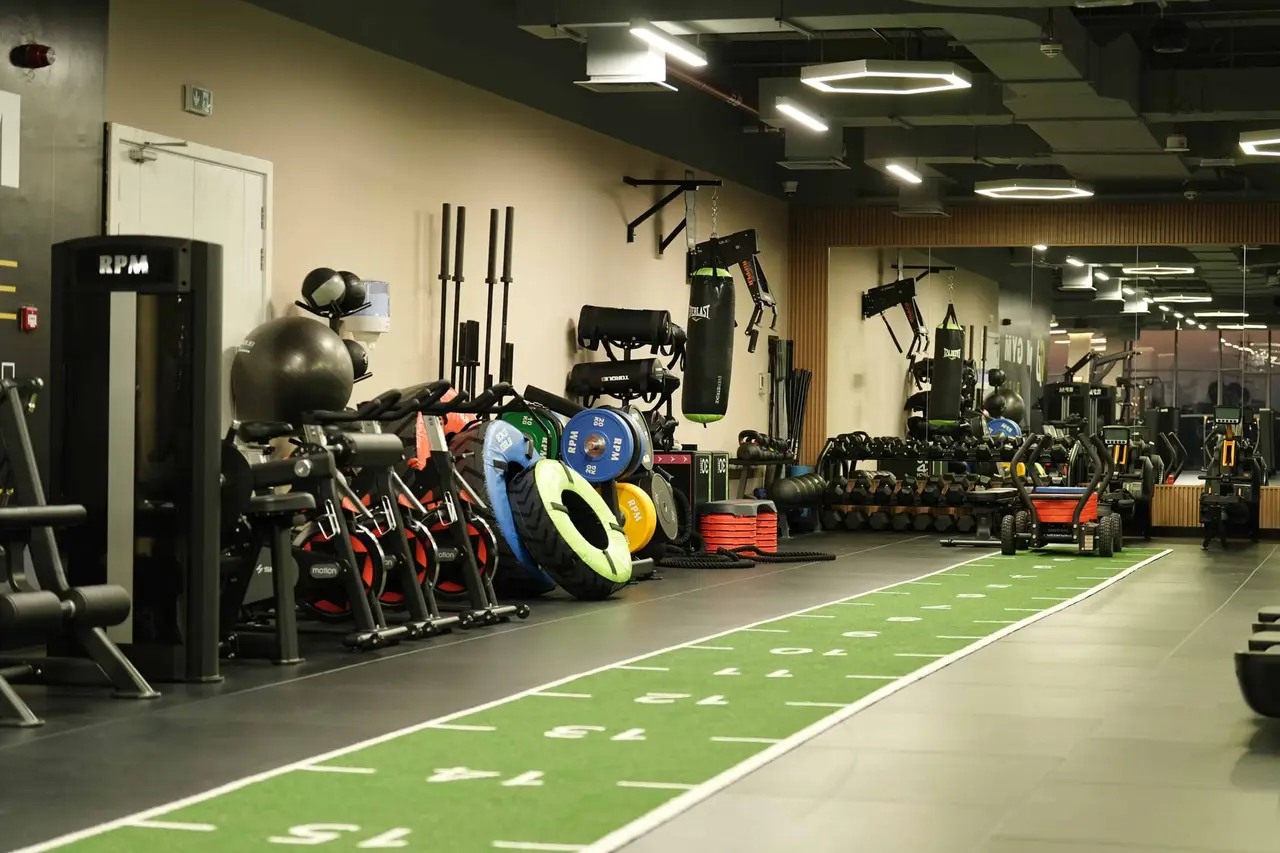
RPM's floor photos show squat racks with barbells and colour bumper plates, a dumbbell rack, kettlebells and the turf lane in the functional area in Al Manhal, and an upright exercise bike on the cardio row, which covers every version on this page and the circuit above. Ask on your free guided tour where you can squat and press with a barbell when the floor is busy. For coaching on depth, the rack position and pacing, book personal training.
Questions, answered.
What muscles do thrusters work?
The quads and glutes in the squat and the drive, the shoulders and triceps in the press, and the upper back and trunk throughout. In longer sets the heart and lungs work hardest.
Are thrusters cardio or strength?
Both, depending on how you use them. Short sets of three to five with a moderate barbell train strength and power; sets of ten or more with a light load are conditioning.
What weight should I use for thrusters?
Start with the empty bar or light dumbbells. Because the press sets the limit, a weight you could strict press about ten times is a useful guide; drop it as soon as your depth or lockout slips.
Dumbbell or barbell thrusters?
A barbell loads in small steps and suits heavier sets. Dumbbells let each arm move freely and are often more comfortable for stiff wrists, though they ask more of your balance and trunk.
What are the benefits of thrusters?
They train most of the body in one movement, build the ability to keep squatting and pressing while out of breath, and fit a lot of work into a short session. They do not replace heavy squats or presses for maximum strength.