Which side is working
The dumbbell pulls you towards it. As you lean into the weight, the muscles on the opposite side of your waist lengthen under load to control the bend, then shorten to pull you upright again. Those are the external and internal obliques, helped by the quadratus lumborum, a deep muscle that runs from the lowest rib to the top of the pelvis. A dumbbell in your left hand therefore trains mostly the right side of your waist, which surprises many people the first time they feel it.
That makes the side bend one of the few trunk exercises that loads sideways bending directly, with a weight you can measure and add to in small steps. Most of the work in the core training guide does the opposite job: holds such as the side plank, and carries with one weight, in which the obliques stop you bending sideways. A balanced week can use both, the side bend for strength through the movement and a hold or carry for resisting it.
It is a muscle exercise, not a way to take fat off the sides of your waist; the last question at the end of this page explains why.
One dumbbell, never two
Holding a dumbbell in each hand looks like twice the work and is close to none. As you lean left, the left dumbbell pulls you down while the right one pulls you back towards the middle, so the two weights largely cancel and your obliques have very little to resist. It is a common sight on a gym floor and one of the least useful. Hold one dumbbell, put your other hand on your hip or its fingertips at your temple, and train the second side with the same weight and the same number of reps.
Pick a weight you can lower in two seconds and bring back up without your hips sliding sideways. For most people that is lighter than the dumbbell they row with. A heavier one usually just shortens the range and turns the return into a heave.
Standing set-up
- Take one dumbbell from the rack and stand tall, feet about hip-width apart, knees soft rather than locked.
- Let the dumbbell hang at your left side with the arm straight and your palm facing your thigh.
- Rest your right hand on your hip, or place its fingertips lightly at your temple with the elbow pointing out. Do not grab the back of your head.
- Level your shoulders, stack your ribs over your pelvis and look straight ahead.
- Breathe out and brace lightly. Picture a pane of glass just in front of you and another just behind: the whole rep happens between them.
The bend and the return
- Breathe in and let the dumbbell slide down the outside of your left thigh as you bend sideways at the waist.
- Go only as far as you can without your chest turning or your hips pushing back. For most people the weight ends a little above the knee.
- Pause for a moment at the bottom, the arm still hanging straight, instead of bouncing out of it.
- Breathe out and use the right side of your waist to draw your ribs back up over your hips until you are standing straight.
- Finish every rep on one side, then move the dumbbell to your right hand and do the same number on the other.
Think slide, not swing: the dumbbell stays against, or just beside, the outside of your leg on the way down and on the way up. About two seconds down, a pause and two seconds up keep the work in your waist. If side bends hurt your lower back, stop and have it checked by a doctor or physiotherapist.
Side bend mistakes
| Mistake | What it looks like | The fix |
|---|---|---|
| Two dumbbells | A weight in each hand, bending to both sides | Hold one dumbbell, other hand on your hip |
| Twisting | The chest turns towards the floor and the dumbbell swings in front of the thigh | Keep the weight against the side of your leg and your chest facing forward |
| Leaning forward | The hips push back and the back rounds on the way down | Stay between the two panes of glass, hips under shoulders |
| Going too heavy | The weight drags you down and you heave back up | Drop to a weight you can lower in two seconds |
| Hips sliding sideways | The hips shift out to the other side instead of the waist bending | Keep your hips over your feet; the bend happens above the belt |
| Bouncing | A quick dip and rebound at the bottom of every rep | Pause at the bottom before you come up |
Cable, kettlebell and floor versions
The same sideways bend works with other kit, and two related exercises train the opposite job: refusing to bend.
Cable side bend
Stand side-on to a cable tower with the pulley at its lowest setting and a single handle in the hand nearer the stack. Step away until the cable is taut, bend towards the pulley and come back up. Unlike a dumbbell, the cable keeps pulling at the top of the rep, so the obliques never quite switch off. The cable machine guide covers pulley heights and handles.
Kettlebell side bend
A kettlebell held by its handle hangs a little further from your leg than a dumbbell and works the same way. Use whichever comes closer to the weight you want.
Suitcase carry
Hold one heavy dumbbell or kettlebell at your side and walk tall without leaning towards it or away from it. Here the obliques work to stop the bend rather than make it, and your grip and hips join in. Loaded carry workouts cover distances and loads.
Side plank
Lying on one side with your hips lifted into a straight line, the obliques hold you up against gravity with no equipment at all. The plank page covers the version from the knees and the full one.
For turning rather than bending, the Russian twist and the cable woodchop work the same muscles through rotation, and the Pallof press trains them to resist it.
Reps, weight and progression
| Goal | Sets × reps | How hard |
|---|---|---|
| Learning the bend | 2 × 10 per side | Light dumbbell; slow, with a pause at the bottom |
| Building the obliques | 3 × 10–15 per side | One or two clean reps left in reserve |
| Paired with a carry | 2–3 × 12 per side, then a suitcase carry | Moderate weight, no twisting in either |
Rest forty-five to sixty seconds between sets, and start each set on your weaker side.
Twice a week is plenty for most people, near the end of a session after the main lifts. Progress the reps first, up to about fifteen a side with a pause, and only then move up one dumbbell. Keep the weight the same on both sides; if one side cannot match the other, stay at the lighter weight until it can.
Side bends at RPM
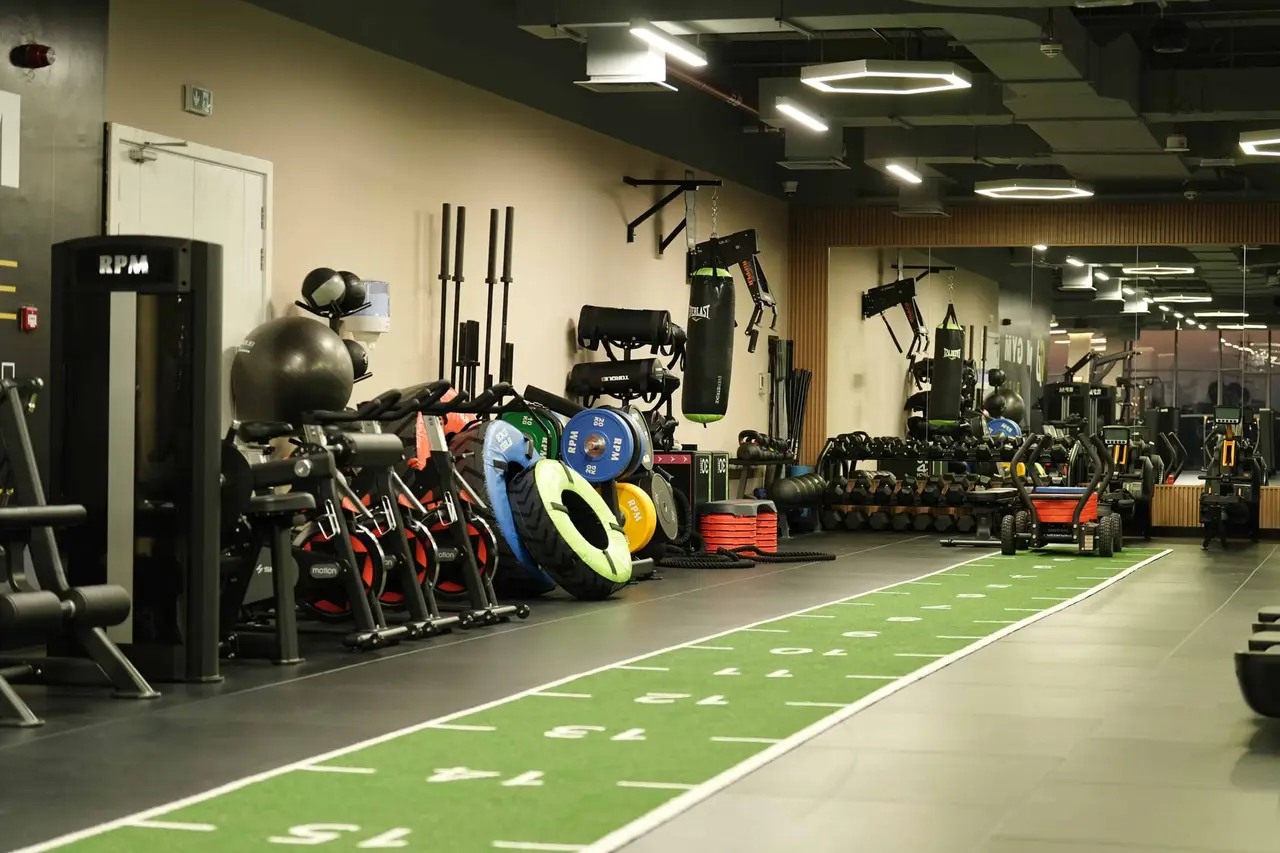
RPM's floor photos show a dumbbell rack, so finding a single weight is simple, and the kettlebells in the photos work for the same bend. For the cable version, the photos show multi-station cable towers. On a free guided tour you can see the floor for yourself, and a personal training session gives you a coach who watches from the front for the twist and from the side for the forward lean.
Sources
Questions, answered.
What muscles do dumbbell side bends work?
Mainly the obliques on the side away from the dumbbell, helped by the quadratus lumborum, a deep muscle low in the back. The rest of your trunk holds you upright, and your grip holds the weight.
Should I hold one dumbbell or two?
One. With a dumbbell in each hand the two weights balance each other, so the side of your waist has almost nothing to resist. Train one side, then switch hands.
Dumbbell side bend or Russian twist?
They train the obliques in different directions. The side bend loads sideways bending standing up and is easy to progress with a heavier dumbbell; the Russian twist is a seated rotation. Choose the one that fits your session, or do each once a week.
Side bend or side plank?
The side bend moves your waist against a weight; the side plank holds it still against your bodyweight. Many programmes start with a hold such as the side plank and add side bends once it feels comfortable, and both have a place.
Are dumbbell side bends good or bad?
Neither on their own: it is a standard exercise for the obliques. It works well with one moderate dumbbell, a slow tempo and no twisting, and poorly with two heavy dumbbells and a fast bounce.
Will side bends get rid of love handles?
No exercise can choose where your body loses fat, and side bends are no exception. In a small trial published in 2011, sedentary adults did abdominal exercises five days a week for six weeks; their muscular endurance improved, but their abdominal fat and waist measurements did not fall compared with a group that did no exercise. Side bends train the obliques, the muscles under that fat; they do not take the fat off. Fat comes off the body as a whole, in an order you cannot choose.