What the woodchop trains, and how it differs from a twist
A chop moves the trunk, unlike the Pallof press, where the same side-on cable is resisted and nothing turns. The obliques do the turning: the external oblique on one side works with the internal oblique on the other, while the deep muscle that wraps the middle stiffens it so the turn travels through the body in one piece. The glutes and hip muscles rotate the pelvis and the legs push into the floor. On the way back the cable tries to whip you round towards the stack, and the same muscles slow it down.
That is the difference from the Russian twist, where you sit and turn the ribcage over a still pelvis. In a good chop the hips turn too. The lower spine has only a small range of rotation to give, so most of the turn comes from the hips and the upper back, with the ribs kept stacked over the pelvis between them. It suits sports that turn, swing or throw, such as golf, padel, tennis or combat sports, and anyone who wants loaded rotation standing up. It is rated intermediate because a steady Pallof press comes first; the core training guide shows where rotation sits beside holds and carries.
Setting up: height, handle and stance
- Set the pulley for the version you are doing: the top of the column for high to low, the bottom for low to high, or about chest height for a horizontal chop.
- Clip on a single D-handle and hold it with both hands, one wrapped over the other, or hold both ends of a rope together.
- Stand side-on to the column, feet a little wider than your shoulders, knees soft, and step away until the stack lifts as your arms reach towards the pulley.
- Turn your hips and chest slightly towards the pulley and reach both arms towards it, long but not locked, with more of your weight on the leg nearest the stack.
- Brace: ribs down over the pelvis, stomach firm as if someone were about to nudge you, neck long.
- Choose a light pin, one you can move through twelve slow reps without your elbows bending or the handle drifting off the line of your breastbone.
The high-to-low chop, rep by rep
- Start with the handle above and outside your near shoulder, arms long, weight on the near leg.
- Push through the near foot and let it pivot onto the ball as your hips begin to turn away from the stack. The hips lead and the chest follows straight after.
- Pull the handle down and across in one straight diagonal towards the outside of your far knee. The handle moves because your body turns, not because your elbows bend.
- Finish with your chest and hips facing the far diagonal, your weight on the far leg, knee slightly bent, and the handle beside that knee. Your back stays long.
- Let the cable turn you back along the same line over two to three seconds, the near heel returning to the floor, until you are reaching towards the pulley again.
- Do every rep on one side, then the other, weaker side first.
Two cues hold the shape: your breastbone and your belt buckle turn together, and the handle stays in front of your breastbone the whole way. Breathe out through the chop and in as the cable takes you back. If the plates crash or the handle wanders, the pin is too heavy.
High to low, low to high and straight across
| Version | Pulley | Path of the handle | What changes |
|---|---|---|---|
| High to low | Top of the column | Above the near shoulder to outside the far knee | The classic chop: the trunk turns and bends forward slightly against the cable, and the far leg sinks at the finish |
| Low to high, often called a lift | Bottom of the column | Outside the near knee to above the far shoulder | Starts from a shallow squat, so the legs and glutes drive more; finish tall without leaning back |
| Horizontal | About chest height | Straight across, arms level with the chest | The least leg drive and the most direct oblique work; keep the hips turning so the waist does not take the whole turn |
Half-kneeling chop and lift
Kneel on the knee nearest the stack with the other foot flat in front, and chop or lift across your body from there. Kneeling takes away the hip turn and most of the help from the legs, so the trunk works harder over a stiller base. Use a lighter pin and keep the hips facing forwards; it is a stricter variation, not the main exercise.
Fast chops for power
Once the slow chop is solid, some coaches add a quick pull with a slow return for sports that need fast rotation. In a 2017 study of 23 fit men doing standing cable wood chops on a weight-stack machine, power peaked below the heaviest load each man could chop, at loads that differed from man to man, and fell between the first and last reps of a 20-rep set. For fast chops that points to a moderate pin and short sets: stop when the pull visibly slows.
Mistakes that move the work out of the trunk
| Mistake | What it looks like | The fix |
|---|---|---|
| Chopping with the arms | The elbows bend and the handle is pulled in to the chest before the body turns | Keep the arms long and start each rep with the hips |
| Feet glued to the floor | Both feet stay flat, the hips stop and the waist twists on its own | Let the near foot pivot so the hips can turn |
| Twisting past your range | The far shoulder drops and you lean over the finish for more turn | Stop when your chest faces the far diagonal |
| Losing the brace | The ribs flare and the back arches, most often at the top of a lift | Ribs down, finish tall, and shorten the range until you can hold it |
| Rushing the return | The cable snaps you back and the plates bang | Two to three seconds back to the start on every rep |
A chop is felt at the sides of the waist and around the hips. If rotation hurts your back, stop the set, and speak to a doctor or physiotherapist before you train it again.
Sets, reps and progression
| Goal | Sets × reps | How hard |
|---|---|---|
| Learning the turn | 2 × 8 each side | Slow: two seconds across, three seconds back |
| Building trunk strength | 3 × 10–12 each side | Two or three clean reps left; the handle on the midline throughout |
| Power, once the slow chop is solid | 3–4 × 5–6 each side | Fast across, slow back, a moderate pin; stop when the speed drops |
Rest about a minute between sets; working one side while the other rests keeps a set moving.
Two or three core blocks a week suit most people, and a chop needs only two or three sets in each, after the main lifts. A Pallof press and a chop make a two-exercise block: one resists the turn, the other trains it. Progress one thing at a time, in this order: a cleaner, slower rep, then the next pin, then a longer range, then the fast version.
Who should start with something else
- If your hips turn or your hands drift on a Pallof press, start there; the chop asks for that control while you move.
- If you want to train the obliques without standing rotation, the Russian twist and the bicycle crunch do it on the floor.
- If twisting brings on back pain, or you are coming back from a back or hip injury, speak to a doctor or physiotherapist first.
- If you are pregnant or postnatal, ask your doctor or midwife before loaded rotation work.
- If the goal is a smaller waist: the chop builds the muscles at the sides of the waist but cannot choose where fat comes off. That comes from losing body fat overall.
Woodchops at RPM
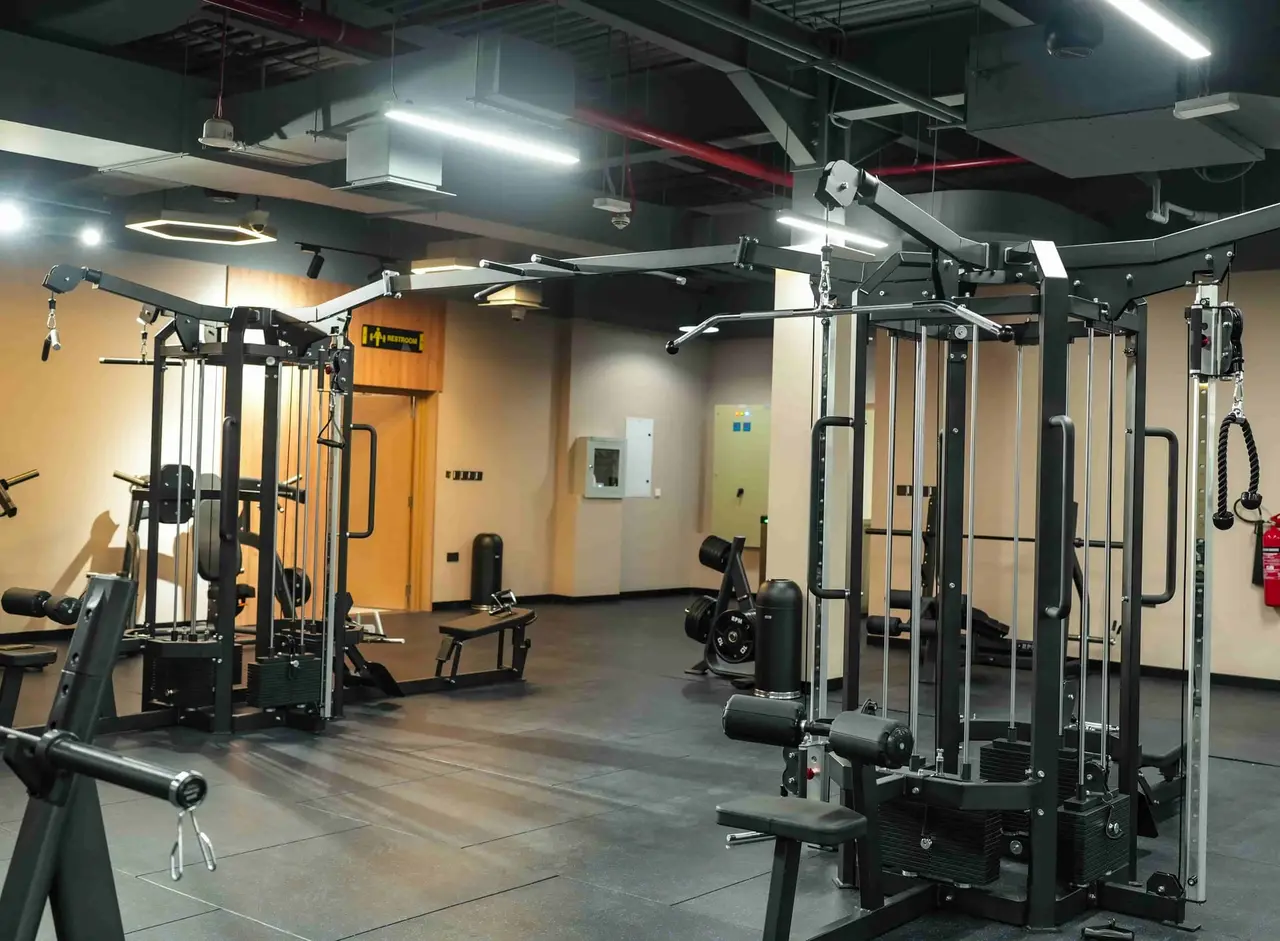
RPM's floor photos of the Al Manhal training floor show multi-station cable towers with a rope and single handles clipped to the stations. A chop needs a column whose pulley slides from top to bottom, and room to turn side-on without stepping into a walkway; the photos cannot show which stations allow both, so check on a free guided tour. The photos also show medicine balls on a ball rack for the lift; ask whether resistance bands are on hand. A personal training session is a quick way to have a coach slow your chop down and check that the hips lead.
Sources
Questions, answered.
What muscles does the cable woodchop work?
Mainly the obliques at the sides of the waist and the deep abdominal muscles that brace the middle. The glutes and hip muscles turn the pelvis, the legs push into the floor and the shoulders keep the arms long.
Woodchop or Pallof press?
Both, for different jobs. The Pallof press trains the trunk to refuse a twist; the woodchop trains it to turn under control and to brake the return. Most coaches teach the Pallof press first.
Can I do woodchops without a cable machine?
Yes, with a resistance band anchored high or low. A medicine ball or a light dumbbell held in both hands copies the low-to-high lift, because gravity resists the upward path, but not the high-to-low chop, where gravity helps. For throws with the same turn, see medicine ball and slam ball workouts.
Can I do woodchops with back pain?
This page cannot answer that for you. Loaded rotation involves the lower back, so if your back hurts, see a doctor or physiotherapist first and ask whether rotation work suits you at the moment.