What the front raise trains, and whether you need it
Lifting the arm forward is the main job of the front deltoid, the head at the front of the shoulder. In a front raise it carries the arm from your thigh to shoulder height against a weight held at the end of a long, almost straight lever. The upper chest, just below the collarbone, helps with the same movement, and as the arm nears shoulder height the trapezius and the serratus anterior start turning the shoulder blade upward.
A 2020 study of ten competitive bodybuilders measured muscle activity in a front raise and four versions of the lateral raise. The front raise produced the highest front-deltoid and pectoralis major activity of the five, while the side deltoid was far more active in a lateral raise with the arm in a neutral position. It was a short laboratory test, not a study of growth, but it confirms what the movement looks like: a front-shoulder and upper-chest exercise.
Whether you need it is a fair question. The bench press, the incline bench press, dips and every overhead press lift the arm forward under load, so the front deltoid is rarely short of work. If you press two or three times a week, the side and rear heads usually need the sets more, and the front raise vs lateral raise comparison explains why most plans start with the lateral raise. The front raise earns its place when:
- Your week has little pressing, such as a legs-first programme with one short upper-body session.
- The front of the shoulder visibly lags the side and rear, mostly a physique concern.
- You want front-shoulder work on a day without another heavy press, as two or three light sets at the end.
Setting up
- Pick a weight far lighter than you press: the load sits at the end of an almost straight arm. Most people use about their lateral raise dumbbells, or one step heavier.
- Stand with your feet about hip width apart, knees soft, ribs down and glutes lightly braced, so your lower back does not arch as the weight travels out in front of you.
- Let the dumbbells hang in front of your thighs, palms facing your legs or facing each other; the grip section below explains the difference.
- Put a slight bend in each elbow and keep that angle for the whole set. Let your shoulders sit low and relaxed rather than pinned back hard.
How to do a rep
- Raise one arm or both straight forward, in line with your shoulders rather than across your body, keeping the bend in the elbows.
- Stop when your hands reach about shoulder height, and no higher than eye level.
- Pause for a moment at the top without leaning back or shrugging.
- Lower over two to three seconds and stop with the weight just in front of your thighs, so the front shoulder stays loaded between reps.
Think of reaching for a shelf at eye height a long arm's length in front of you, not of lifting the weight to the ceiling. Breathe out on the way up and in on the way down. A pinch at the top or front of the joint is a reason to end the set; if it keeps coming back, leave the exercise out and speak to a doctor or physiotherapist.
Grip, height and one arm or two
| Choice | What changes |
|---|---|
| Palms down | The classic grip. If the top of the shoulder feels crowded as the arm rises, try thumbs up |
| Thumbs up, palms facing in | The same front-shoulder work; many people find it the more comfortable grip |
| Stop at shoulder height | The usual finish. With a dumbbell the lever is longest, and the rep hardest, when the arm is level |
| Go above eye level | The work shifts to the muscles that turn the shoulder blade; little to gain for the front deltoid |
| One arm at a time, or alternating | Shows up a weaker side; start the next arm only when the last is back down, without twisting |
A plate held in both hands sits between the two grips, with the palms angled in. On a cable, a rope lets the hands turn to a thumbs-up position, while a straight bar fixes them palms down.
Mistakes to fix first
| Mistake | What it looks like | The fix |
|---|---|---|
| Leaning back | The torso tips back and the hips push forward as the weight rises | Go lighter, or sit on the end of a bench with your back upright |
| Swinging | The knees dip and the hips throw the weight up | Start every rep from a still position |
| Lifting overhead | The arms pass eye level and the shoulders creep towards the ears | Stop at shoulder height |
| Arms bending as you tire | The elbows fold mid-set and the raise turns into a curl | Set the elbow angle at the start and keep it |
| Dropping the weight | The lowering takes less than a second | Count two to three seconds on the way down |
Dumbbell, cable and plate versions
All of them train the front deltoid. They differ in where the rep is hardest and how finely you can add load.
Dumbbell front raise
The standard version: both arms together, alternating, or one arm at a time with the other hand on your hip. Seated on the end of a flat bench, your legs cannot help, which makes it harder to cheat. The dumbbell is almost weightless at the bottom and hardest when the arm is level.
Cable front raise
Set the pulley at its lowest point and stand facing away from the stack, with the cable running between your feet. Hold a single handle, a short straight bar or a rope, step forward until the plates lift, and raise as with a dumbbell. The cable pulls from below and behind, so the front deltoid works from the first inch, and the stack moves in smaller steps than most dumbbell pairs. The cable shoulder exercises page shows where it fits in a cable-only session.
Plate front raise
Hold a weight plate with both hands on the sides of the rim, at three and nine o'clock, arms almost straight, and raise it to eye height. The grip works hard, especially on a thick bumper plate, and plates go up in large steps, so start light and progress with reps.
Who it suits, and who should pick something else
- It suits lifters whose programme is light on pressing, anyone after extra front-shoulder volume for appearance, and beginners learning to control a light weight.
- If broader shoulders are the goal and you already press two or three times a week, put those sets into the lateral raise and rear-shoulder work instead.
- If strength is the goal, a press does more: the dumbbell shoulder press or the Arnold press loads the front deltoid far more heavily.
- If lifting your arm forward is painful, or you have a shoulder problem, speak to a doctor or physiotherapist before you train it.
Sets, reps and progression
| Goal | Sets × reps | How hard |
|---|---|---|
| Learning the movement | 2 × 12–15 | Stop with two or three reps left; pause at shoulder height |
| Building the front shoulders | 2–4 × 10–15 | One or two reps left, no swing |
| Finisher after pressing | 1–2 × 15–20 | Light, steady and continuous |
Rest about a minute between sets. Count front raises together with your presses: if you press twice a week, two to four sets of front raises a week is usually plenty. The hypertrophy volume calculator helps you add up the week.
Add reps before load. When every set reaches the top of your range with a pause at shoulder height, slow the lowering to three seconds, then move to the next dumbbell or pin. If the jump to the next plate costs more than four reps, stay with the lighter one or switch to dumbbells or the cable. Once or twice a week, at the end of a shoulder or upper-body session, is enough.
Front raises at RPM
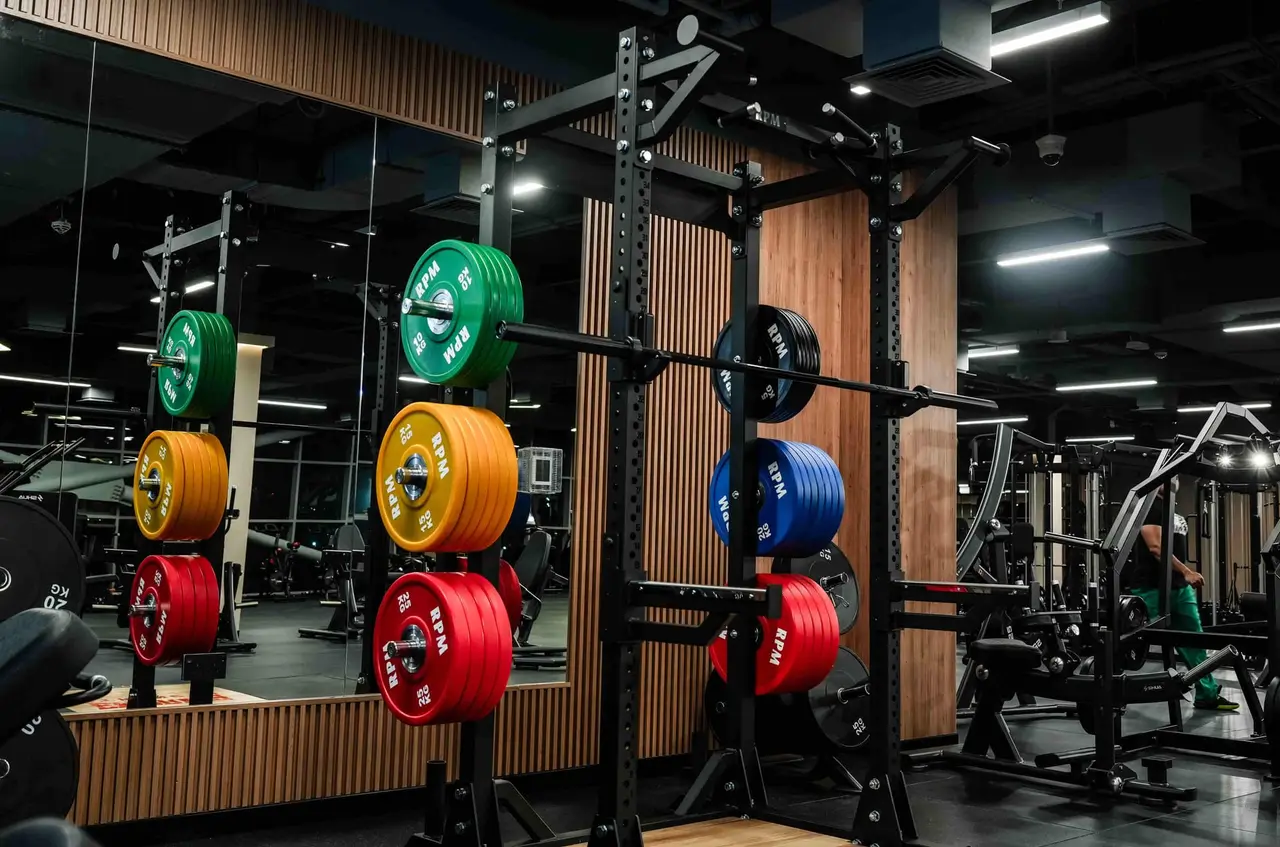
RPM's floor photos show a dumbbell rack, multi-station cable towers and squat racks with barbells and colour bumper plates on the training floor in Al Manhal, so the dumbbell, cable and plate versions on this page can all be done there. Which attachments are clipped to a cable station on a given day is worth checking on a free guided tour. The shoulder exercise guide shows where a front raise fits beside presses and side and rear work, and a personal training session can check your height, grip and load.
Sources
Questions, answered.
What muscles do front raises work?
Mainly the front deltoid, with the upper chest helping. The traps and the serratus anterior turn the shoulder blade near the top, and the side deltoid assists a little.
Do I need front raises if I already bench press?
Often not. The bench press, incline press and overhead press all train the front deltoid hard. Add front raises only if your week has little pressing or the front of the shoulder clearly lags; otherwise lateral raises and rear-shoulder work make better use of the sets.
Front raise or lateral raise?
They train different heads: the front raise the front of the shoulder, the lateral raise the side. If you can fit only one, most people need the lateral raise more. The front raise vs lateral raise comparison sets them side by side.
Dumbbell, cable or plate: which front raise should I do?
Any of them. Dumbbells are simplest and work one arm at a time; the cable loads the bottom of the rep in small steps; a plate is quick to grab but jumps in large steps. Pick the one you can do strictly.
How heavy should front raises be?
Light enough to stop at shoulder height with a short pause on every rep and no lean back, for 10 to 15 reps. For most people that is roughly their lateral raise weight, or one step above.