What the cable does well for the shoulders, and what it does not
If the cable station is where you train your shoulders, by choice or because the dumbbells are busy, this page builds the sessions from it. How the three heads work and how many sets a week they need is covered in the shoulder exercise guide, and the dumbbell shoulder exercises page is the free-weight counterpart.
A cable pulls along the line the pulley sets, not straight down. A dumbbell raise is almost weightless for the first part of the rep and hardest at the top; a cable from a low pulley loads the muscle from the first inch. The pull can come from behind you, across your body or in front of you, so one station reaches all three heads, and the stack moves in steps far smaller than most light dumbbell pairs.
What the cable does not do is make the muscle grow faster on its own. In a 2025 study, 24 trained men and women did lateral raises twice a week for eight weeks, one arm with a cable and the other with a dumbbell, over a matched range of motion and to failure. The side deltoid thickened by similar amounts in both arms. Choose the cable for its tension and small steps. Its limits are real too: heavy pressing belongs to barbells and dumbbells, single-arm sets double the time, and crossed-cable work needs two columns.
Pulley heights for the shoulders
- Low, at or near the floor: lateral raises, front raises, Y-raises, upright rows and the cable press. Most cable shoulder work starts here.
- Shoulder height: reverse flies with the cables crossed, and single-arm rear-delt rows.
- Forehead height or a little above: face pulls with a rope.
Write down which column you used as well as the pin: two stations with different pulley set-ups can feel very different at the same number. For a first set, judge by reps, choosing a weight you can move twelve times with a one-second pause at the hardest point.
Eight movements, grouped by head
Eight cable movements cover the shoulder. The linked pages take their movement step by step; the others are described here.
- Side deltoids: the cable lateral raise, one arm at a time, side-on to a low pulley with the cable crossing in front of you; the cable Y-raise, which lifts the arm up and out to a Y slightly above shoulder height and brings in the lower traps; and the cable upright row with a rope or a short bar, which adds the upper traps.
- Front deltoids: the cable front raise, facing away from a low pulley with the cable between your feet; and the cable shoulder press, standing or kneeling between two low pulleys with a handle in each hand, pressing up and slightly in. The press needs two low columns side by side.
- Rear deltoids: the face pull with a rope at forehead height, which also works the upper back; the cable reverse fly, the cable form of the rear delt fly, with two cables crossed at shoulder height; and the single-arm rear-delt row, pulling a handle towards your shoulder with the elbow high and wide.
You do not need all eight. One movement per head makes a complete session; the rest are swaps for when a column is taken or a movement does not suit you.
Pulley, attachment and the cue for each
| Movement | Pulley and attachment | The cue |
|---|---|---|
| Cable lateral raise | Low; one handle or a wrist cuff | Push the hand out to the wall, not up to the ceiling |
| Cable Y-raise | Low on two facing columns with the cables crossed, or one column, one arm | Thumbs up; finish slightly in front of and just above the shoulders |
| Cable upright row | Low; rope or short straight bar | Elbows lead and stop at shoulder height |
| Cable front raise | Low, behind you; one handle, a bar or a rope | Reach forward to eye level with the torso still |
| Cable shoulder press | Low on two columns side by side; one handle each | Start at shoulder height, press up and slightly in |
| Face pull | Forehead height; rope | Pull the rope apart towards your ears, elbows high |
| Cable reverse fly | Shoulder height on two columns, cables crossed | Sweep the arms out and back with soft elbows |
| Single-arm rear-delt row | Shoulder height; one handle | Elbow out to the side; finish with the upper arm level |
Clip each attachment on and check that the carabiner has closed before the first rep. The cable machine page covers adjusting the pulley and the other attachments.
Two cable-only shoulder sessions
Session A: a full shoulder day on one station
For a day when the cable station is all you use. Press first while you are fresh, then the side and rear work, and start single-arm moves on the weaker side.
| Exercise | Sets × reps | Coaching note |
|---|---|---|
| Cable shoulder press | 3 × 8–12 | Kneeling takes the legs out of it |
| Cable lateral raise | 3 × 12–15 each arm | Pause with the arm level |
| Face pull | 3 × 12–15 | Hold the finish for a second |
| Cable Y-raise | 2 × 12–15 | Light; no shrug at the top |
| Cable reverse fly | 2 × 15–20 | Arms long, slow on the way back |
Session B: raises after a free-weight press
Use it after a dumbbell or barbell press, such as the overhead press, which has already worked the front of the shoulder.
| Exercise | Sets × reps | Coaching note |
|---|---|---|
| Cable lateral raise | 3 × 12–20 each arm | Last set close to failure |
| Single-arm rear-delt row | 3 × 10–12 each arm | Elbow high and wide |
| Cable upright row with a rope | 2 × 12–15 | Let the hands drift apart at the top |
| Cable front raise | 1–2 × 12–15 | Only if your week is light on pressing |
Session A is 13 sets; Session B is 9 or 10 after the press. Rest about a minute between sets. If two low columns are not available for the cable press, open Session A with a dumbbell press instead.
Progressing on the stack
Shoulder raises use small loads, so even one pin can be a large share of the weight. Work to a range, 12 to 20 reps for raises and flies and 8 to 12 for the press, and move up a pin only when every set reaches the top of it with clean reps. When that jump is too big, use the steps in between:
- Slow the lowering to three seconds.
- Hold the hardest point, the arm level in a raise or the rope beside the ears in a face pull, for a full second.
- Stand half a step further from the column, so the cable takes the load earlier in the rep.
- Add a set before you add a pin.
Over months, the press runs out of stack before the raises do. Then move the press to dumbbells or a barbell and keep the cable for the raises, flies and face pulls.
Mistakes on cable shoulder work
- Standing too close. If the plates touch down between reps, the muscle rests; step away until they stay lifted.
- Pulley too high for raises. From a mid-height pulley a lateral raise loses the tension at the bottom, which is the point of the cable.
- Shrugging into raises. If the shoulders climb towards the ears, the traps are doing the lifting: lower the pin.
- Leaning away to finish. A body lean moves the load, not the shoulder; keep the torso still and hold the frame with your other hand.
- Turning face pulls into rows. Elbows that drop below the hands make it a row; keep them high.
- Training through a pinch. A burn in the muscle is normal; a pinch or sharp pain in the shoulder means stopping, and pain that persists needs a doctor or physiotherapist.
Cable shoulder training at RPM
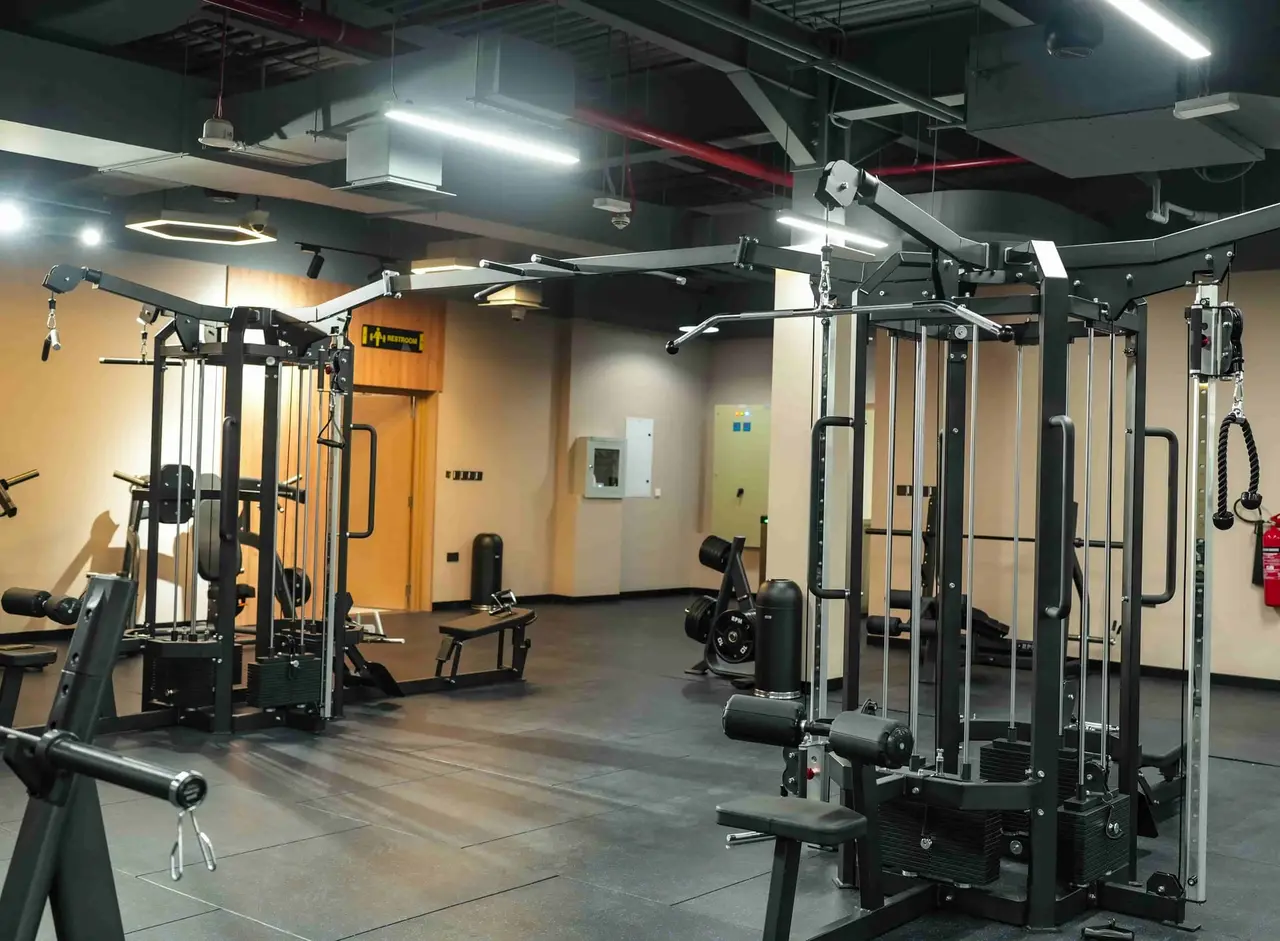
RPM's floor photos show multi-station cable towers set among benches on the training floor in Al Manhal, with pulleys at the top of each frame, pulldown seats, and a rope and single handles clipped to the stations. The photos cannot show which columns slide down to floor height, whether two low columns sit side by side for the press and the crossed-cable moves, or whether a wrist cuff is kept at a station, and several movements here depend on those, so check them on a free guided tour. A personal training session can set the pulley heights and loads with you.
Sources
Questions, answered.
Which cable shoulder exercises suit beginners?
Start with the cable lateral raise, the face pull and the cable reverse fly, two or three sets each, after a press. All three use light loads and a path the cable guides.
Can you build your shoulders with cables only?
Yes, especially the side and rear heads, as long as the reps and loads rise over months. The press is the movement a stack limits first; stronger lifters usually press with dumbbells or a barbell and keep the cables for the rest.
Cable or dumbbell lateral raises?
Both work: in the 2025 study above, the side deltoid grew by similar amounts with each. The cable loads the bottom of the rep in smaller steps; dumbbells need no spare column. Choose by feel and convenience.
Which cable exercises work the rear delts?
The face pull, the cable reverse fly with crossed cables and the single-arm rear-delt row. The reverse fly isolates the rear deltoid most; the face pull and the row bring in the upper back as well.
Do I need a wrist cuff for cable lateral raises?
No. A single handle works; a cuff around the wrist takes the grip out, which some people prefer. Ask on your tour whether one is kept at the station.
Are cable shoulder exercises different for women?
No. The movements, sets and progressions are the same; the starting pin differs from person to person, not by gender.