What the landmine press trains, and what the angle changes
Because the bar pivots at the floor, it travels in an arc that finishes between an incline and an overhead press, depending on how far you stand from the anchor. The front deltoid does most of the work, the upper part of the chest helps more than in an overhead press, and the triceps straighten the elbow. At the end of each rep the shoulder blade slides forward around the ribs as you reach, which brings in the serratus anterior along the side of the ribcage. Pressed with one arm, the bar also tries to turn you towards it, so the trunk and hips work to stay square.
That angle is the main reason to choose it. The arm finishes in front of the head rather than beside the ears, so the press needs less overhead range than a strict overhead press, and the lower back is less tempted to arch. Coaches use it for people still building that range, for athletes who push from a split stance in their sport, and as a second press on an upper-body day. It does not fix shoulder pain: if pressing at this angle hurts, stop and have the shoulder checked by a doctor or physiotherapist. The shoulder exercise guide shows where it sits among the other presses.
Setting up the bar
- Slide one end of an Olympic barbell into the sleeve of a landmine attachment. It may sit on a heavy base or fix to a rack; either way the sleeve should swivel freely.
- Start with the empty bar. The anchor carries part of its weight, so you hold only some of it, which makes it a light first set. Add small plates to the outer end once every rep looks the same.
- Bring the outer end to your shoulder: hinge down, take the end of the bar beyond the plates in both hands, stand up, then pass it to the pressing hand so the end rests at the front of that shoulder.
- Wrap your fingers round the end of the bar with the wrist straight and the elbow a little below and in front of the hand, tucked about halfway between your side and straight out.
- Set your distance from the anchor. Closer makes the press steeper and more like an overhead press; further back makes it flatter and more like an incline press. Pick one and keep it for the set.
Without a landmine attachment, a common substitute is to wedge the end of the bar into a corner of the room so it cannot slide. Gyms differ on whether they allow it, because the bar can mark the walls and floor and the spot needs to be clear of people walking past, so ask the team whether it is allowed and where before you try it.
Choosing your stance
| Stance | How you stand | Why choose it |
|---|---|---|
| Half-kneeling | The knee on the pressing side down, the other foot forward, hips square to the bar | The easiest to learn: kneeling stops you leaning back, and the trunk has to resist the twist |
| Tall kneeling | Both knees down, upright | Harder to balance; a strict step on once half-kneeling feels easy |
| Split stance | Standing, the foot on the pressing side back | Lets the legs and hips join in, as in sports that push from a split stance |
| Standing, feet level | Feet hip width apart, facing the anchor | The heaviest one-arm version; the trunk works hardest to stay still |
| Two hands | Standing, both hands on the end of the bar at chest height | More chest, more load and no twist to resist |
Kneel on a mat if the floor is hard. Most people learn half-kneeling first and move to a split stance or standing after a few weeks.
How to do a rep
- Brace with your ribs down. In half-kneeling, squeeze the glute of the down leg so the hips stay forward.
- Press the bar up and forward along its arc, keeping the forearm under the bar.
- At the top, let the shoulder blade slide forward a little so the arm reaches, with the elbow straight and the bar in line with your shoulder.
- Keep your chest facing the anchor. The bar will try to turn you towards it; do not let it.
- Lower under control over about two seconds until the end of the bar is back at the front of your shoulder.
Breathe out as you press and in as you lower. The work should be felt in the front of the shoulder, the chest and the back of the arm. If the joint pinches, check that the elbow is not flaring wide and that you are not leaning back; if the pinch stays, end the set and get the shoulder checked.
Mistakes to fix first
| Mistake | What it looks like | The fix |
|---|---|---|
| Twisting towards the bar | The shoulders and hips rotate as you press | Lighten the load and keep the chest square to the anchor |
| Leaning back | The torso tips back and the press turns flat | Ribs down, glutes squeezed; half-kneeling makes this harder to do |
| Elbow flaring wide | The elbow points straight out to the side at the start | Tuck it halfway between your side and straight out |
| Stopping short | The arm stays bent at the top | Finish with a straight elbow and a small reach |
| Changing distance | Each set starts at a different spot | Mark where you kneel or stand and keep the same angle |
| Dropping the bar back | The bar falls onto the shoulder after each rep | Take two seconds on the way down |
Variations, and what to use without a landmine
The arc stays the same in every version. What changes is how many hands you use and how much the legs help.
Two-handed landmine press
Hold the end of the bar with both hands, one cupped over the other, at the middle of your chest, and press forward and up. It loads the chest and front shoulders more, takes more weight and removes the twist.
Landmine push press
A short dip of the knees and a drive from the legs start the bar, and the arm finishes the press. It moves more weight and trains power; learn the strict press first.
Landmine squat to press
Hold the end of the bar at your chest with both hands, squat, and press as you stand. It turns the press into a whole-body movement for conditioning sessions.
No landmine and no corner?
A one-arm dumbbell shoulder press from half-kneeling is the closest copy, and the incline dumbbell press presses at a similar angle with your back supported. On a cable station, face away from a low pulley and press up and forward for a similar arc.
Who it suits, and who should pick something else
- Beginners learning to press: the bar follows a fixed arc, the stance teaches the trunk to stay still, and the empty bar is light.
- Lifters who cannot yet get their arms straight overhead without arching: it trains the same muscles while that range is built.
- Athletes in sports that push from a split stance, and anyone who wants one-arm pressing with a trunk challenge.
- Pick something else if there is no attachment and no approved place to anchor a bar; the alternatives above do the same job.
Sets, reps and progression
| Goal | Sets × reps | How hard |
|---|---|---|
| Learning the press | 2–3 × 8–10 each arm | The empty bar; three or four reps left |
| Building muscle | 3–4 × 8–12 each arm | One or two reps left, no twist |
| Strength | 3–4 × 5–6 each arm | Heavier, split stance or standing, every rep strict |
Rest about a minute and a half between sets, or alternate arms with a short pause. Once or twice a week is enough.
Start each set with your weaker arm and match its reps on the other side. Progress by reps first, then by the smallest plates: unlike the bar, a plate on the outer end is held almost entirely by you, so even a small one is a real jump. Pair the landmine press with a row or a face pull, so the upper back gets a pulling set for each pressing set.
The landmine press at RPM
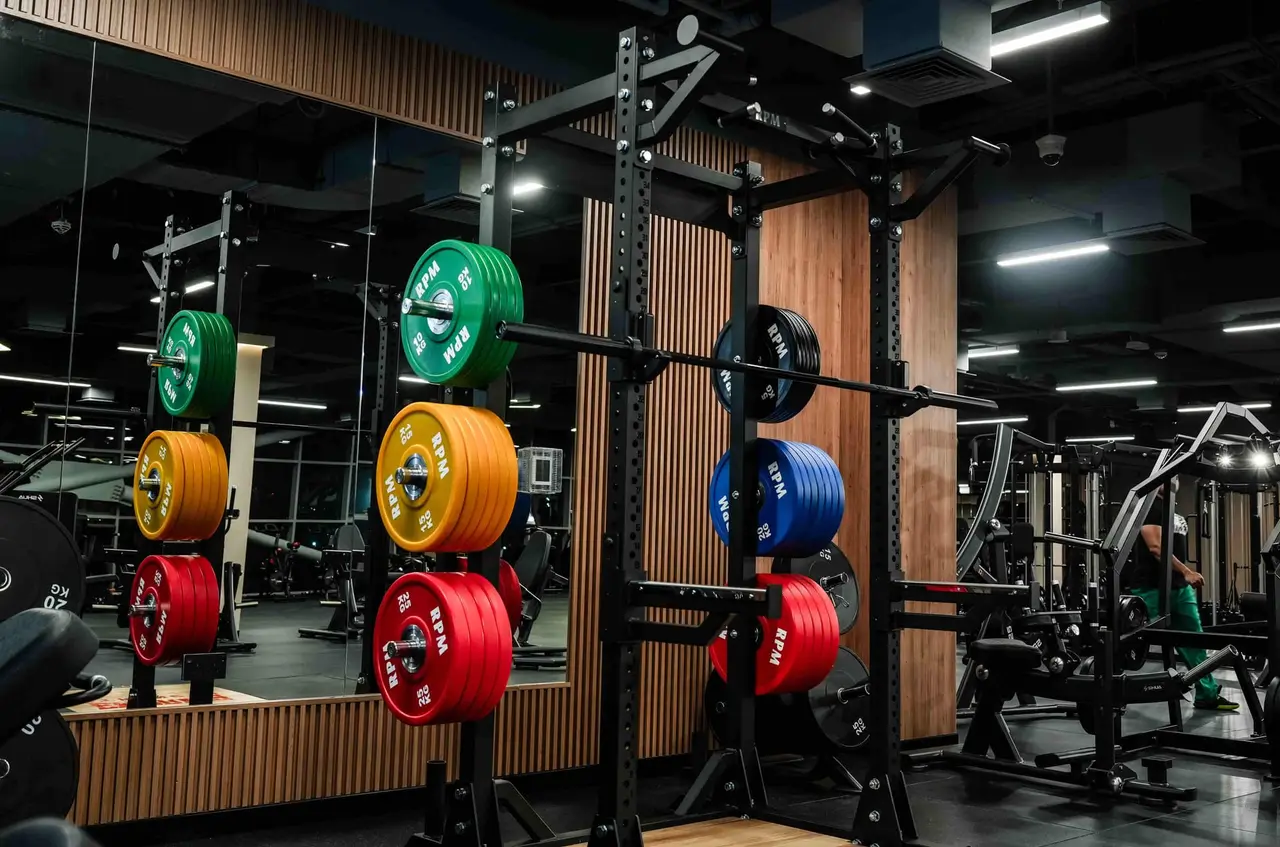
RPM's floor photos show barbells with colour bumper plates, but they do not show a landmine attachment, so ask on your free guided tour whether there is one on the floor, and if not, whether a bar may be wedged in a corner and where. If you want a coach to set your stance and check the arc of the press, book a personal training session.
Questions, answered.
What muscles does the landmine press work?
Mainly the front shoulders, the upper chest and the triceps. The serratus anterior helps at the end of the reach, and in the one-arm version the trunk works to stop you twisting.
Is the landmine press easier on the shoulders than overhead pressing?
Many people find it more comfortable, because the arm finishes in front of the head and needs less overhead range. That describes the movement; it is not a promise about your shoulder. If it hurts, stop and have it checked by a doctor or physiotherapist.
What can I use instead of a landmine attachment?
Some gyms allow a bar wedged into a corner; ask the team first. Otherwise a half-kneeling one-arm dumbbell press or an incline dumbbell press does a similar job.
How much weight am I lifting on a landmine press?
Less than the bar and plates weigh in total, because the anchor carries part of the bar, and the share you hold changes as the bar rises. Plates on the end are held almost entirely by you. Track what you load and your reps rather than a calculated figure.
Landmine press or overhead press?
The overhead press is the heavier strength lift, straight up with both hands. The landmine press is lighter, on an angle and usually one-armed. Many programmes use the overhead press as the main lift and the landmine press as a second press, or in its place while overhead range is built.
Is the landmine press good for beginners?
Yes. It is one of the easier presses to learn, because the bar follows a fixed arc and the half-kneeling stance keeps you upright. Start with the empty bar.