Why train sideways
Squats, lunges and step-ups all move you forwards and backwards. The lateral lunge works side to side, the direction you move in when you shuffle, cut or change direction in sport. On the bent leg, the quads and glutes lower you and drive you back up, as in any squat. The difference is the inner thigh: the adductors of the bent leg control the descent, while those of the straight leg are pulled long, which is why most people feel a strong stretch down the inside of the straight leg.
With bodyweight it is a beginner's exercise, and it stays useful at every level: as a warm-up before leg day, as accessory work for the inner thighs and the side of the hip, and as preparation for court and field sports. It is not a variant of the forward lunge, because the direction and the muscles that lead both change. Place it after your main squat or hinge, or in the warm-up. The leg exercises guide shows the other patterns it sits beside.
Before your first rep
- Clear a strip of floor about two long strides wide, so you can step out without hitting anything.
- Stand with your feet together or at hip width, toes pointing forward.
- Use bodyweight for the first sessions, reaching your arms forward as a counterbalance when you sit.
- Once you can sink comfortably, hold a dumbbell or kettlebell at your chest, choosing one you could use for twelve reps a side with two to spare.
- Set the step width with one slow test rep: wide enough that the straight leg stays straight and the bent knee stays above its foot, but not so wide that you cannot push back.
How to do a rep
- Step one foot out to the side and land on the whole foot, toes pointing forward or very slightly out.
- As the foot lands, push your hips back and bend that knee, as if sitting onto a chair placed off to that side.
- Keep the other leg straight with its foot flat. Your chest tips forward a little, your back stays flat and your weight sits over the heel and middle of the bent leg's foot.
- Sink as low as you can with that heel down and your lower back flat; for most people that means the thigh close to parallel.
- Push the floor away with the bent leg to return to the start and stand tall. Finish all reps on one side, or alternate.
Think 'hips back, not knee forward'. If the bent knee shoots past the toes and the heel lifts, you are sitting forward instead of back. Breathe in as you step out and out as you push home. A strong pull along the inner thigh of the straight leg is normal; a sharp pain in the groin or knee is not, so stop and have it checked by a doctor or physiotherapist.
Mistakes to fix first
| Mistake | What it looks like | The fix |
|---|---|---|
| Sitting forward instead of back | The bent knee travels well past the toes and the heel lifts | Push the hips back first and keep the heel down |
| Bent knee caving in | The knee drops inward towards the big toe | Keep the knee over the middle toes and step slightly less wide |
| Straight leg bending | Both knees bend, so the lunge turns into a wide squat | Keep the trailing leg straight and sink only into the working side |
| Rounding to reach depth | The chest collapses and the lower back curls | Stop higher, lift the chest and build range over the weeks |
| Step too narrow or too wide | Too narrow and nothing stretches; too wide and you cannot get back | Find the width where the straight leg stretches and you can still push home |
Variations: Cossack, goblet and the order of reps
Warm-ups and conditioning circuits often add a knee drive, raising the trailing knee as you return to standing, or a reach of the opposite hand towards the front foot at the bottom. The curtsy lunge, which crosses one leg behind the other, is a different exercise aimed mainly at the side of the hip.
Cossack squat
Start in a wide stance and stay there. Shift your weight to one side and sink as deep as you can on that leg, while the straight leg's heel stays down and its toes turn up towards the ceiling, then pass through the middle to the other side. It needs far more hip and ankle mobility than the lateral lunge, so most people begin with bodyweight, a light counterweight held in front and a partial range.
Goblet lateral lunge
Hold a dumbbell or kettlebell at your chest, as in a goblet squat. The weight in front helps you sit back and keep the chest up, which makes this the easiest loaded version. When you outgrow it, hold a dumbbell in each hand and let the one on the working side hang just inside the bent knee.
Alternating or one side at a time
Alternating, stepping out and back on each rep, adds balance and coordination and suits warm-ups and circuits. Doing every rep on one side first keeps the muscles working continuously and makes it easier to match the two sides. You can also stay in a wide stance and sink to the same side repeatedly without stepping. Whichever you choose, start with the weaker side.
Short on space? A sumo squat trains the inner thighs in a fixed wide stance, and a lateral step-up works the side of the hip on a box.
Sets, reps and progression
| Goal | Sets × reps | How hard |
|---|---|---|
| Warm-up and mobility | 1–2 × 6 each side | Bodyweight, slow, within a comfortable range |
| Learning the movement | 2 × 8 each side | Bodyweight or a light goblet hold, every rep to the same depth |
| Building muscle | 3 × 8–12 each side | Goblet dumbbell or kettlebell, one or two reps left |
Rest about thirty seconds between sides and one to two minutes between rounds.
Build depth first, then load. When you can sink to a near-parallel thigh on both sides with the heel flat and the back straight, add weight in small steps. The inner thighs are often less trained than the quads, so expect some soreness after the first sessions.
Lateral lunges at RPM
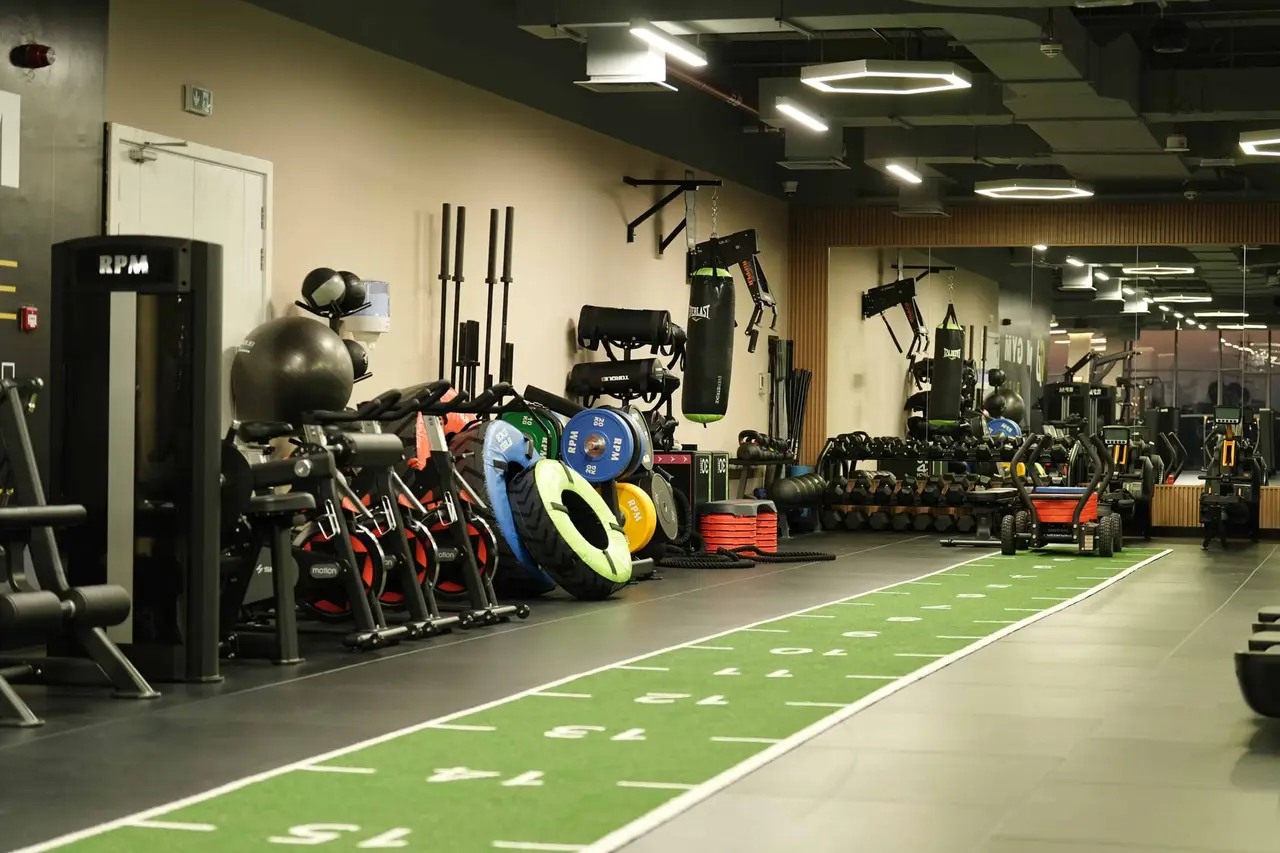
RPM's photos show a dumbbell rack and kettlebells in the functional zone, with open floor around the turf lane, which is everything this exercise needs. A hip adduction machine is not in those photos, so ask about one on your free tour if you want to add machine work for the inner thighs. A personal training session can check your depth and knee position.
Questions, answered.
What muscles do lateral lunges work?
The quads and glutes of the bent leg and the adductors of both inner thighs, with the hamstrings and trunk helping. The muscles at the side of the hip keep the bent knee and pelvis steady.
Is a side lunge the same as a lateral lunge?
Yes, they are two names for one exercise. A lateral squat usually means the version without the step, where you stay in a wide stance and shift from side to side.
Lateral lunge vs forward or reverse lunge?
Forward and reverse lunges step front to back and load the quads and glutes most. The lateral lunge steps sideways, so the inner thighs do far more, and it trains a direction most leg exercises leave out. A balanced plan can use both.
Lateral lunge vs sumo squat?
Both bias the inner thighs. The sumo squat keeps both feet fixed and both legs working together, so it takes more load; the lateral lunge works one side at a time with a step and a deeper stretch on the straight leg.
Is there a machine alternative to the lateral lunge?
Nothing copies the side step exactly. The hip adduction machine trains the inner thighs directly, and the leg press with the feet wide and high works them alongside the quads and glutes. Machines make useful extras, but none replaces the balance the lunge demands.
Lateral lunges hurt my knee. What should I do?
Stop and have it checked by a doctor or physiotherapist; knee pain during side-to-side movement can have several causes. Ask them whether a shorter range, a narrower step or a different exercise is a sensible option for you.