Two exercises in one: a plank and a run
A mountain climber is a plank with the legs running underneath it. Your hands and arms hold you up, so the chest, front shoulders and triceps work to keep the elbows straight and the shoulders over the hands. Every time a foot leaves the floor you are left on three points, and the trunk muscles, the rectus abdominis and the obliques most of all, stop the hips sagging or twisting towards the unsupported side. The hip flexors pull each knee forwards, and the legs push back into the floor to switch.
Speed decides which of those jobs leads. Slow, deliberate knee drives with a pause are trunk training: the plank has to stay perfect while one leg moves. Fast climbers in a running rhythm become conditioning: each step is light but the work never stops, so heart rate and breathing climb quickly, as they do in a burpee without the trip to the floor and back up. Both versions are worth having; the mistake is doing the fast one with a plank that has already fallen apart.
They need no equipment and very little floor, which is why they turn up in warm-ups, circuits and session finishers. Beginners can start with their hands raised on a bench. They will not build much muscle, and they do not replace heavier core or leg work; the core training guide shows what else a week needs.
Setting up the high plank
- Start on hands and knees with your hands directly under your shoulders, fingers spread and pointing forwards.
- Walk your feet back until your body is one straight line from head to heels, on the balls of your feet, feet about hip-width apart.
- Push the floor away so your upper back is full and your shoulders sit over your wrists rather than behind them.
- Squeeze your glutes lightly and draw your ribs towards your hips. Your hips are level with your shoulders, neither piked up nor sagging.
- Look at the floor a little ahead of your hands. If holding this position for twenty seconds is already hard, start with your hands on a bench or a box.
How to do mountain climbers, slow then fast
- Brace, then lift your right foot and drive the knee towards your chest, as far as it will go without your hips rising or your back rounding.
- Pause for a moment with the knee under your chest, then put the foot back where it started.
- Repeat with the left leg. This slow version, one knee drive every second or two, is how to learn the movement and the one to use for core work.
- To speed up, switch legs in the air: as one foot lands, the other leaves, in a light running rhythm. Keep the steps short and quiet.
- Count each knee drive as one rep, or work to a time. End the set when your hips start to bounce or your hands creep forwards.
Let the feet travel but keep the shoulders still: they stay over your hands for the whole set, whatever the legs are doing. In the fast version, breathe in a rhythm, out on every second or third knee drive, rather than holding your breath. If your wrists, shoulders or lower back hurt, stop and speak to a doctor or physiotherapist before you carry on.
Mistakes that turn it into a shuffle
| Mistake | What it looks like | The fix |
|---|---|---|
| Hips piked high | The backside rises to give the knees room to come in | Lower the hips to shoulder height and take shorter knee drives |
| Hips bouncing | The hips rise and fall with every step | Slow down until the hips stay level, then build the speed back up |
| Shoulders behind the hands | The body rocks back towards the heels as the knees come in | Keep the shoulders stacked over the wrists |
| Toe taps instead of knee drives | The feet shuffle a few inches and the knees barely move | Bring each knee under your chest, at least on the slow reps |
| Dropped head | The chin sinks towards the chest | Neck long, eyes on the floor just ahead of the hands |
| Speeding up as form fades | The rhythm gets faster as the plank gets worse | Choose a pace you can hold for the whole interval |
Incline, cross-body and spider climbers
Raising your hands makes mountain climbers easier; changing where the knee goes changes what your trunk has to resist.
Incline mountain climber
Put your hands on a flat bench or a sturdy box and set the same straight line from there. Less of your weight goes through your hands and the knees have more room, so it suits beginners, heavier lifters and anyone whose wrists dislike the floor. Lower your hands step by step as it gets easier.
Cross-body mountain climber
Drive each knee towards the opposite elbow instead of straight in. The hips want to turn as the knee crosses, so the obliques work harder to keep them square. Go slower than in the straight version; a fast, twisting cross-body climber mostly swings the hips.
Spider climber
Bring the knee to the outside of the same-side elbow, as if stepping your foot up beside your hand. It asks for more hip mobility and side-to-side control, which is why it often appears in warm-ups. Keep the hips low and pause at the elbow.
Mountain climber with a hold
Drive one knee in and hold it under your chest for three to five seconds while the other leg and both hands keep the plank. It is the strictest core version and a useful test: if your hips drift during the hold, the fast version is not ready yet.
Wrists or floor not working for you? A dead bug trains the trunk while the legs move, with nothing through your hands. For more of the body working each rep, the burpee and the kettlebell swing take conditioning further, and the plank itself is the still version to master first.
Sets, intervals and where they fit
| Goal | Sets × reps | How hard |
|---|---|---|
| Learning the movement | 3 × 8–10 each leg, slow | A pause on every knee drive; hips level throughout |
| Core work | 3 × 20–30 seconds, slow to moderate | Stop when the hips start to bounce |
| Conditioning intervals | 6–10 rounds of 20 seconds on, 40 seconds off | Breathing hard, but the last round looks like the first |
| Warm-up | 2 × 20 seconds, easy | Enough to raise your breathing, not to tire you |
In intervals the clock sets the rest; while you are learning, rest until your breathing settles.
Progress one thing at a time: first the speed you can hold with a still plank, then the length of each interval, then the number of rounds, and only then shorter rests. Mountain climbers suit the start of a session as a warm-up or the end as a finisher, and they pair well with a strength move done standing, such as a set of goblet squats between rounds. How many calories they use depends on your size, pace and how long you keep going, so this page gives no figure.
Mountain climbers at RPM
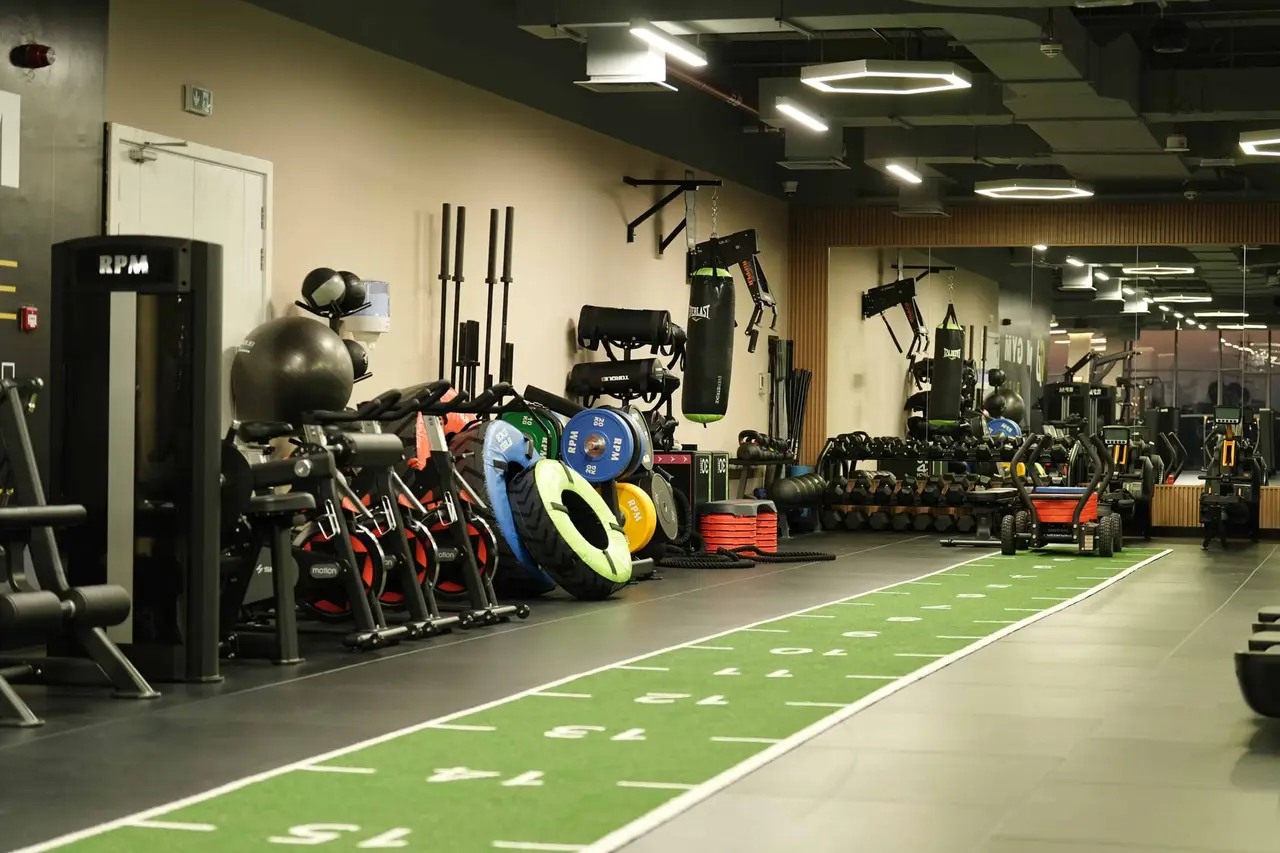
Mountain climbers need nothing but a patch of floor, in either section. RPM's floor photos show a turf lane in the functional area with room for floor work, flat benches for the incline version and soft plyo boxes; ask on a free guided tour where floor work fits at the hour you train. For intervals inside a wider conditioning plan, see functional training at RPM, or book personal training if you want a coach to set your pace.
Questions, answered.
What muscles do mountain climbers work?
The rectus abdominis and the obliques hold the plank, the hip flexors drive the knees, and the chest, shoulders and triceps keep you up on straight arms. Done fast, they work your heart and lungs as well.
Mountain climbers or burpees: which is harder?
Burpees, for most people: each rep takes you down to the floor and back up into a jump. Mountain climbers keep you in the plank, so they are easier to pace and need less space. Many circuits use both.
Mountain climbers or running?
Running builds the endurance a runner needs and works the legs far more. Mountain climbers pack trunk work and a quick rise in heart rate into a small space. They suit a circuit or a finisher; if running is your goal, they do not replace your runs.
Do mountain climbers burn belly fat?
No exercise removes fat from one place. Mountain climbers train the trunk muscles and raise your heart rate; how your stomach looks depends on overall body fat, which changes with what you eat and how active you are.
Are mountain climbers good for beginners?
Yes, in the slow or the incline version. Learn the plank first, then slow knee drives, then speed. If a twenty-second plank on the floor is not yet steady, put your hands on a bench.
How many mountain climbers should I do?
Once you go fast, count time rather than reps: twenty to thirty seconds a set is plenty for most people, with the plank still solid at the end. For slow, core-focused sets, eight to ten knee drives a leg.